The ratio needs a numerator and denominator
“10:1” is shorthand. A useful specification should expand it into a sentence:
> A defined mass of identified starting material was used to produce a defined mass of a stated extract, under a specified basis and process.
For Lion’s Mane, ask what each side represents.
| Ratio field | Question to answer |
|---|---|
| Starting species | Is it identified as Hericium erinaceus? |
| Starting material | Fruiting body, mycelium, myceliated substrate or a mixture? |
| Input basis | Fresh weight, dried weight or another basis? |
| Output | Native extract, total extract, concentrate or finished powder? |
| Added excipients | Carrier, drying aid, starch or standardization material included? |
| Solvent/process | Water, ethanol, dual or another defined method? |
| Ratio form | Exact number or expected range? |
| Serving mass | How many milligrams of the actual extract are in one serving? |
Without these fields, the ratio is not reproducible enough for a confident comparison.

Genuine/native DER versus total DER
Formal herbal-extract guidance offers precise terms that help expose ambiguity. The European Medicines Agency defines a genuine, or native, drug extract ratio as the quantity of herbal substance used relative to the quantity of resulting genuine extract. Excipients added after extraction for technological or standardization reasons are excluded from the native-extract denominator.
The same guidance distinguishes a total drug extract ratio, which relates starting substance to the whole extract. A finished dry extract may include a carrier added to make a sticky concentrate stable or free-flowing. If that carrier is included in one denominator but excluded in another, identical-looking ratio claims can describe different materials.
EMA terminology governs its own regulatory context. It is used here as a disciplined vocabulary model, not as proof that a US Lion’s Mane supplement is an authorized herbal medicine or complies with EMA requirements.
Fresh weight and dry weight can change the number
Fresh mushrooms contain substantial water. A ratio based on fresh input can therefore have a larger numerator than a ratio based on dried input even before selective extraction is considered.
Imagine two suppliers each start with the same harvest. One reports the mass at harvest; the other dries the material and reports only dry input. Their ratios may differ dramatically because water was counted in one numerator and not the other. That difference does not demonstrate that one final powder contains more of a desired compound.
Ask the supplier to state:
- whether the starting mass was fresh or dried;
- whether water naturally present in the material was included;
- the moisture specification, if relevant;
- what material was removed before weighing; and
- whether the output was measured before or after adding excipients.
“Raw mushroom equivalent” is incomplete if the raw-material basis is unstated.
Why a range may be more credible than one exact ratio
Biological starting materials vary, and extraction yield can change by batch. Formal herbal guidance notes that genuine DER is commonly expressed as a range. A range such as 8–10:1 can acknowledge that it took between eight and ten units of starting material to produce one unit of native extract under controlled specifications.
A single “10:1” number may be a rounded target or marketing shorthand. That does not make it false, but it should lead to questions about the permitted range and the batch record supporting it.
Precision on the front label is not the same as analytical precision. Ratios are usually calculated from manufacturing records; they are not analytes directly measured in a finished gummy by an ordinary potency panel.
Extract ratio is not extraction yield
Ratio and yield describe related mass flow from different angles, but they are not interchangeable without aligned definitions.
If 100 kilograms of defined dry starting material produce 10 kilograms of native dry extract, the simple mass relationship is 10:1 and the native-extract yield is 10%. If the finished powder then includes 2 kilograms of carrier, the whole extract weighs 12 kilograms. A ratio calculated against that total powder would differ.
This example is arithmetic, not a Lion’s Mane potency claim. It shows why the carrier and denominator matter.
Do not assume a low yield means failure. Extraction can intentionally select soluble fractions and leave insoluble material behind. Nor does a high yield prove broad compound retention; it may reflect the process, moisture, carrier or what the manufacturer counts as extract.
Mood’s mushroom extraction-method guide owns the comparison of hot-water, ethanol, dual and assisted processes.
Do not turn “equivalent” mass into active dose
Suppose a label states 250 mg of 8:1 Lion’s Mane extract. Multiplying yields 2,000 mg as a nominal starting-material equivalent under that ratio. Three boundaries must remain attached:
- The product physically contains 250 mg of extract, not 2,000 mg of extract.
- The 2,000 mg figure is meaningful only if the ratio basis is defined and substantiated.
- It does not state the mass of beta-glucans or any other constituent retained in the serving.
The equivalent figure cannot be compared with 2,000 mg of whole powder as though the two have identical chemistry. Extraction changes composition. Different processes can concentrate, lose or transform different fractions.
For actual per-gummy mass arithmetic, use Mood’s mushroom extract-in-gummies guide.
10:1 does not mean ten times the biological effect
The ratio does not measure a response in a person. To claim a tenfold effect, researchers would need a matched dose-response study using characterized products and a defined endpoint. Manufacturing mass flow cannot substitute for that trial.
A higher ratio also does not automatically mean:
- more beta-glucan;
- more hericenones or erinacines;
- better absorption;
- greater purity;
- less starch;
- broader compound retention;
- safer contaminant levels; or
- better cognition, focus or mood.
Each assertion needs its own evidence. Beta-glucan requires an appropriate analytical method and basis. Species and fungal material require identity controls. Contaminants require relevant panels. Human outcomes require a suitable clinical study.
What the human 10:1 study can show
A 2025 randomized, placebo-controlled, double-blind crossover study tested an acute 3 gram dose of a standardized 10:1 Hericium erinaceus fruiting-body extract in 18 healthy adults aged 18 to 35. The researchers assessed cognition and mood and reported limited acute findings, while calling for longer research, dose work and pharmacokinetic clarification.
The ratio is part of the tested preparation’s identity. It is not proof that the ratio itself caused an outcome. The study does not establish that:
- every 10:1 extract has the same composition;
- 10:1 is superior to 8:1 or 1:1;
- a smaller amount is equivalent when multiplied by the ratio;
- a gummy with CBD and CBG reproduces the extract; or
- the acute research amount is a consumer recommendation.
Use a study only when species, fungal material, extraction, standardization, amount, route, population and endpoint align closely enough with the claim.
Ratio versus beta-glucan and other markers
Extract ratio and marker percentage answer different questions. A ratio describes manufacturing input and output. A measured beta-glucan result estimates a defined constituent under a method and reporting basis.
If a characterized ingredient genuinely contains 25% beta-glucan and the serving contains 300 mg of that same ingredient, the label-based marker calculation is 75 mg. The extract ratio is not multiplied into that calculation.
“Polysaccharides” is broader than beta-glucans and can include other carbohydrates. Hericenones and erinacines are research terms often associated with different Lion’s Mane materials, but their presence and amount cannot be inferred from a high DER.
Mood’s beta-glucan guide owns method, basis and marker interpretation.
A comparison worksheet
Use one row for every definition rather than ranking the largest number.
| Field | Product A | Product B |
|---|---|---|
| Scientific species | ||
| Fruiting body/mycelium/substrate | ||
| Physical extract per serving | ||
| Ratio or DER range | ||
| Genuine/native or total | ||
| Fresh or dry input | ||
| Extraction solvent/process | ||
| Carrier/excipients in extract powder | ||
| Extraction yield | ||
| Measured markers and basis | ||
| Batch/lot documentation |
If one product states 8:1 on a dry native-extract basis and another states 10:1 using fresh material and total finished powder, do not rank them numerically. Mark the definitions as different and compare measured composition and serving mass separately.
What a COA can verify
A laboratory report may measure identity, beta-glucans, other composition markers or contaminants. A routine finished-product test generally cannot reconstruct the exact historical mass of starting mushrooms used in manufacturing.
Ratio support therefore often lives in supplier specifications and batch production records, while analytical results address composition of a sampled material. The strongest evidence chain connects both to the exact finished product and lot.
A report for raw extract does not prove the amount included in each finished gummy. A cannabinoid potency panel does not verify Lion’s Mane ratio or beta-glucans. Mood’s mushroom gummy COA guide explains the product–lot–sample–panel chain.
How Mind Food fits
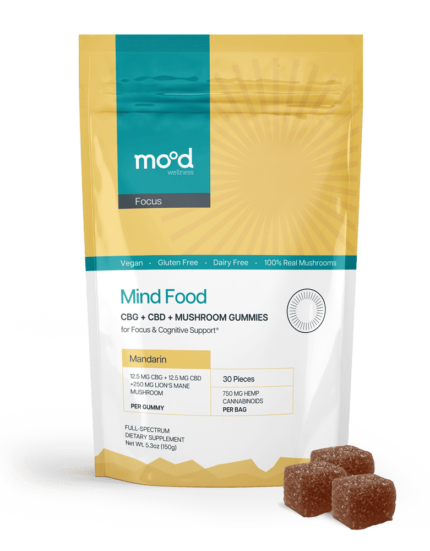
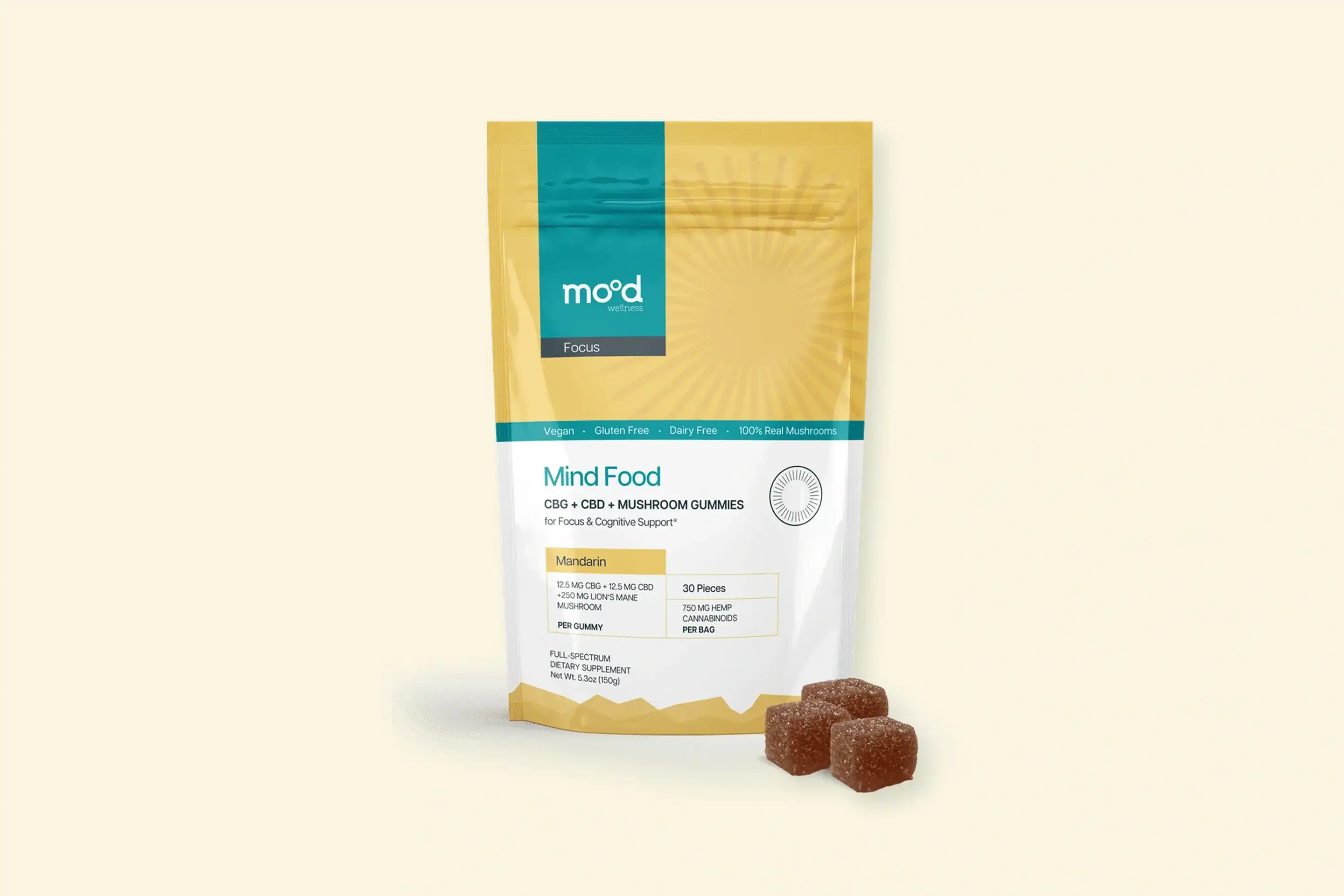
Mood’s current Mind Food CBD + CBG + Lion’s Mane gummy is described as containing CBD, CBG and Lion’s Mane fruiting-body extract. Materials reviewed for this project state 250 mg Lion’s Mane extract per gummy.
The public information reviewed does not state a verified 8:1, 10:1 or other Lion’s Mane extract ratio. The correct entry is “ratio not stated,” not 1:1 and not an inferred value from the serving mass.
The 250 mg physical extract amount should remain separate from the CBD and CBG amounts. A study of 3 grams of a specified 10:1 extract does not validate the combined gummy or create an equivalent serving calculation.
Bottom Line: Extract Ratio
A Lion’s Mane extract ratio is useful only when its nouns are visible: identified starting material, fresh or dry basis, native or total extract, excipients and process. Without those fields, 8:1 and 10:1 are incomplete shorthand.
Do not choose the largest ratio by default. Compare the actual extract mass per serving, defined DER convention, extraction process, carrier content, measured markers and lot-specific evidence. Keep raw-material equivalent, physical extract and clinical dose in separate columns.
For Mind Food, the responsible statement is that the reviewed page discloses Lion’s Mane fruiting-body extract and a physical amount, while a ratio was not verified. Missing data should remain missing rather than becoming marketing arithmetic.
Quick answers
Frequently asked questions about Lion’s Mane Extract Ratio Explained
What is the practical answer about Lion’s Mane Extract Ratio Explained?
A Lion’s Mane extract ratio is useful only when its nouns are visible: identified starting material, fresh or dry basis, native or total extract, excipients and process. Without those fields, 8:1 and 10:1 are incomplete shorthand. Do not choose the largest ratio by default. Compare the actual extract mass per serving, defined DER convention, extraction process, carrier content, measured markers and lot-specific evidence.
Which Mood product fits this topic?
Mind Food is the most relevant Mood option for this topic. Mood Mind Food combines CBD, CBG and Lion’s Mane in a stimulant-free gummy designed for a calm, focused daytime routine.
What should I compare before choosing a product?
Compare the cannabinoid amount per measured serving, the complete ingredient list, spectrum or THC information, current product directions and available batch documentation. The best choice is the formula that fits the goal and is easy to use consistently.
How should I start using a new CBD or cannabinoid product?
Follow the current package directions, choose a low-demand first-use window and keep timing and meal context reasonably consistent. Review medication, pregnancy, liver and impairment considerations with a qualified clinician when relevant.
References
- European Medicines Agency. Questions and answers on quality of herbal medicinal products.
- European Medicines Agency. Questions and answers on quality of herbal medicinal products.
- Docherty S, et al. Acute effects of a standardised Lion’s Mane extract on cognition and mood. Randomized placebo-controlled crossover study.
Editorial boundary: EMA terminology is used as a precise model for interpreting extract declarations, not as a claim that a US supplement is EMA-authorized. The human trial tested one characterized 10:1 extract and does not validate the ratio category.