
Five numbers to capture before comparing gummies
| Field | Where to look | Why it matters |
|---|---|---|
| Serving size | Top of Supplement Facts | Defines the denominator for every per-serving amount |
| Gummies per container | Supplement Facts or net quantity | Helps check package math, not potency by itself |
| Mushroom amount | Supplement Facts or named blend line | States extract mass per serving when disclosed |
| Cannabinoid amount | Supplement Facts and relevant COA | Identifies separate CBD, CBG, CBN or THC exposure |
| Lot and report date | Package and certificate | Connects documentation to the product actually purchased |
Front-label phrases such as “six mushrooms,” “10:1,” “fruiting body” or “high potency” do not replace these numbers. They may describe composition or processing, but none supplies a serving-normalized extract amount on its own.

Per serving versus per gummy
The most common arithmetic error is comparing one product’s per-gummy claim with another product’s per-serving claim.
One-gummy serving
If the serving size is one gummy and the label states 250 mg mushroom extract per serving:
250 mg ÷ 1 gummy = 250 mg per gummy
Two-gummy serving
If the serving size is two gummies and the label states 500 mg mushroom extract per serving:
500 mg ÷ 2 gummies = 250 mg per gummy
The products match on extract mass per gummy even though one label’s headline number is twice as large.
A variable direction is not a new serving size
A page may tell a consumer to take one or two gummies. Do not automatically assume that every amount displayed nearby is per one gummy. The controlling denominator is the wording attached to the amount and the current Supplement Facts serving size.
FDA labeling guidance defines a supplement serving around the maximum amount recommended per eating occasion, subject to the applicable rules. Always read the actual panel rather than reconstructing it from directions or promotional copy.

Single mushroom, named blend and proprietary blend
The label structure determines what can be calculated.
Single named extract
“Lion’s Mane extract: 250 mg per gummy” supports a direct 250 mg extract statement. It does not, without more documentation, state 250 mg beta-glucan or 250 mg of a specific Lion’s Mane compound.
Individually quantified blend
If a two-gummy serving lists 200 mg Lion’s Mane, 150 mg Reishi and 100 mg Cordyceps, each amount can be normalized separately:
- Lion’s Mane: 100 mg per gummy
- Reishi: 75 mg per gummy
- Cordyceps: 50 mg per gummy
- Total named mushroom extract: 225 mg per gummy
Total blend with ingredients named
If a two-gummy serving lists a 600 mg mushroom blend and names six mushrooms without individual weights, the supported calculation is:
600 mg total blend ÷ 2 gummies = 300 mg total blend per gummy
The six ingredients are not necessarily present equally. Under FDA rules, proprietary-blend ingredients are generally listed in descending order of predominance by weight, while only the total blend weight may be shown. Dividing 300 mg by six would create numbers the label did not provide.
Mushrooms named with no visible amount
If a product page names six extracts but provides no total mushroom mass, the amount is unknown from that page. “Contains six mushrooms” answers variety, not quantity.
Extract milligrams are not raw-mushroom equivalents
A dried mushroom extract has been processed from starting material. Its mass should not be silently relabeled as an equal mass of unextracted mushroom, and an extraction ratio should not be used as if it were a clinical multiplier.
For example, 250 mg of a stated 8:1 extract might be marketed as an equivalent starting-material quantity under a manufacturer’s ratio definition. That still does not mean the gummy contains 2,000 mg of physical extract, nor does it prove eight times the biological effect of a 1:1 product.
The previous mushroom extraction methods guide explains how water, ethanol, dual processes, ratio and yield differ. For gummy comparison, keep the labeled dried-extract mass as its own field.
Extract amount, beta-glucan amount and polysaccharides
These quantities are related only when the label and assay connect them.
Suppose a gummy contains 250 mg of one mushroom extract and a matching test reports 25% beta-glucan by weight for that same ingredient:
250 mg × 0.25 = 62.5 mg calculated beta-glucan from the stated extract amount
That calculation is valid only if:
- the 25% result applies to the exact extract used;
- the reporting basis is compatible with the serving amount;
- the ingredient lot is traceable to the gummy batch; and
- no carrier or blend allocation changes the denominator.
“25% polysaccharides” is not automatically “25% beta-glucan.” Polysaccharides are a broader category and may include alpha-glucans such as starch. Use the beta-glucan label guide for the assay-specific distinction.
Three worked Mood examples
The examples below use statements visible on Mood’s US product pages when checked September 9, 2026. They describe the pages, not independent laboratory confirmation.
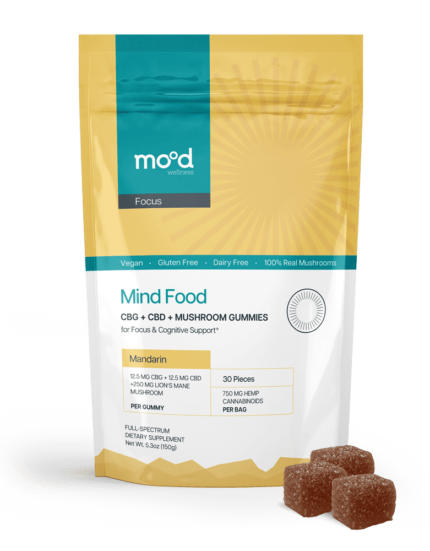
Mind Food
The Mind Food page states per gummy:
- 250 mg Lion’s Mane fruiting-body extract;
- 12.5 mg CBD; and
- 12.5 mg CBG.
The mushroom calculation is already normalized: 250 mg Lion’s Mane extract per gummy. The cannabinoids are separate ingredients and should not be added to the mushroom mass to create a “total actives” potency comparison.
The page also says beta-glucan content is verified above 25%. The public gummy certificate reviewed during this audit is an older cannabinoid-potency report, dated February 22, 2023. It does not visibly show a beta-glucan assay. The percentage therefore remains a current product-page claim unless a matching mushroom assay is supplied.
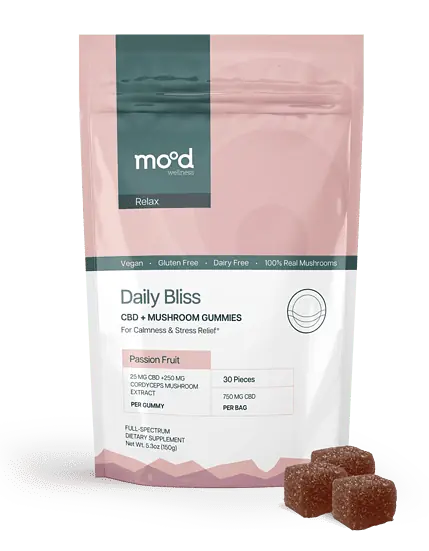
Daily Bliss
The Daily Bliss page states per gummy:
- 250 mg Cordyceps fruiting-body extract; and
- 25 mg CBD.
The supported mushroom amount is 250 mg Cordyceps extract per gummy. The page instructs consumers to start with one gummy and describes a one-to-two-gummy use range. That direction does not change the stated per-gummy amount: two gummies would arithmetically provide 500 mg of the claimed extract and 50 mg CBD, but use should follow the current label and individual safety context.
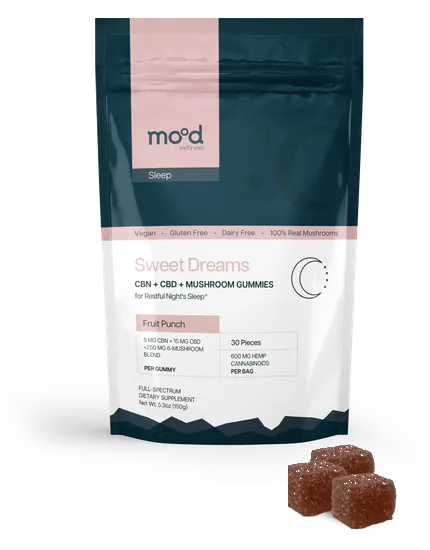
Sweet Dreams
The Sweet Dreams page names six fruiting-body mushroom extracts, Reishi, Cordyceps, Turkey Tail, Maitake, Shiitake and Agaricus blazei, and states 15 mg CBD plus 5 mg CBN per gummy.
The visible page reviewed does not state a total mushroom-blend weight or individual mushroom milligrams. The defensible answer is therefore: the mushroom extract amount cannot be calculated from the visible product-page copy reviewed.
It would be inaccurate to divide an unstated total among six species or to use the CBD and CBN amounts as a proxy for the mushroom blend.
Mood comparison table
| Product | Mushroom statement on current page | Mushroom amount supported by page | Other labeled actives per gummy |
|---|---|---|---|
| Mind Food | Lion’s Mane fruiting-body extract | 250 mg | 12.5 mg CBD + 12.5 mg CBG |
| Daily Bliss | Cordyceps fruiting-body extract | 250 mg | 25 mg CBD |
| Sweet Dreams | Six named fruiting-body mushroom extracts | Not stated in visible page copy | 15 mg CBD + 5 mg CBN |
This table is deliberately asymmetric. Preserving an unknown value is more accurate than forcing every formula into a complete-looking comparison.

What a certificate of analysis can verify
A COA verifies only what it actually tested in the submitted sample. A cannabinoid-potency panel can report CBD, CBG, CBN, THC and related cannabinoids. It does not establish mushroom extract weight, beta-glucan percentage, species identity, heavy metals or residual solvents unless those tests appear.
The Mind Food and Sweet Dreams reports captured from Mood’s public lab-results page are dated February 2023 and focus on cannabinoid potency. They should not be called current-batch mushroom-composition certificates.
For a mushroom amount claim, useful documentation could include:
- a finished-product weight or marker assay using an appropriate method;
- an ingredient specification tied to a supplier lot;
- production records showing how much ingredient entered the batch; and
- traceability connecting the ingredient lot, finished lot and package.
A finished gummy can be difficult to analyze for every raw ingredient by mass after manufacturing. That makes supply-chain and batch records important, but it does not justify presenting an ingredient specification as if it were a finished-product assay.
Comparing cost without false precision
Price per gummy is easy to calculate. Price per stated mushroom-extract gram is possible only when a mushroom amount is disclosed.
For a hypothetical $30 bag with 30 gummies and 250 mg extract per gummy:
- total stated extract = 30 × 250 mg = 7,500 mg, or 7.5 g;
- price per gummy = $30 ÷ 30 = $1; and
- price per stated extract gram = $30 ÷ 7.5 g = $4 per gram.
That result compares declared mass, not quality or expected outcome. It does not adjust for species, extract method, marker percentage, testing depth, cannabinoids or formula fit.
Do not calculate price per mushroom milligram for a formula whose total mushroom amount is not disclosed. The correct spreadsheet entry is “unknown.”
Quality questions beyond the milligram number
More milligrams do not automatically mean a better gummy. Ask:
- Is the species identified precisely?
- Is fruiting body, mycelium or another material disclosed?
- Is the ingredient an extract or unextracted powder?
- Is the amount stated per gummy or only per serving?
- Are individual blend components quantified?
- Is an extraction method or ratio defined?
- Are beta-glucans or other relevant markers tested?
- Does the certificate match the package lot?
- Are contaminants and residual solvents addressed where relevant?
- What cannabinoids and other actives are in the same gummy?
The current functional mushroom collection can be compared using those fields. Product fit should come after the arithmetic, not replace it.
Cannabinoid and safety context
Mood’s mushroom gummies also contain hemp cannabinoids. Full-spectrum products can contain trace THC below the federal hemp threshold and may create drug-testing risk. Sweet Dreams includes CBN and carries drowsiness-oriented directions; daytime formulas have different use instructions.
Review the entire formula, serving direction and warning, not only the mushroom number. Do not combine products merely to reach a larger extract total. Ask a qualified clinician or pharmacist before use if you take medication, have a medical condition, are pregnant or breastfeeding, have mushroom allergies, have liver concerns, or are preparing for surgery.
FDA does not approve dietary supplements for safety and effectiveness before they are marketed. A compliant-looking label and a large milligram number are not premarket endorsements.
A reproducible label worksheet
For each product, record one row with:
| Field | Entry rule |
|---|---|
| Serving size | Copy exactly from current Supplement Facts |
| Gummies per serving | Use the stated unit count |
| Mushroom amount per serving | Copy the named extract or total blend amount |
| Mushroom amount per gummy | Divide only when both inputs are known |
| Species and material | Record scientific/common name and fruiting body/mycelium claim |
| Extract details | Record method and ratio without converting to efficacy |
| Marker result | Include method, basis, sample and date |
| Cannabinoids | Keep separate by compound |
| Batch evidence | Match product, lot, laboratory and report date |
| Unknowns | Write “not stated”; never estimate |
This worksheet produces a fairer comparison than ranking the largest front-label number.

Bottom Line: How Much Mushroom Extract Is in a Gummy
The amount of mushroom extract in a gummy is a serving-math question before it is a wellness question. Find the labeled extract or blend weight, identify the serving denominator and normalize to one gummy. Keep cannabinoid milligrams, extract ratios and beta-glucan percentages in separate columns.
Mind Food and Daily Bliss currently state 250 mg of their named mushroom extract per gummy. Sweet Dreams names six mushroom extracts but does not show a mushroom mass in the visible product-page copy reviewed. That unknown should remain visible until a current label or verified document supplies the number.
Quick answers
Frequently asked questions about How Much Mushroom Extract Is in a Gummy
What is the practical answer about How Much Mushroom Extract Is in a Gummy?
The amount of mushroom extract in a gummy is a serving-math question before it is a wellness question. Find the labeled extract or blend weight, identify the serving denominator and normalize to one gummy. Keep cannabinoid milligrams, extract ratios and beta-glucan percentages in separate columns.
Which Mood product fits this topic?
Mind Food is the most relevant Mood option for this topic. Mood Mind Food combines CBD, CBG and Lion’s Mane in a stimulant-free gummy designed for a calm, focused daytime routine.
What should I compare before choosing a gummy?
Compare the cannabinoid amount per measured serving, the complete ingredient list, spectrum or THC information, current product directions and available batch documentation. The best choice is the formula that fits the goal and is easy to use consistently.
How should I start using a new CBD or cannabinoid product?
Follow the current package directions, choose a low-demand first-use window and keep timing and meal context reasonably consistent. Review medication, pregnancy, liver and impairment considerations with a qualified clinician when relevant.
Sources
- U.S. Food and Drug Administration. Dietary Supplement Labeling Guide: Chapter IV. Nutrition Labeling.
- U.S. Food and Drug Administration. Questions and Answers on Dietary Supplements.
- Mood Wellness. CBD + CBG + Lion’s Mane Gummies | Mind Food. Checked September 9, 2026.
- Mood Wellness. CBD + Cordyceps Gummies | Daily Bliss. Checked September 9, 2026.
- Mood Wellness. CBD + CBN + 6 Mushrooms Sleep Gummies | Sweet Dreams. Checked September 9, 2026.
- Mood Wellness. Public lab-results page and linked reports. Audited September 9, 2026.
- U.S. Food and Drug Administration. Dietary Supplements. Accessed September 2026.