
Gummies and powder are delivery formats
A gummy is a formulated food matrix. It may contain Cordyceps powder or extract plus sugars or syrups, gelling agents, flavors, acids and other active ingredients. A loose powder is a physical format, but its contents can still vary dramatically.
| Attribute | Cordyceps gummy | Loose Cordyceps powder |
|---|---|---|
| Portioning | Fixed per gummy | Measured by scoop or scale |
| Adjustability | Limited to fractions or whole gummies | Usually flexible within label directions |
| Added ingredients | Commonly sweeteners, flavors and gelling agents | Often fewer, but verify carriers and fillers |
| Taste | Masked or flavored | Earthy or bitter depending on material |
| Portability | High | Requires container and measuring method |
| Other actives | May include CBD or a mushroom blend | Often single-ingredient, but not always |
| Comparison risk | Fixed ratio can hide what drives the decision | Scoop size and powder type can be misunderstood |
Those are practical differences. They do not establish a biological advantage.
“Powder” does not identify the ingredient
Three products can all be called Cordyceps powder while containing different materials:
- Whole fruiting-body powder: dried cultivated fruiting bodies milled into powder.
- Mycelial biomass powder: fungal mycelium, sometimes grown on and harvested with grain substrate.
- Powdered extract: soluble material concentrated through water, ethanol or another process, then dried, sometimes with a carrier.
The label should identify the scientific species, such as Cordyceps militaris, and ideally state the fungal material. “10:1 extract” describes an input-to-extract relationship under a particular process; it does not by itself reveal beta-glucan, cordycepin, carrier content or clinical potency.
For a deeper process explanation, see the guide to mushroom extraction methods.
Normalize the label before comparing milligrams
Start with the amount per unit, then convert each product to a common daily basis. Do not cross-multiply unlike materials.
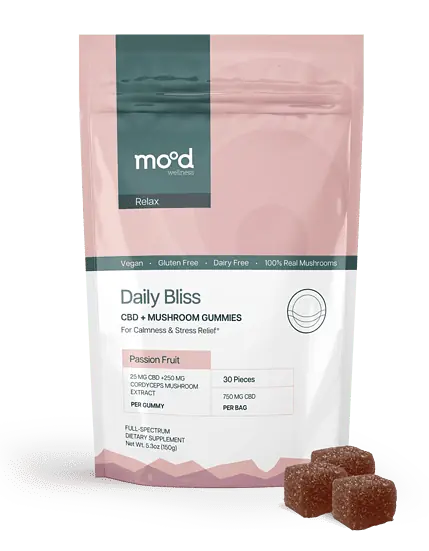
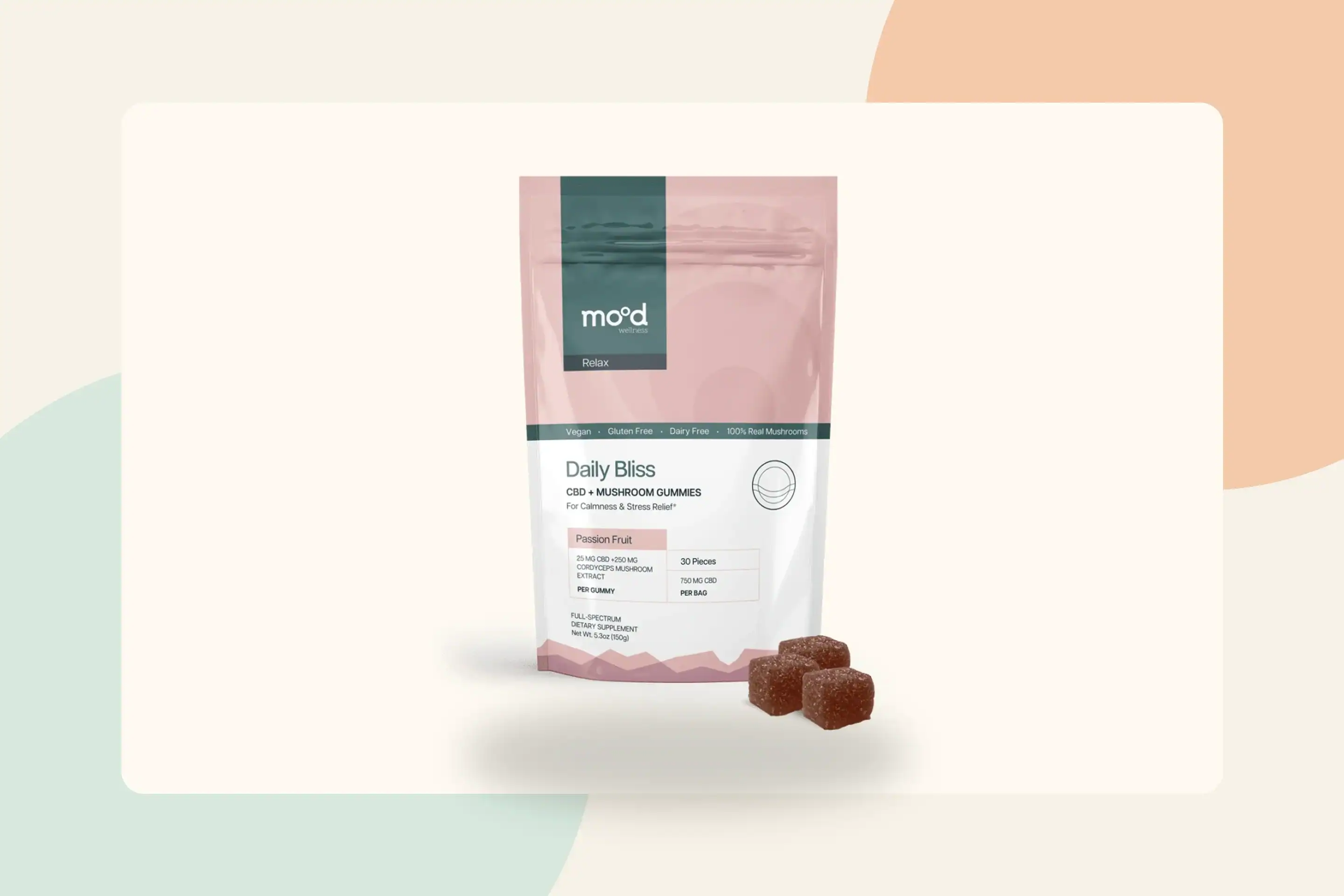
Mood’s current Daily Bliss page states that one gummy contains 250 mg of C. militaris fruiting-body extract and 25 mg CBD. The page describes one to two gummies in its directions.
| Daily Bliss units | Labeled Cordyceps extract | Labeled CBD |
|---|---|---|
| 1 gummy | 250 mg | 25 mg |
| 2 gummies | 500 mg | 50 mg |
This arithmetic describes the label; it is not a recommendation to take two gummies.
Suppose a loose-powder label lists a 1,000 mg scoop. You cannot conclude that the scoop delivers four times the Cordyceps exposure of one Daily Bliss gummy until you establish that both are the same species, fungal material and extract type. If the scoop is whole powder and the gummy contains an extract, the mass numbers describe different materials.
A six-field comparison that works
Use the same six fields for every candidate:
| Field | What to record | Why it changes the decision |
|---|---|---|
| Identity | Scientific species | Different Cordyceps species are not interchangeable evidence |
| Material | Fruiting body, mycelium or both | Shows what fungal material is present |
| Processing | Whole powder or extract; method if disclosed | Prevents raw-powder-to-extract comparisons |
| Amount | Per gummy/scoop and per labeled daily serving | Enables honest label math |
| Composition | Beta-glucan or other relevant assay with method | Adds information beyond total mass |
| Batch evidence | Lot match, date, laboratory and analytes | Shows what the submitted sample actually verified |
If one product leaves several fields blank, the uncertainty should remain visible instead of being filled with marketing assumptions.
What human research can and cannot decide
Human Cordyceps research does not answer the retail-format question directly. A randomized, double-blind study published in 2016 enrolled 28 young adults and tested 4 grams per day of a mushroom blend containing C. militaris. It examined exercise outcomes after one and three weeks.
That study has several boundaries:
- it tested a multi-mushroom blend, not a single Cordyceps product;
- the daily amount was gram-level;
- it did not compare gummy and loose-powder formats;
- it did not test Daily Bliss; and
- it did not include CBD as a matched comparison factor.
A 2026 narrative review of human C. militaris exercise research described the evidence as limited and inconsistent, with small samples, heterogeneous participants and protocols, incompletely standardized preparations and frequent use of multi-ingredient products. That makes a universal “best format” conclusion especially weak.
The right evidence question is not “Has Cordyceps been studied?” It is “How closely does the studied material match this exact product, amount, population and outcome?”
Does extraction make a gummy stronger?
Extraction can change which constituents are recovered and concentrated, but the word “extract” is not a strength score. Two extracts with the same mass can have different source materials, yields, carriers and measured composition.
A defensible comparison might include:
- extract mass per serving;
- extraction solvent or method;
- extraction ratio and whether it is native or carrier-adjusted;
- measured beta-glucan on a stated basis;
- cordycepin or other marker when relevant and validated; and
- identity and contaminant testing.
Without those fields, saying an extract is “10 times stronger” because it is 10:1 overstates what the ratio proves. The same caution applies to a gummy front label that highlights fruiting body or milligrams without a matching specification.
Added CBD creates a different product decision
Plain Cordyceps powder and a Cordyceps + CBD gummy are not merely two forms of the same supplement. CBD adds its own dose, evidence limits and safety considerations.
Daily Bliss is currently described as full spectrum with less than 0.3% THC. “Full spectrum” means a shopper should not treat it as THC-free. Actual exposure depends on the tested concentration, serving count, frequency and lot. People subject to workplace, sport, legal or clinical testing should treat any full-spectrum product as a meaningful drug-testing risk.
FDA warns that CBD may affect how other medications work, can change alertness, may cause gastrointestinal effects and carries potential liver risk. Combining CBD with alcohol or other substances that slow brain activity may increase sedation. Those questions generally do not apply to a plain single-ingredient Cordyceps powder, though that powder still has its own allergy, interaction and quality considerations.
Read the CBD buyer’s guide before comparing a CBD-containing gummy with a non-CBD powder.
Batch evidence: ask each document one question
A certificate is useful only for the analytes and sample it reports. A cannabinoid potency panel can help check CBD and THC. It does not automatically verify:
- Cordyceps species;
- fruiting-body versus mycelial material;
- extract amount;
- beta-glucan or cordycepin;
- heavy metals, microbes or pesticides; or
- whether the report matches the package lot.
Conversely, a supplier specification for Cordyceps does not prove finished-gummy cannabinoid potency. The evidence chain may require several documents: ingredient identity and composition, manufacturing traceability, finished-product potency and appropriate contaminant panels.
Mood’s public Daily Bliss report reviewed during the September 9, 2026 audit was an older cannabinoid-potency document, not a current finished-lot Cordyceps composition report. “Not shown” means the document cannot answer the mushroom question; it does not mean the ingredient failed.
Use the CBD COA guide to match lot, date, units and tested analytes.
Cost per serving needs a comparable denominator
Package price can mislead because gummies and powders contain different serving counts and materials. Calculate at least two numbers:
Cost per labeled serving = ordinary package price ÷ labeled servings
Cost per comparable gram = ordinary package price ÷ comparable labeled Cordyceps grams
Use the regular price available when you compare, not a temporary subscription discount unless you intend to maintain it. Include shipping and the amount you actually discard through expired product or an impractical routine.
Do not compare cost per gram across whole powder and extract as though the grams are functionally identical. If composition is documented, a cost per measured marker may be informative, but only when assay methods and reporting basis align.
Routine fit and serving accuracy
Gummies reduce measuring friction. Each intact gummy should deliver a fixed labeled amount, although cutting gummies introduces imprecision. They are convenient for travel but may be unsuitable for people avoiding sugar, certain sweeteners or specific excipients.
Powder supports gradual amount changes and can be mixed into coffee, smoothies or food. A household scoop, however, is a volume measure, not a guaranteed mass. Powder density and scoop technique vary. When precision matters, follow the label’s gram measure and use an appropriate scale rather than assuming every level scoop weighs the same.
Neither format requires you to feel an immediate effect for the label to be valid. Avoid fast redosing based on sensation, especially when the gummy also contains CBD.
Safety and interaction checklist
Talk with a clinician or pharmacist before using either format if you take medications, have a chronic condition, are preparing for surgery, or are pregnant or breastfeeding. Extra review is appropriate for liver disease, mushroom or mold allergy, autoimmune conditions, immunosuppressive therapy and anticoagulant use.
For a CBD-containing gummy, also consider:
- other sedating substances;
- changes in alertness or digestion;
- cumulative CBD from other products;
- full-spectrum THC exposure; and
- driving or operating machinery before you know your response.
Stop use and seek medical advice for a concerning reaction. A supplement comparison is not a substitute for diagnosis or treatment.
Which format fits which shopper?
| Your priority | More practical starting format | Condition attached |
|---|---|---|
| Fixed, portable serving | Gummy | Verify added ingredients and all active amounts |
| Adjustable amount | Powder | Measure mass accurately and follow label directions |
| Minimal excipients | Often powder | Confirm carriers, substrate and flavor ingredients |
| Combined Cordyceps + CBD | Gummy formula such as Daily Bliss | Accept fixed ratio, CBD safety and THC risk |
| Comparing cost | Either | Normalize equivalent material and ordinary price |
| Strongest documentation | Either | Choose the better identity, composition and lot evidence |
This matrix identifies routine fit. It does not rank clinical effectiveness.
How to compare Daily Bliss with a powder
Start with the current Daily Bliss product page and the powder’s complete label.
- Confirm the scientific species on both products.
- Record fruiting body, mycelium or mixed material.
- Separate whole powder from powdered extract.
- Convert both labels to a daily amount without assuming unlike masses are equivalent.
- Record Daily Bliss’s 25 mg CBD separately from its 250 mg Cordyceps claim.
- Compare sweeteners, carriers, allergens and other active ingredients.
- Match each package lot to the relevant cannabinoid, mushroom and contaminant evidence.
- Calculate cost per serving and, only where materials match, cost per comparable gram.
- Choose the routine you can measure and use consistently.

Bottom Line: Cordyceps Gummies vs Powder
Cordyceps gummies win on fixed portions and convenience; powder wins on flexibility and usually simpler mixing. Neither wins on effectiveness by format alone.
The meaningful comparison is species + material + processing + amount + composition + batch evidence. Daily Bliss currently states 250 mg C. militaris fruiting-body extract and 25 mg CBD per gummy, which makes it a combined cannabinoid-and-mushroom choice, not a direct substitute for every loose Cordyceps powder.
Normalize the label, preserve unknowns and choose the format that fits your routine and safety context. Until a controlled trial compares matched gummy and powder preparations, avoid claims that one format “works better.”
Quick answers
Frequently asked questions about Cordyceps Gummies vs Powder
What is the practical answer about Cordyceps Gummies vs Powder?
Cordyceps gummies win on fixed portions and convenience; powder wins on flexibility and usually simpler mixing. Neither wins on effectiveness by format alone. The meaningful comparison is species + material + processing + amount + composition + batch evidence. Daily Bliss currently states 250 mg C.
Which Mood product fits this topic?
Daily Bliss is the most relevant Mood option for this topic. Mood Daily Bliss offers a premeasured CBD gummy with functional mushrooms for shoppers who prefer a convenient, positive daily wellness routine.
What should I compare before choosing a gummy?
Compare the cannabinoid amount per measured serving, the complete ingredient list, spectrum or THC information, current product directions and available batch documentation. The best choice is the formula that fits the goal and is easy to use consistently.
How should I start using a new CBD or cannabinoid product?
Follow the current package directions, choose a low-demand first-use window and keep timing and meal context reasonably consistent. Review medication, pregnancy, liver and impairment considerations with a qualified clinician when relevant.
Sources
- Hirsch KR, et al. Cordyceps militaris Improves Tolerance to High-Intensity Exercise After Acute and Chronic Supplementation. 2016. PMID 27408987.
- Current Evidence of Ergogenic and Post-Exercise Recovery Effects of Dietary Supplementation with Cordyceps militaris in Humans, A Narrative Review. 2026. PMCID PMC12986667.
- U.S. Food and Drug Administration. What You Need to Know About Products Containing Cannabis or Cannabis-Derived Compounds, Including CBD.
- Mood Wellness. Daily Bliss product and lab-results pages. Checked September 9, 2026.
- U.S. Food and Drug Administration. Dietary Supplements. Accessed September 2026.