
Extraction, powder and finished format are different layers
Three decisions often get collapsed into one:
| Layer | Question it answers | Example |
|---|---|---|
| Starting material | What entered the process? | Named species; fruiting body, mycelium or another fungal material |
| Extraction process | How were selected constituents separated? | Hot water, ethanol or a sequential water-and-ethanol process |
| Finished format | How is the formula delivered? | Dried extract powder, capsule, liquid tincture or gummy |
A gummy can contain a dried hot-water extract. A powder can itself be an extract rather than simply milled mushroom. A liquid tincture may contain alcohol, while a spray-dried extract made with ethanol may contain little or no ethanol after solvent removal. Format cannot reliably reveal the manufacturing method.
Mood’s mushroom extract-in-gummies guide owns the serving-level choice between preparations. This page stays with the extraction process and the evidence required to interpret it.
What happens during mushroom extraction
A commercial process may include more steps than the headline on a package suggests:
- Identify and prepare the mushroom material.
- Mill or reduce it to a controlled particle size.
- Contact it with water, ethanol or another permitted processing medium.
- Control time, temperature, pH, pressure and agitation.
- Separate liquid extract from insoluble material.
- Concentrate the liquid.
- Dry it into powder or formulate it as a liquid.
- Add a carrier when needed for drying or handling.
- Test the ingredient against identity and composition specifications.
- Manufacture and test the finished supplement.
The solvent name describes only one variable. Two “hot-water extracts” may differ because one used a higher temperature, longer residence time, repeated extraction cycles or a different ratio of water to raw material. Processing can also alter the size, solubility or measured recovery of compounds.

Hot-water extraction
Hot water is a traditional and widely studied way to recover water-soluble material from mushrooms. Research reviews describe it as a common approach for fungal polysaccharides, though results depend on species, temperature, duration, pH and downstream purification.
The simplified workflow is:
- prepared mushroom material contacts heated water;
- soluble material moves into the liquid phase;
- insoluble solids are separated;
- the liquid is concentrated; and
- the concentrate may be dried into a powder.
What “hot-water extracted” can tell you
It can tell you that heated water played a role in processing. When the manufacturer also supplies a specification and assay, it may help explain how a measured water-soluble fraction was produced.
What it cannot tell you
It does not state the beta-glucan percentage, extraction yield, species identity or amount per serving. It also does not prove that the process preserved every compound of interest. Those require separate documentation.
Ethanol extraction
Ethanol is less polar than water and may recover compounds with different solubility characteristics. Reishi research, for example, often discusses alcohol-soluble triterpenoid fractions separately from polysaccharide-rich fractions. But the actual composition depends on ethanol concentration, water content, temperature, duration and the starting material.
An ethanol process should raise practical documentation questions:
- What ethanol concentration was used?
- Was ethanol the only extraction medium or part of a sequence?
- Was the final ingredient dried or retained as a liquid?
- Is residual-solvent testing relevant and available?
- Which marker compounds were measured afterward?
“Alcohol extracted” does not mean that a dried gummy ingredient contains an intoxicating amount of alcohol. Conversely, “made with food-grade ethanol” does not by itself show that solvent removal and residual-solvent specifications were met.

What dual extraction means, and does not mean
Dual extraction generally means using both water and ethanol to capture a broader chemical range. The two phases may be performed sequentially on the same material and later combined, or a manufacturer may use a hydroalcoholic mixture.
The phrase is not standardized enough to reconstruct the process. It usually leaves unanswered:
- the order of the phases;
- solvent concentrations;
- temperature and time;
- whether both fractions reached the final ingredient;
- extraction yield;
- carrier content; and
- tested marker levels.
Calling dual extraction “full spectrum” does not solve those gaps. Nor is dual extraction automatically preferable for every species or product goal. If a formula is standardized to a relevant marker and supported by clear testing, that result may be more decision-useful than a more elaborate process name with no assay.
Advanced and assisted extraction methods
Research and industrial production may also use pressure, ultrasound, microwaves, enzymes, alkaline or acidic conditions, subcritical water, supercritical fluids or combinations of techniques. These approaches can change extraction time, solvent use, yield or selectivity.
They should not be ranked from a marketing adjective alone. “Ultrasonic,” “supercritical” or “advanced” does not establish that the process is safer or more effective for a finished supplement. Ask what target was defined and what the resulting ingredient was shown to contain.
Laboratory studies may optimize recovery under tightly controlled conditions that do not match a commercial product. A paper describing one species, solvent system and analytical endpoint cannot be silently applied to a different gummy.

Extract ratio, yield and marker content
These numbers answer different questions.
Extract ratio
An input ratio such as 10:1 often communicates that ten units of starting material were used to produce one unit of extract under the manufacturer’s definition. It does not prove that every constituent was concentrated tenfold.
Extraction yield
Yield describes how much extract was recovered relative to the starting material. If 100 kilograms of dried mushroom produces 20 kilograms of extract, the mass yield is 20%. Yield can be influenced by what the process dissolves and by any carrier or retained solids.
Marker percentage
A marker assay reports a measured constituent in the tested sample, such as beta-glucan under a named method. It gives chemical evidence about that sample, not an automatic clinical interpretation.
Consider a hypothetical label with 300 mg of 8:1 extract per serving and a supplier specification of 25% beta-glucan. The ratio and percentage cannot be multiplied to claim “2,400 mg of active beta-glucan.” If the percentage genuinely applies to the same ingredient, the simple marker calculation is:
300 mg × 0.25 = 75 mg of measured beta-glucan in the stated extract amount
Even that estimate needs a matching basis and batch. An ingredient specification is not the same as a finished-product result.
A method-to-evidence comparison
| Label phrase | Reasonable inference | Evidence still needed |
|---|---|---|
| Hot-water extract | Heated water was used in processing | Conditions, ratio/yield, markers, amount and lot evidence |
| Ethanol extract | Ethanol was used to recover a fraction | Concentration, removal, residual-solvent controls and markers |
| Dual extract | Water and ethanol both played a role | Sequence, fraction combination, final composition and testing |
| 10:1 extract | A stated starting-to-finished relationship | Ratio definition, yield, carrier content and assay |
| Standardized to beta-glucans | A compositional target is claimed | Named method, result basis, sample identity, date and lot |
| Fruiting-body extract | A mushroom part is claimed | Species and supply-chain identity plus composition testing |
This is why process disclosure and composition testing belong together. The process explains intent; the assay checks outcome.
How to evaluate a mushroom extract label
Start with the Supplement Facts panel and supporting documentation, not the largest number on the front.
1. Confirm the species
Common names can be ambiguous. A scientific name provides a more precise identity anchor, though it still does not verify authenticity by itself.
2. Identify the mushroom part or material
Record whether the ingredient is described as fruiting body, mycelium or another material. Do not infer “grain free” or “pure fruiting body” from a beta-glucan number.
3. Find the amount per serving
Look for the mass of each extract or a clearly defined blend. A front-label ratio without a serving amount cannot tell you how much extract is consumed.
4. Record the extraction description
Write down the solvent or method exactly as disclosed. “Extract” alone does not identify hot water, ethanol or a dual process.
5. Separate ratio from standardization
An extraction ratio and a marker percentage are not substitutes. Capture both when supplied.
6. Look for a matching certificate
A useful report identifies the tested material or finished product, lot, laboratory, method, date, analyte and result. A generic supplier sheet should not be presented as a current finished-batch certificate.
7. Check other safety panels
Beta-glucan or triterpene testing does not cover heavy metals, microbes, pesticides or residual solvents. Determine which panels are relevant to the ingredient and whether results apply to the actual lot.
For more help evaluating laboratory records, use Mood’s guide to reading a certificate of analysis. The same identity-and-lot logic applies even though mushroom assays and cannabinoid assays measure different analytes.
Ingredient certificate versus finished-product proof
A supplier certificate can show that an incoming extract met a specification. To connect it to a gummy, the manufacturer also needs traceability: which ingredient lot entered which production batch and how much was added.
A finished-product assay can provide more direct evidence about the consumer product, but complex gummy matrices can require appropriate methods and validation. The best evidence chain preserves both layers rather than pretending one document answers every question.
Mood’s public lab-results page links certificates for its cannabinoid products. In the September 9, 2026 audit, the sampled mushroom-gummy files were older cannabinoid-potency reports. They did not visibly disclose extraction solvent, extract ratio, beta-glucan or triterpene assays, or residual-solvent results. Those facts therefore cannot be verified from the public files reviewed.
That is an evidence gap, not proof of a failed specification. A careful guide distinguishes “not shown in the reviewed document” from “not tested” or “not present.”
Reading Mood mushroom products accurately
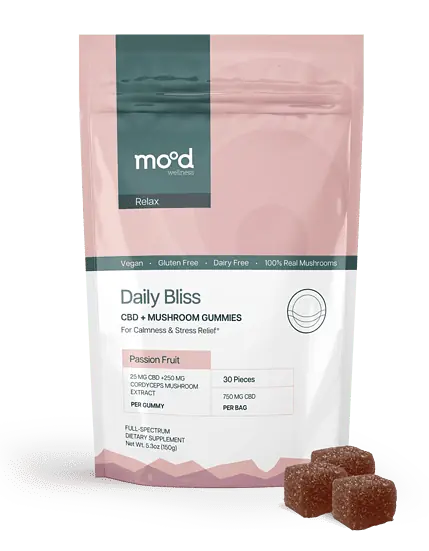
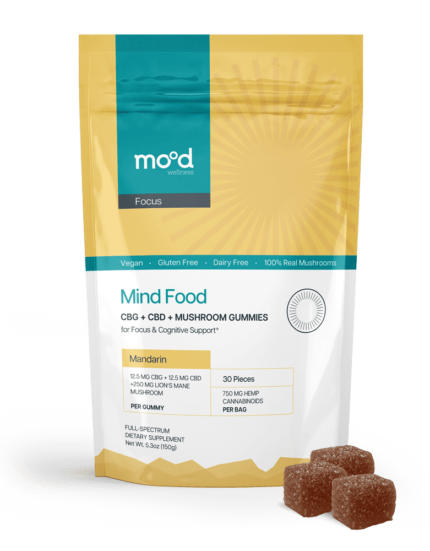
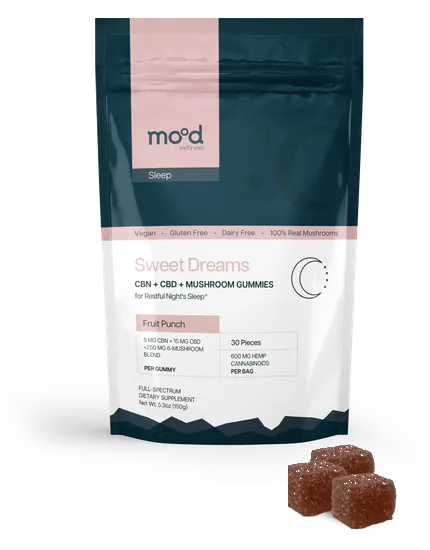
Mood’s functional-mushroom pages identify fruiting-body extracts in products including Mind Food, Daily Bliss and Sweet Dreams. Mind Food currently states 250 mg of Lion’s Mane fruiting-body extract per gummy and describes beta-glucan verification above 25%. Daily Bliss states 250 mg of Cordyceps fruiting-body extract per gummy. Sweet Dreams describes a six-mushroom fruiting-body blend.
Those product-page statements do not, on their own, disclose a full extraction workflow. Shoppers should use the current package, Supplement Facts panel and lot-matched documentation as the controlling sources. Mood’s functional mushroom collection can be compared on that basis without assuming that one method name guarantees an outcome.
Safety and Evidence Limits for Mushroom Extraction Methods
Extraction can concentrate desired constituents, but it can also concentrate unwanted material if sourcing and controls are weak. Manufacturing therefore needs identity specifications, contaminant controls and process-appropriate testing.
Mushroom supplements can also cause unwanted effects or interact with medications. Formula complexity matters: a gummy may combine several mushrooms, cannabinoids, sweeteners and other ingredients. Review the whole label. Ask a qualified clinician or pharmacist before use if you are pregnant or breastfeeding, have a medical condition, take prescription medication, have mushroom allergies, or are preparing for surgery.
Do not use an extraction method as evidence that a product treats, prevents or cures disease. Chemical recovery in a laboratory and a meaningful health outcome in humans are different evidence questions.
Mushroom Extraction Methods Buyer Checklist
Before comparing two mushroom extracts, verify:
- Scientific species name.
- Fruiting body, mycelium or other starting material.
- Extract amount per serving.
- Extraction medium and meaningful process details.
- Ratio definition and extraction yield, if claimed.
- Carrier or excipient content.
- Relevant marker assay and method.
- Ingredient-lot and finished-batch traceability.
- Contaminant and residual-solvent panels appropriate to the process.
- Laboratory, report date and package lot match.
If one of these fields is missing, mark it unknown. Do not fill the gap with a prettier marketing phrase.

Bottom Line: Mushroom Extraction Methods
Mushroom extraction methods are tools for separating compounds; they are not self-validating quality seals. Hot water, ethanol and dual extraction can produce different mixtures, while advanced methods can alter selectivity or efficiency. The result still has to be defined and measured.
The most defensible comparison joins process disclosure to species identity, material, serving amount, ratio or yield, marker assays, safety panels and lot traceability. When those pieces are available, extraction language becomes informative. Without them, “dual,” “concentrated” and “advanced” remain incomplete descriptions.
Quick answers
Frequently asked questions about Mushroom Extraction Methods Explained
What is the practical answer about Mushroom Extraction Methods Explained?
Mushroom extraction methods are tools for separating compounds; they are not self-validating quality seals. Hot water, ethanol and dual extraction can produce different mixtures, while advanced methods can alter selectivity or efficiency. The result still has to be defined and measured. The most defensible comparison joins process disclosure to species identity, material, serving amount, ratio or yield, marker assays, safety panels and lot traceability.
Which Mood product fits this topic?
Mind Food is the most relevant Mood option for this topic. Mood Mind Food combines CBD, CBG and Lion’s Mane in a stimulant-free gummy designed for a calm, focused daytime routine.
What should I compare before choosing a product?
Compare the cannabinoid amount per measured serving, the complete ingredient list, spectrum or THC information, current product directions and available batch documentation. The best choice is the formula that fits the goal and is easy to use consistently.
How should I start using a new CBD or cannabinoid product?
Follow the current package directions, choose a low-demand first-use window and keep timing and meal context reasonably consistent. Review medication, pregnancy, liver and impairment considerations with a qualified clinician when relevant.
Sources
- U.S. Food and Drug Administration. Dietary Supplement Labeling Guide: Chapter IV. Nutrition Labeling.
- U.S. Food and Drug Administration. Revised Draft Guidance for Industry: Dietary Supplements: New Dietary Ingredient Notifications and Related Issues. April 2024.
- Venturella G, et al. Mushroom-Derived Bioactive Molecules as Immunotherapeutic Agents: A Review. Molecules. 2021.
- Cerletti C, et al. Edible Mushrooms: A Comprehensive Review on Bioactive Compounds with Health Benefits and Processing Aspects. Foods. 2021.
- McCleary BV, Draga A. Measurement of β-Glucan in Mushrooms and Mycelial Products. Journal of AOAC International. 2016.
- Mood Wellness. Functional Mushrooms, product and lab-results pages. Checked September 9, 2026.
- U.S. Food and Drug Administration. Dietary Supplements. Accessed September 2026.