
Separate taste, aroma, mouthfeel and irritation
People often use “taste” to describe several different sensations. Separating them gives customer support a more useful report.
- Taste includes bitter, sweet, sour, salty and savory sensations.
- Aroma reaches the nose and may be described as grassy, nutty, citrus, paint-like or rancid.
- Mouthfeel includes thickness, oiliness, graininess and coating.
- Irritation is burning, stinging, numbness or swelling. It is not merely a flavor preference.
A bitter taste with an earthy aroma may be expected for one formula. A new paint-like smell, visible particles and throat irritation create a very different situation. If there is swelling, breathing difficulty or another urgent symptom, seek emergency help rather than troubleshooting the bottle online.
Where CBD oil flavor comes from
There is no single “CBD flavor.” Four parts of the product can change what you perceive.
The hemp extract
Full-spectrum and broad-spectrum extracts can retain multiple plant-derived compounds. Their flavor may be more herbaceous or bitter than a highly purified CBD isolate. Extraction and refining choices also affect which compounds remain. That difference does not establish that one formula works better.
The carrier oil
CBD is commonly dispersed in MCT, hemp seed or olive oil. MCT is often mild and relatively neutral. Hemp seed oil can be green, nutty or grassy. Olive oil can contribute its own fruitiness, bitterness or peppery character. The CBD carrier-oil comparison explains these formulation differences without turning taste into a quality ranking.
Added flavoring
Mint, citrus and other flavors can soften or redirect the botanical profile, but they do not remove the extract or prove freshness. Compare the actual ingredient list. “Natural flavor” is not a complete sensory specification, and different production lots can show modest variation.
Storage and oxidation
Air, light, heat, time and the carrier matrix can influence oil stability. Oxidation of edible oils can create off-aromas and flavors. Yet a consumer cannot identify a specific chemical change or its extent by tasting the bottle. Controlled laboratory measurements, not a palate, are needed for that.

Expected profile or warning sign?
Use this table as a triage aid, not a diagnosis.
| Observation | Could fit an expected formula | What to check | Pause and contact support when |
|---|---|---|---|
| Earthy or grassy | Unflavored broad- or full-spectrum extract | Spectrum, carrier and flavor ingredients | It is new, extreme or paired with packaging damage |
| Nutty or seed-like | Hemp seed or another flavorful carrier | Carrier listed in ingredients | Aroma becomes stale, paint-like or sharply unpleasant |
| Mild bitterness | Extract, olive carrier or flavor balance | Product description and first-opening memory | Bitterness suddenly intensifies or comes with irritation |
| Peppery sensation | Olive oil or certain botanical components | Carrier and added flavors | Sensation is burning, painful, numbing or causes symptoms |
| Rancid or paint-like odor | Not a desirable target profile | Date, seal, heat/light/air exposure | Any new rancid or solvent-like note is present |
| Fermented or unexpectedly sour | Not established by the word CBD | Leakage, pressure, contamination history | Odor is new, there is gas, bubbling or damaged closure |
| Chemical or solvent-like | Cannot be verified safely at home | Stop; preserve bottle and batch details | Do not retaste, contact the maker |
Words are imperfect. “Bitter” to one person may be “green” to another. Focus on whether the sensation was present from first opening, whether it matches the labeled ingredients and whether it changed during the life of the same bottle.
Bitter does not mean stronger
A consumer cannot estimate CBD concentration from flavor intensity. A strongly flavored carrier can dominate a lower-concentration formula, while flavoring can mask a concentrated extract. Full-spectrum does not have a standard bitterness score, and a neutral taste does not prove isolate purity.
Quantitative potency requires a validated analytical method applied to a defined sample. Use the label for the stated amount and a matching certificate for measured batch results. Mood's CBD oil strength guide explains milligrams, milliliters and concentration without using taste as evidence.
Taste cannot prove purity or contamination
Some contaminants have no obvious taste or odor. Other harmless formulation differences can be noticeable. This creates two symmetrical mistakes:
- “It tastes normal, so it must be safe.”
- “It tastes bitter, so it must be contaminated.”
Neither conclusion follows. Contaminant panels require specific methods and reporting limits. A certificate of analysis can answer only the panels actually performed on the identified sample. Review how to read a CBD COA and the CBD contaminant-panel guide rather than relying on sensory impressions.
What the research says about sensory variation
Research can explain why formulations differ without identifying your bottle from afar.
A chemical and sensory literature base on commercial CBD oils shows wide variation in cannabinoid, terpene, carrier and oxidation characteristics. A study of commercially available European preparations analyzed cannabinoid content, terpene fingerprints and oxidation stability. Its findings reinforce that “CBD oil” describes a category of different matrices, not one uniform liquid.
Researchers have also developed sensory vocabulary for cold-pressed hemp seed oil. Descriptors include green, nutty, toasted, hay-like, bitter and pungent, while undesirable notes can include rancid, fishy or paint-like qualities. That lexicon applies to hemp seed oil as a food oil; it is not a universal pass/fail key for finished CBD products.
Formulation research comparing oil solutions and emulsions notes that carrier properties, extract and oxidation can affect odor, bitterness and acceptability. Separate heat-aging work on consumer cannabis oils found cannabinoid depletion varied by carrier under experimental conditions. These studies support careful storage and product-specific assessment, but they cannot establish that a particular bottle is safe to use.
A safe no-retaste troubleshooting workflow
Once a flavor or odor seems wrong, further tasting adds exposure without producing reliable evidence.
1. Stop and preserve the bottle
Close it, keep it upright and follow its labeled storage directions. Do not discard it immediately unless safe storage is impossible; the manufacturer may need the lot information or photographs.
2. Describe the experience
Write down whether the concern involved taste, smell, texture or irritation. Use plain comparisons, earthy, nutty, rancid, paint-like, sour, burning, without trying to name a chemical.
3. Check whether it changed
Was the flavor present at first opening? Did it develop after weeks of use? Did a new bottle from a different lot taste different? Batch variation and personal perception can matter, but a change within one bottle deserves closer review.
4. Inspect without sampling
Check the seal, cap, dropper and bottle for cracks, residue or leakage. Look for unexpected haze, crystals, sediment, layers or color change. Use the cloudy CBD oil guide if appearance is also involved.
5. Record storage history
Note heat, sunlight, a vehicle, refrigeration, freezing, a loose cap or contact between the dropper and another surface. Do not assume one event caused the change; give support the facts you know.
6. Match the package and report
Record the product name, bottle size, ingredients, lot code and date marks. Use the batch-number matching workflow to avoid attaching a generic or older report.
7. Contact the responsible company
Send unedited photographs, purchase source, storage history and sensory description. Ask whether the profile is expected for that exact formula and batch, and follow the company's disposition instructions.
Why Does CBD Oil Taste Bitter or Different Mistakes to Avoid
- Do not keep tasting an oil to determine whether it is spoiled.
- Do not ask another person to taste an uncertain product.
- Do not add mint, sweetener, food, alcohol or another carrier to hide an off-note.
- Do not heat the bottle to remove an odor or thin the oil.
- Do not filter, transfer or re-formulate it at home.
- Do not use a matching COA as proof that nothing changed after testing.
Adding ingredients changes concentration and traceability. Heating may accelerate degradation. Transferring the oil can introduce contamination and separates it from the labeled package and batch code.
When to stop using it
Pause use and seek product-specific guidance when there is:
- a new rancid, paint-like, fermented, solvent-like or otherwise disturbing odor;
- burning, stinging, swelling, numbness or other symptoms;
- a broken seal, cracked bottle, damaged dropper, leakage or unexpected pressure;
- foreign-looking material, bubbling or persistent unexplained separation;
- substantial color, clarity or viscosity change;
- an expired date or unknown storage and purchase history;
- a mismatch between product, lot and available report.
For serious symptoms, contact emergency services or poison control as appropriate. For medication, pregnancy, liver or other health concerns, consult a qualified clinician. The FDA cautions that CBD can present interaction and safety risks regardless of flavor.

Checking a Mood CBD oil
Start with the exact Mood bottle, not a general description from another product. Record:
- formula and bottle size;
- full-spectrum status and listed carrier;
- added flavors and other ingredients;
- batch or lot code;
- date marks and labeled storage directions;
- when the sensory change began;
- whether appearance or packaging also changed.
Then check Mood's lab-results directory for the corresponding product and batch. During our September 2026 review, some publicly linked Mood reports were older potency-only documents. They should not be presented as current-lot or full contaminant evidence unless the report itself supports that description.
If support confirms that the bottle should not be used, current formulas can be compared in the Mood CBD oils collection. A replacement purchase is a separate decision; it does not diagnose the original bottle.
How to reduce future uncertainty
Note the product's ordinary flavor when first opened, without turning use into a formal sensory test. Keep the original package, cap it promptly, store it as labeled and avoid contaminating the dropper. Record the opening date if the label does not provide a place for it.
When comparing products, prioritize a clear ingredient list, precise cannabinoid units, accessible batch documentation and responsive support. “Great tasting” is subjective marketing, while “bitter means potent” is an unsupported shortcut.
Bottom Line: Why Does CBD Oil Taste Bitter or Different
CBD oil may naturally taste earthy, grassy, nutty, peppery or bitter. Its hemp extract, carrier and flavor ingredients all matter. What deserves attention is a new or disturbing off-taste, odor, irritation or packaging/appearance change.
Do not use taste to estimate potency or prove purity. Stop sampling an uncertain bottle, document the exact sensory and physical changes, preserve the package and batch code, and ask the manufacturer about that specific formula and lot.
Quick answers
Frequently asked questions about Why Does CBD Oil Taste Bitter or Different? What the Flavor Can, and Cannot, Tell You
What is the practical answer about Why Does CBD Oil Taste Bitter or Different? What the Flavor Can, and Cannot, Tell You?
CBD oil may naturally taste earthy, grassy, nutty, peppery or bitter. Its hemp extract, carrier and flavor ingredients all matter. What deserves attention is a new or disturbing off-taste, odor, irritation or packaging/appearance change. Do not use taste to estimate potency or prove purity. Stop sampling an uncertain bottle, document the exact sensory and physical changes, preserve the package and batch code, and ask the manufacturer about that specific formula and lot.
Which Mood product fits this topic?
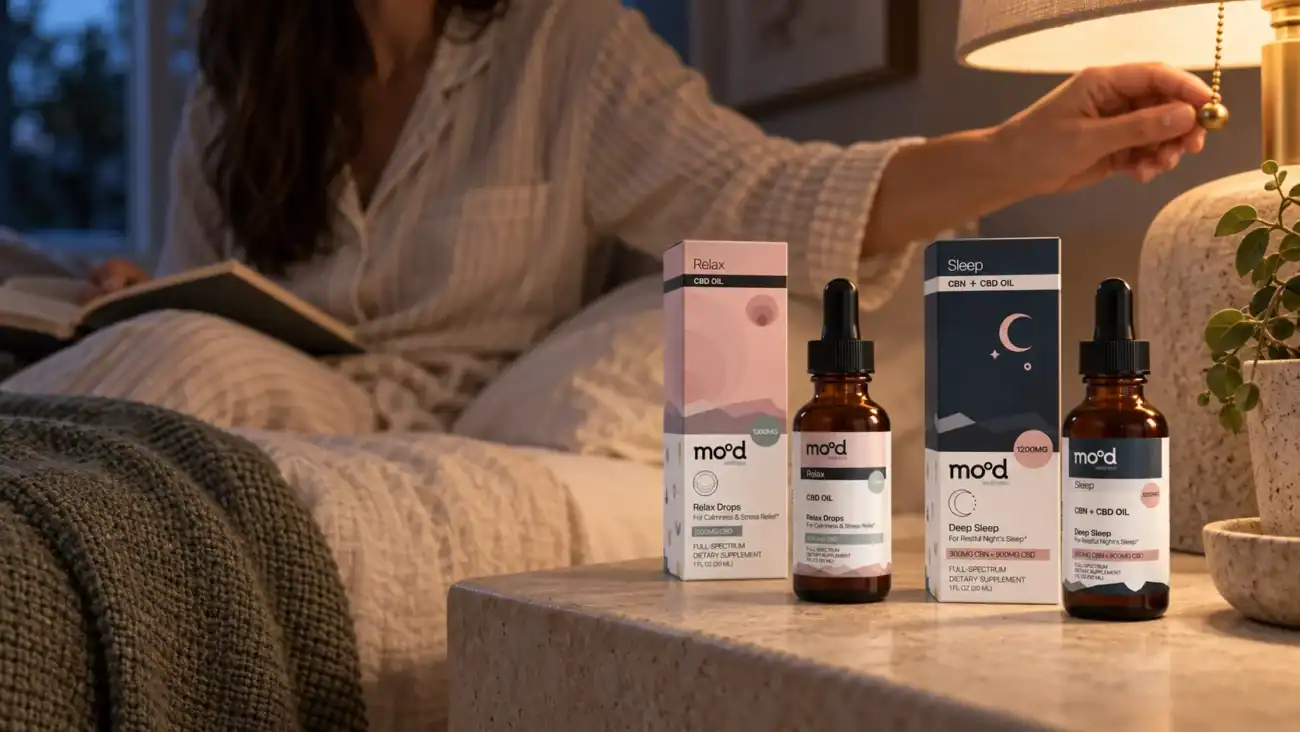
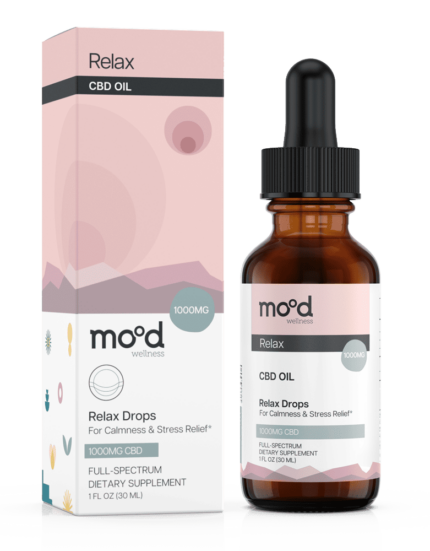
Relax Drops is the most relevant Mood option for this topic. Mood Relax Drops provide a clearly labeled CBD oil format for shoppers who want flexible serving control and an easy way to build CBD into a daily or evening routine.
What should I compare before choosing a oil?
Compare the cannabinoid amount per measured serving, the complete ingredient list, spectrum or THC information, current product directions and available batch documentation. The best choice is the formula that fits the goal and is easy to use consistently.
How should I start using a new CBD or cannabinoid product?
Follow the current package directions, choose a low-demand first-use window and keep timing and meal context reasonably consistent. Review medication, pregnancy, liver and impairment considerations with a qualified clinician when relevant.
Sources
- Citti C, et al. “Quality Traits of ‘Cannabidiol Oils’: Cannabinoids Content, Terpene Fingerprint and Oxidation Stability of European Commercially Available Preparations.” PMCID: PMC6100014.
- Mikołajczak N, et al. “Sensory Wheel and Lexicon for the Description of Cold-Pressed Hemp Seed Oil.” PMCID: PMC9914576.
- “Formulation and Analytical Evaluation of Liquid Cannabidiol Preparations: Comparative Study of Oil-Based Solutions and Emulsions.” PMCID: PMC12736438.
- “Heating of consumer cannabis oils can lead to free radical initiated degradation, causing CBD and THC depletion.” PMID: 36113706.
- U.S. Food and Drug Administration. Consumer information on cannabis-derived compounds including CBD. Accessed September 9, 2026.
- U.S. Food and Drug Administration. What the FDA is Doing to Protect Consumers from Cannabidiol (CBD) in Foods. Accessed September 2026.