Total milligrams versus concentration
Two bottles can contain the same total CBD and have different concentrations.
| Bottle | Total CBD | Volume | Labeled concentration |
|---|---|---|---|
| A | 1,000 mg | 15 mL | 66.7 mg/mL |
| B | 1,000 mg | 30 mL | 33.3 mg/mL |
| C | 1,000 mg | 60 mL | 16.7 mg/mL |
All three contain the same labeled total. Bottle A puts that total into less carrier oil, so each milliliter is more concentrated. Bottle C spreads it across more liquid.
The reverse is also possible: bottles with different totals can have equal concentration. A 500 mg/15 mL bottle and a 1,000 mg/30 mL bottle both calculate to about 33.3 mg/mL.
This guide owns the strength-label calculation. For the separate packaging decision, see the 15 mL vs 30 mL vs 60 mL bottle-size comparison.

How to calculate CBD per measured serving
First locate the label serving volume. Then multiply it by concentration.
For a 1,000 mg CBD, 30 mL bottle:
1,000 ÷ 30 = 33.3 mg/mL
| Measured volume | Labeled CBD arithmetic |
|---|---|
| 0.25 mL | about 8.3 mg CBD |
| 0.5 mL | about 16.7 mg CBD |
| 0.75 mL | about 25 mg CBD |
| 1 mL | about 33.3 mg CBD |
For a 2,000 mg CBD, 30 mL bottle:
2,000 ÷ 30 = 66.7 mg/mL
| Measured volume | Labeled CBD arithmetic |
|---|---|
| 0.25 mL | about 16.7 mg CBD |
| 0.5 mL | about 33.3 mg CBD |
| 0.75 mL | about 50 mg CBD |
| 1 mL | about 66.7 mg CBD |
These tables do not establish which amount a person should use. They only translate labeled concentration into measured volume.
Why drops and “dropperfuls” are weak units
A milliliter is a defined volume. A drop is not a stable consumer measurement: drop size can change with liquid properties, dropper geometry, angle and technique. “One dropperful” can also mean liquid up to a marked line, a fully compressed bulb or whatever happens to enter the pipette.
Prefer a clearly marked mL line and keep the dropper level when reading it. If the package gives only drops, ask the manufacturer for the measured serving volume and do not assume a universal number of drops per mL.
Do not count drops to create spurious precision. A calculation such as “1.11 mg per drop” looks exact while its volume input may be uncertain.
Current Mood Relax Drops example
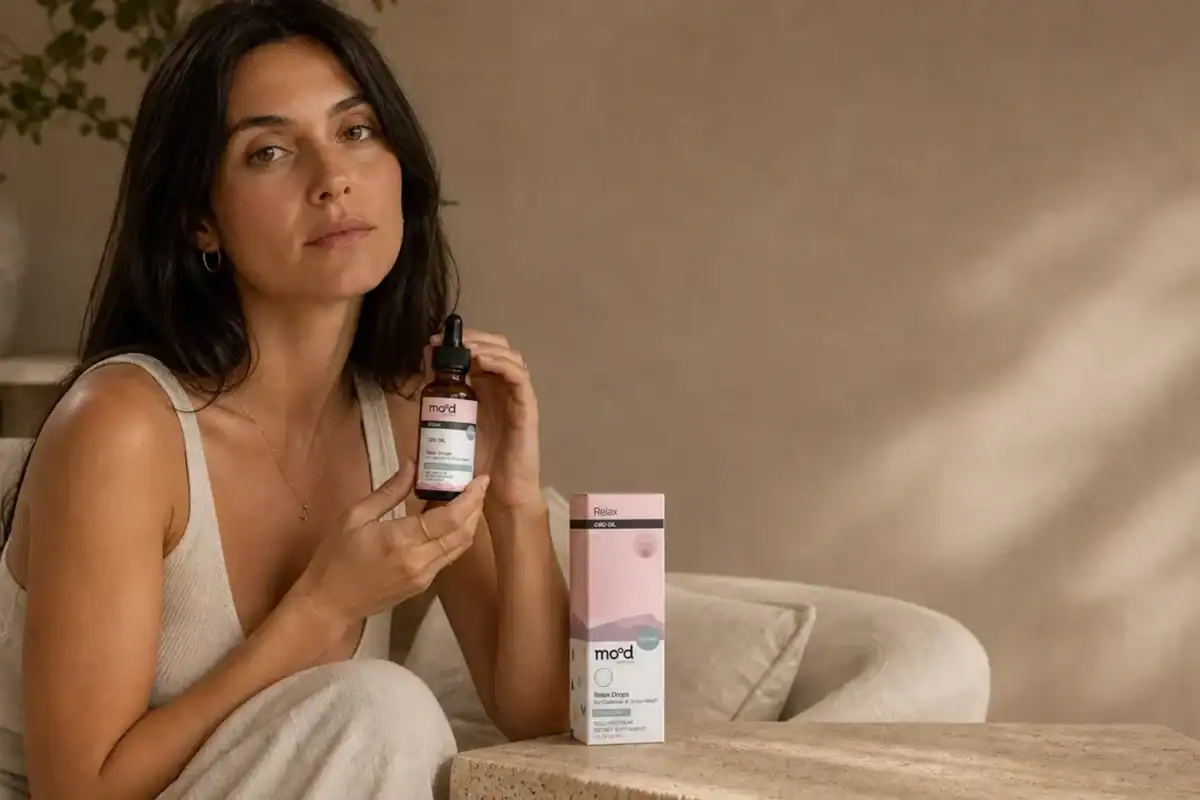
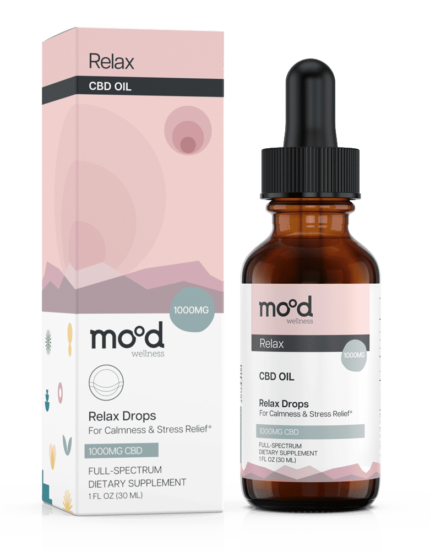
Mood’s current Relax Drops page states that both options are 30 mL and lists:
- 1,000 mg CBD per bottle, about 33 mg CBD per 1 mL;
- 2,000 mg CBD per bottle, about 66 mg CBD per 1 mL; and
- 30 stated servings per bottle.
The product-page concentrations are rounded. Direct division gives about 33.3 and 66.7 mg/mL. Either presentation is reasonable if the rounding basis is explicit.
The 2,000 mg variant is twice the labeled concentration of the 1,000 mg variant because the total doubles while volume remains 30 mL. It does not contain twice as much liquid, and “extra strength” does not by itself predict twice the response.
Open the exact option in the current CBD oils collection and verify the physical label before using the arithmetic.

Combined totals: Brain Fuel and Deep Sleep
Mixed-cannabinoid oils make front-panel totals especially easy to misread.
Brain Fuel’s 1:1 ratio
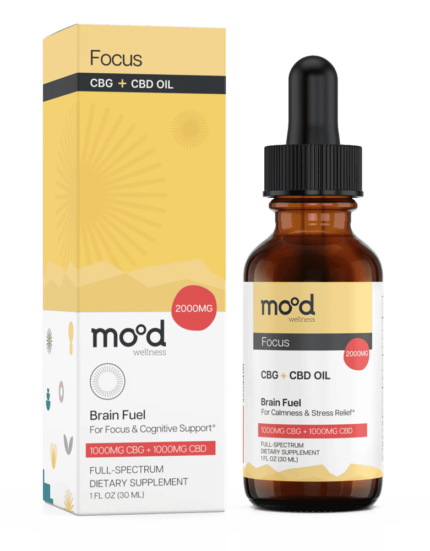
Mood currently describes Brain Fuel as:
- 1,000 mg total: 500 mg CBD + 500 mg CBG;
- 2,000 mg total: 1,000 mg CBD + 1,000 mg CBG; and
- 1:1 CBD-to-CBG in both variants.
If the bottles are 30 mL, the lower-total option calculates to about 16.7 mg/mL CBD plus 16.7 mg/mL CBG. The higher calculates to about 33.3 mg/mL of each. Both are 1:1, yet one is twice as concentrated.
A ratio never supplies the missing amount. Five milligrams of each and 50 milligrams of each are both 1:1.
Deep Sleep’s combined 1,200 mg
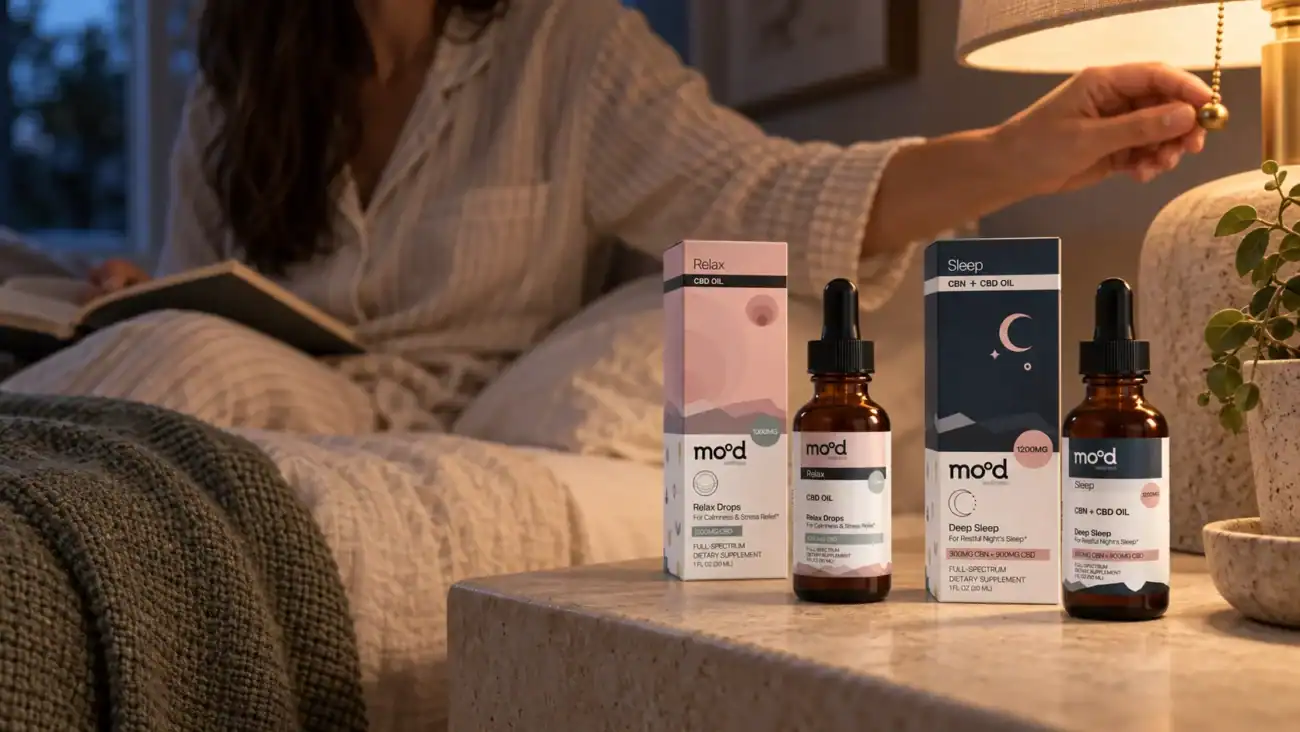
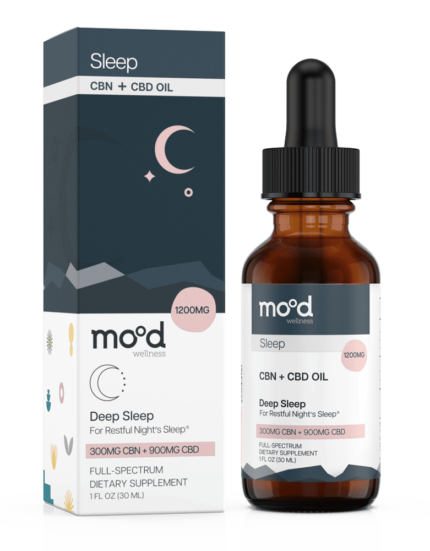
Mood’s current Deep Sleep page states 900 mg CBD plus 300 mg CBN per bottle, for 1,200 mg combined. In a 30 mL bottle, label arithmetic gives:
- CBD: 900 ÷ 30 = 30 mg/mL;
- CBN: 300 ÷ 30 = 10 mg/mL; and
- named cannabinoids combined: 1,200 ÷ 30 = 40 mg/mL.
Calling this “40 mg/mL CBD” would be wrong. The noun after the number must remain attached.
What does a percentage mean?
Some oil labels use percentages. A percent may describe mass per mass, mass per volume or another jurisdiction-specific convention. Oil density may also differ from water. Without the basis, converting a percentage to mg/mL can introduce an unsupported assumption.
Do not automatically state that 5% always equals 50 mg/mL. Ask:
- Is the percentage w/w, w/v or v/v?
- Does it refer to CBD alone or total extract?
- What container mass or volume is used?
- Is density supplied when conversion requires it?
- Does the Supplement Facts panel already give mg per serving?
When a label provides both percentage and mg/mL, use the explicit mg/mL for consumer comparison and check whether the two reconcile under the manufacturer’s stated convention.
Labeled strength versus laboratory result
Label math describes the claim. A certificate of analysis describes a submitted sample under the report’s units and conditions. The numbers can only be compared after matching:
- exact product and strength;
- lot or batch identifier;
- report date;
- finished-oil sample type;
- mg/mL, mg/g or percentage units;
- CBD definition, such as CBD versus total potential CBD; and
- laboratory and method context.
Do not treat mg/g as mg/mL without density. Do not multiply a per-gram result by bottle milliliters. Do not use a raw-extract report to claim finished-bottle concentration.
Mood’s CBD COA guide provides a field-by-field workflow. Its public lab-results index currently links separate reports for Relax Drops and Brain Fuel strengths, but the package lot must still match.
THC and spectrum are separate from CBD strength
A high CBD mg/mL number does not tell you whether the oil is isolate, broad spectrum or full spectrum. Nor does a “less than 0.3% THC” hemp statement disclose THC per measured serving.
Check the lot report for delta-9 THC and other relevant THC analytes, reporting units and detection limits. Convert them to the same intended mL amount. Full-spectrum products may carry drug-testing or impairment considerations even when marketed as non-intoxicating.
CBD concentration also does not cancel THC. Keep CBD strength and THC exposure as separate rows in a comparison.
Strength is not effectiveness
Twice the mg/mL means twice the labeled CBD in the same measured volume. It does not prove twice the benefit, faster onset or longer duration. Response depends on more than label concentration, and finished retail oils may differ in route instructions, extract profile, food context and other ingredients.
FDA states that CBD can affect medications, alertness and liver safety. It also notes substantial unanswered questions about long-term consumer use and different routes. Only one prescription CBD drug has FDA approval for specific seizure disorders; retail oils do not inherit that approval.
Speak with a clinician or pharmacist before CBD if you take medication, have liver concerns, are pregnant or breastfeeding, or face other relevant risks. Do not drive until you understand how the complete product affects you.
CBD oil strength comparison checklist
For each oil, record:
| Field | Why it matters |
|---|---|
| Exact product and variant | Prevents strength mix-ups |
| Total bottle volume in mL | Required for concentration |
| Total CBD mg | Required for CBD mg/mL |
| CBD mg/mL | Normalized concentration |
| Serving volume in mL | Required for per-serving math |
| CBD per labeled serving | Measured label amount |
| Other cannabinoid totals and mg/mL | Prevents combined-total errors |
| Ratio | Describes proportion only |
| Spectrum and THC per serving | Separate exposure question |
| Lot-matched certificate | Tests the relevant sample |
| Carrier and other ingredients | Tolerability and fit |
If price is the decision, carry these verified strength numbers into the separate CBD cost-per-milligram calculator.
Preserve the calculation trail
Save the package total, bottle volume, labeled serving volume and cannabinoid breakdown before calculating. Write the formula beside the result and keep units attached at every step. If the label changes between package sizes or batches, calculate each bottle independently. A product-card screenshot without Supplement Facts is not enough evidence for dose math, and an assumed “full dropper” should never replace a stated volume.
Bottom Line: CBD Oil Strength Explained
CBD oil strength is clearest when expressed as CBD mg/mL. Divide total labeled CBD by bottle volume, then multiply concentration by the exact mL being measured. Keep bottle total, concentration, serving amount, cannabinoid ratio and combined totals separate.
Avoid calculations built on an undefined percentage, assumed drops per mL or a certificate with incompatible units. Finally, check THC, other cannabinoids, ingredients, batch evidence and safety. Strength is a quantity on a label, not a promise of effectiveness.
Quick answers
Frequently asked questions about CBD Oil Strength Explained
What is the practical answer about CBD Oil Strength Explained?
CBD oil strength is clearest when expressed as CBD mg/mL. Divide total labeled CBD by bottle volume, then multiply concentration by the exact mL being measured. Keep bottle total, concentration, serving amount, cannabinoid ratio and combined totals separate. Avoid calculations built on an undefined percentage, assumed drops per mL or a certificate with incompatible units.
Which Mood product fits this topic?
Relax Drops is the most relevant Mood option for this topic. Mood Relax Drops provide a clearly labeled CBD oil format for shoppers who want flexible serving control and an easy way to build CBD into a daily or evening routine.
What should I compare before choosing a CBD oil?
Compare the cannabinoid amount per measured serving, the complete ingredient list, spectrum or THC information, current product directions and available batch documentation. The best choice is the formula that fits the goal and is easy to use consistently.
How should I start using a new CBD or cannabinoid product?
Follow the current package directions, choose a low-demand first-use window and keep timing and meal context reasonably consistent. Review medication, pregnancy, liver and impairment considerations with a qualified clinician when relevant.
Sources
- U.S. Food and Drug Administration. Consumer guidance on CBD safety and product uncertainty. Accessed September 9, 2026.
- Mood Wellness. Relax Drops, Brain Fuel and Deep Sleep product pages. Checked September 9, 2026.
- Mood Wellness. CBD Oils category and Lab Results pages. Checked September 9, 2026.
- U.S. Food and Drug Administration. What the FDA is Doing to Protect Consumers from Cannabidiol (CBD) in Foods. Accessed September 2026.