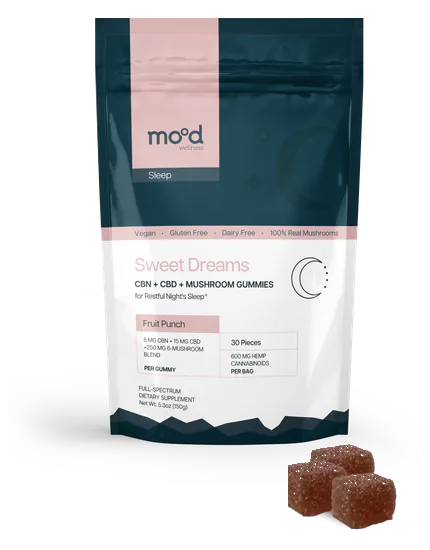
First describe what you see
Separate observations before deciding what they mean. A gummy can change in more than one way at once.
| Observation | What it looks or feels like | Useful context to record | Escalate when |
|---|---|---|---|
| Softened | Keeps a rough shape but compresses easily | Package temperature, delivery time, storage | Texture remains abnormal after return to labeled conditions |
| Fused | Two or more pieces adhere as a cluster | Heat exposure, pressure during shipping | Individual units can no longer be separated reliably |
| Sticky | Surface clings to fingers or package | Humidity, coating, open-package history | Stickiness is new, severe or paired with odor/color change |
| Surface moisture | Clear droplets or damp film | Condensation, humidity, temperature change | Moisture is unexplained, persistent or inside a damaged seal |
| Oily film | Slick residue rather than water-like droplets | Formula oils and coating | There is leakage, pooling or package failure |
| Collapsed or liquid | Shape is lost; material has pooled | Hot-car, mailbox or transit exposure | Serving units are no longer intact or traceable |
Do not use a photo from another brand as the baseline. Compare the package with its own product images, your earlier photographs, the maker's description and another intact package of the same formula and lot when available.
Why formulation matters
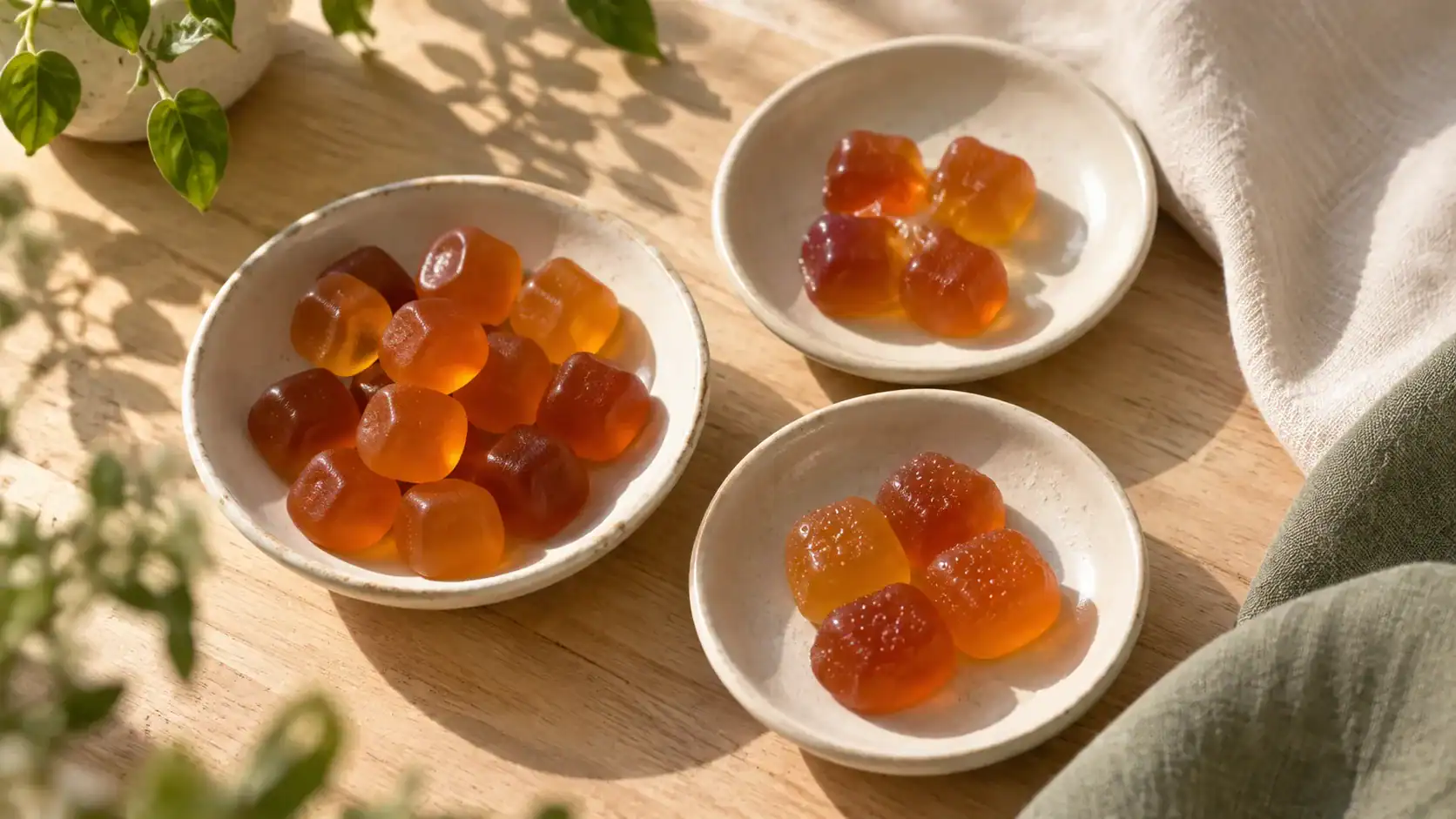
A gummy is a structured food matrix. Its behavior comes from the interaction of water, sweeteners, acids, flavors, oils, colors, coatings and a gelling or thickening system. Cannabinoids are only one part of that system.
Gelatin and pectin do not behave identically
Gelatin forms a thermoreversible network: warming can soften it and sufficient heat can disrupt its structure. A controlled confectionery study reported that commercial storage recommendations commonly fall around ordinary room conditions and noted that gelatin gummies often melt below 35°C (95°F). That observation explains why a warm vehicle can matter, but it is not a universal failure threshold for every finished product.
Pectin relies on a different network involving pectin type, acidity, soluble solids and, in some systems, calcium. It is often chosen for plant-based gummies. “Pectin” does not mean heat-proof, just as “gelatin” does not identify the exact temperature response of a branded gummy. Recipe, processing and package all matter.
Other hydrocolloids, including agar, starches and gums, may appear alone or in combination. Read the ingredient list rather than inferring the structure from whether a gummy is labeled vegan. For a broader field-by-field review, use the CBD gummy ingredient guide.
Sugars and humectants affect moisture movement
Sucrose, glucose syrup, tapioca syrup and other sweeteners do more than add sweetness. They influence solids, water binding, crystallization and texture. Some ingredients act as humectants, helping a formulation retain moisture. The balance can affect whether a gummy dries, hardens, becomes tacky or develops visible surface moisture.
Water activity is a laboratory property related to available water, not simply the amount of water listed in a recipe. Research on gelatin- and pectin-based confections shows that formulation and storage conditions can change water activity and texture. A consumer cannot determine water activity by touching a gummy or looking for droplets.
Oils and coatings can look like sweat
A surface film may be water, oil, dissolved sugar or a mixture. Some gummies use oils, waxes, starches or sugar coatings to reduce sticking or create a finish. Heat and pressure can make a coating uneven or make an oil more visible. Condensation can also form when a cool package meets warm, humid air.
The word “sweating” therefore does not identify the material. Do not lick or taste the surface to investigate it. Record whether the film looks watery or oily, whether it is inside or outside the sealed package, and whether the seal, seams or closure are intact.

Heat exposure versus humidity
Heat and humidity can occur together, but they create different questions.
Heat can soften the matrix
A delivery truck, porch, mailbox, car, luggage compartment or sunny counter can become much warmer than an air-conditioned room. The package may also be compressed while warm, causing pieces to fuse even if they never become liquid.
Record the facts you know: delivery timestamp, time outside, whether the carton was in direct sun, whether the pouch felt warm, and whether neighboring products were affected. Avoid inventing a peak temperature when no measurement exists.
Humidity can change the surface
After opening, repeated exposure to humid air can affect tackiness and coatings. Temperature transitions can also create condensation. A damp-looking surface is not automatically mold, but it is not proof of safety either.
Keep the package closed while you document the exterior and storage history. Opening, handling and transferring pieces can add new moisture or contamination and make the original condition harder to assess.
Pressure changes the outcome
Warm gummies may deform more readily under shipping weight. Pieces can flatten against a pouch or fuse where they touch. That physical event does not tell you whether the cannabinoid distribution remains uniform in the new mass. Once labeled units have lost their boundaries, per-gummy arithmetic may no longer be dependable.
What controlled research can and cannot show
Confectionery studies support several limited conclusions:
- storage temperature and formulation affect texture;
- gelling system, sugar profile and water content influence physical behavior;
- water activity helps describe moisture migration and microbial stability; and
- changes can continue during storage rather than occurring only at manufacture.
They do not prove that a particular CBD gummy is safe after a hot delivery. Most studies use laboratory recipes, controlled temperatures and measured instruments. They may not contain CBD, the same gelling system, the same package or the same shipping conditions as your product.
Do not import a study's exact temperature, water-activity value or storage duration as a pass/fail rule for a retail package. The manufacturer knows the intended formula, specifications, packaging and stability program for its product.
Appearance is not a potency test
A gummy that looks intact may still have an unknown storage history. A gummy that softened may still contain cannabinoids, but sight cannot quantify them. Melting or fusing also does not show whether cannabinoids remained evenly distributed among former serving units.
A certificate of analysis answers only the questions represented by its sample, lot, analytes, methods and dates. It does not recreate what happened to a consumer package after testing. Use the CBD COA guide and batch-number matching workflow to verify the document without treating it as a post-shipping inspection.
If several gummies have fused into one mass, do not estimate a serving by cutting equal-looking pieces. Visual area or weight alone does not prove uniform active distribution. The original label math assumes intact units. The separate CBD gummy potency guide explains those units when the product is undamaged.
Appearance is not a contamination screen
Clear droplets, stickiness or softening cannot identify bacteria, yeast, mold, chemical contamination or package migration. Likewise, the absence of visible growth is not a microbial result.
Stop and contact the manufacturer if you see:
- a broken seal, open seam, puncture or leaking closure;
- unexpected gas, swelling or pressure;
- fuzzy, stringy or foreign-looking material;
- a new fermented, rancid, solvent-like or otherwise disturbing odor;
- dramatic or unexplained color change;
- persistent liquid pooling;
- missing or unreadable lot/date information;
- evidence that children, pets or another person accessed the package; or
- symptoms after use.
For symptoms, seek appropriate medical or poison-control guidance. Do not continue tasting the product to characterize a reaction.
A practical documentation workflow
1. Keep the original container
Do not discard the pouch, jar, carton, insert or shipping materials until the concern is resolved. Packaging establishes identity, lot, dates, responsible party and the state of the seal.
2. Photograph before handling
Take unfiltered photographs in neutral indirect light. Capture the full package, closure, seams, date and lot areas, the product condition through any clear area, the shipping carton and any leakage. Do not expose private order details when sharing images publicly.
3. Record the exposure history
Write down purchase source, arrival time, time outdoors, known vehicle or mailbox exposure, room conditions, opening date and where the product was stored. Distinguish what you observed from what you infer.
4. Read the exact label
Check identity, ingredient list, serving size, pieces per package, storage directions, date marks, lot or batch code and responsible-party contact. The FDA dietary-supplement labeling guide identifies core label statements, but the presence of a Supplement Facts panel does not mean FDA approved the CBD product.
5. Contact the manufacturer
Send the product name, size, flavor/formula, purchase source, order information, lot/date marks, photographs and exposure timeline. Ask whether the appearance is expected, whether serving units remain reliable, and whether the company recommends replacement or disposal.
6. Preserve the answer
Keep the support response with your photographs. If the company cannot identify the product or lot, or cannot address the package condition, do not substitute social-media reassurance for product-specific guidance.
Why Do CBD Gummies Melt or Sweat Mistakes to Avoid
- Do not microwave, bake, boil or place the package in direct sun.
- Do not add water, sugar, oil, starch or another gummy product.
- Do not wash sticky gummies.
- Do not freeze a melted mass in a mold to recreate pieces.
- Do not cut fused gummies into guessed servings.
- Do not transfer the contents before recording the original package.
- Do not use smell, taste or a home moisture meter as a safety test.
- Do not assume a COA proves the condition after shipment.
These interventions change the evidence and can change the product. They may also create uneven pieces, new contamination opportunities and false confidence about serving size.
Should you refrigerate or freeze CBD gummies?
Follow the exact label and manufacturer, not a universal internet rule. Refrigeration can change texture and may create condensation when a package is repeatedly moved into humid room air. Freezing can alter some gel structures and does not reverse an unknown heat event.
If support recommends cooling an intact sealed package, follow its specific instructions and keep the package closed during the transition. If the label prohibits refrigeration, do not improvise. Cooling can firm a gummy physically without proving that potency, uniformity or microbiological condition remained acceptable.
Prevention belongs to the storage plan
Store gummies in their original closed package, out of prolonged direct light and heat, and where children and pets cannot reach them. Avoid cars, windowsills and other places with large temperature swings. Keep wet utensils and hands out of the package.
For general product-selection and storage context, use the CBD gummy buyer’s guide. This article addresses an observed melting or sweating event rather than predicting how long an unopened package lasts. For shelf life, expiry dates and signs of deterioration, see whether CBD gummies expire.
Checking a Mood gummy package
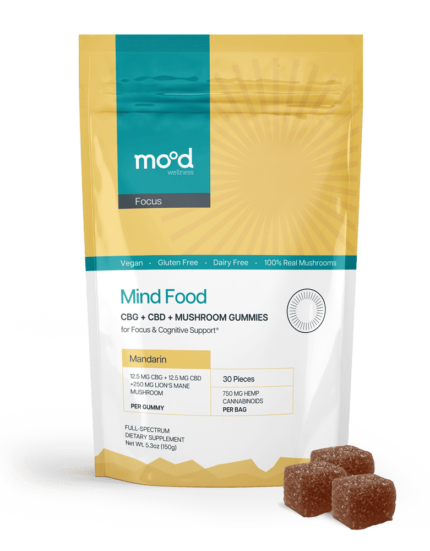
Mood's current gummy collection includes formulas with different cannabinoids, mushroom ingredients and flavors. Do not assume they share identical physical behavior. Start with the exact pouch in hand.
Check:
- full product and flavor name;
- ingredient list and gelling system;
- labeled serving and package count;
- lot or batch code and date marks;
- seal and seam condition;
- storage statement;
- purchase source and delivery history; and
- whether the pieces remain individually identifiable.
Use Mood's lab-results directory only when a report matches the product and lot. During our September 2026 review, several publicly linked Mood reports were older cannabinoid-potency documents; they did not establish the current condition of a differently stored package.
If replacement is appropriate, compare the current Mood CBD gummy collection by exact formula and label. A replacement package creates a new baseline; it does not prove the disposition of the heat-affected one.
CBD safety still matters
Physical condition is only one part of the decision. CBD may interact with medications and can carry other risks. Full-spectrum products may contain THC and may contribute to impairment or a positive drug test. Keep candy-like products securely away from children and pets.
Pregnancy, breastfeeding, significant liver disease, medication use, planned surgery, driving and safety-sensitive work warrant professional guidance. These questions cannot be answered by whether a gummy looks firm or sticky.
Bottom Line: Why Do CBD Gummies Melt or Sweat
CBD gummies may soften, fuse or develop a wet-looking surface because heat, humidity, pressure and formulation interact. Gel system, sugars, acids, oils, coatings and packaging all matter. There is no universal visual test or temperature rule that can clear every product.
Pause when a package changes unexpectedly. Keep it intact, photograph the condition, record the exposure history, verify the exact lot and ask the manufacturer what to do. Do not re-form, cut or taste-test questionable gummies. Appearance can document a problem; it cannot certify potency, uniformity, contamination status or safety.
Quick answers
Frequently asked questions about Why Do CBD Gummies Melt or Sweat? A Practical Troubleshooting Guide
What is the practical answer about Why Do CBD Gummies Melt or Sweat? A Practical Troubleshooting Guide?
CBD gummies may soften, fuse or develop a wet-looking surface because heat, humidity, pressure and formulation interact. Gel system, sugars, acids, oils, coatings and packaging all matter. There is no universal visual test or temperature rule that can clear every product. Pause when a package changes unexpectedly.
Which Mood product fits this topic?
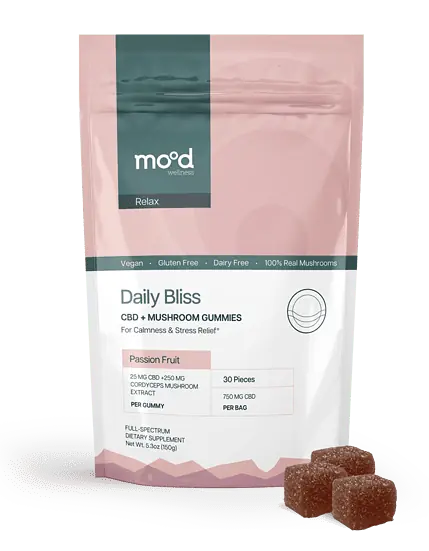
Daily Bliss is the most relevant Mood option for this topic. Mood Daily Bliss offers a premeasured CBD gummy with functional mushrooms for shoppers who prefer a convenient, positive daily wellness routine.
What should I compare before choosing a gummy?
Compare the cannabinoid amount per measured serving, the complete ingredient list, spectrum or THC information, current product directions and available batch documentation. The best choice is the formula that fits the goal and is easy to use consistently.
How should I start using a new CBD or cannabinoid product?
Follow the current package directions, choose a low-demand first-use window and keep timing and meal context reasonably consistent. Review medication, pregnancy, liver and impairment considerations with a qualified clinician when relevant.
Sources
- Tireki S, et al. “Correlation between physical and sensorial properties of gummy confections with different formulations during storage.” PMCID: PMC8292526.
- Cebin AV, et al. “Physicochemical and Sensory Stability Evaluation of Gummy Candies Fortified with Mountain Germander Extract and Prebiotics.” PMCID: PMC10818720.
- “Sugar-Free, Vegan, Furcellaran Gummy Jellies with Plant-Based Triple-Layer Films.” PMCID: PMC10573701.
- “Development of healthier gummy candy by substituting glucose syrup with various fruit juice concentrates.” PMCID: PMC11521684.
- U.S. Food and Drug Administration. Dietary Supplement Labeling Guide and consumer information on cannabis-derived compounds including CBD. Accessed September 9, 2026.
- U.S. Food and Drug Administration. What the FDA is Doing to Protect Consumers from Cannabidiol (CBD) in Foods. Accessed September 2026.