

The label fields that answer different questions
| Field | What it tells you | Frequent error |
|---|---|---|
| CBD per gummy | Unit potency | Reading a package total as one gummy |
| Gummies per serving | Label-defined serving size | Assuming every serving is one piece |
| CBD per serving | CBD in the complete labeled serving | Comparing it with another product's per-gummy number |
| Gummies per container | Piece count | Treating count as potency |
| Total CBD in package | Sum of labeled CBD across all pieces | Treating it as serving amount |
| Other cannabinoids | CBG, CBN or THC quantities | Folding them into “CBD potency” |
| Other actives | Mushrooms, melatonin or botanicals | Ignoring how they scale with two pieces |
The front, Supplement Facts panel and directions should reconcile. If they do not, pause and verify the physical package with the manufacturer.
Three ways gummy potency is displayed
Per-gummy labeling
This is the easiest format: “25 mg CBD per gummy.” If the labeled serving is one gummy, unit and serving potency are the same. If directions describe two gummies, the two-gummy arithmetic is 50 mg CBD.
Per-serving labeling
The Supplement Facts panel may state 50 mg CBD per serving while defining a serving as two gummies. Divide by two to compare with a one-piece product.
Package-total labeling
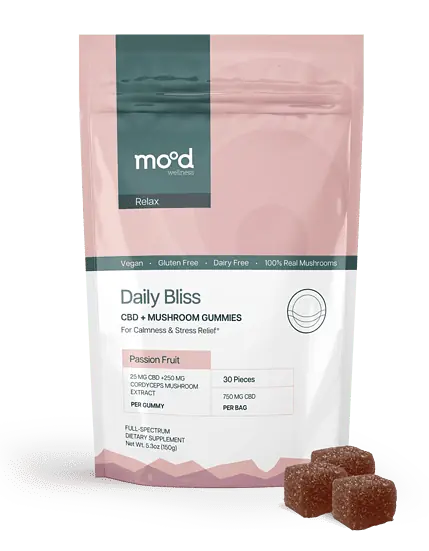
A pouch may feature “750 mg CBD” while containing 30 gummies. If the total applies only to CBD:
750 mg ÷ 30 = 25 mg CBD per gummy
Confirm that the large number is CBD, not hemp extract, total cannabinoids or a multi-ingredient blend.
A normalized comparison example
Imagine three 30-count products:
| Product | Front-panel statement | Serving | CBD per gummy | CBD per serving |
|---|---|---|---|---|
| A | 750 mg CBD per package | 1 gummy | 25 mg | 25 mg |
| B | 50 mg CBD per serving | 2 gummies | 25 mg | 50 mg |
| C | 450 mg CBD per package | 1 gummy | 15 mg | 15 mg |
Products A and B have the same unit potency but different labeled serving totals. Product C has a lower unit potency. The table does not establish which product is more effective or appropriate.
If a label uses an approximate count, do not assume an exact package total from multiplication. Use the manufacturer's explicit total or treat the calculation as an estimate.
Current Mood gummy examples
Mood’s current gummy category contains three formulas with different cannabinoids and other actives.
| Product | Current per-gummy page statement | One-gummy arithmetic | Two-gummy arithmetic |
|---|---|---|---|
| Daily Bliss | 25 mg CBD + 250 mg Cordyceps extract | 25 mg CBD | 50 mg CBD |
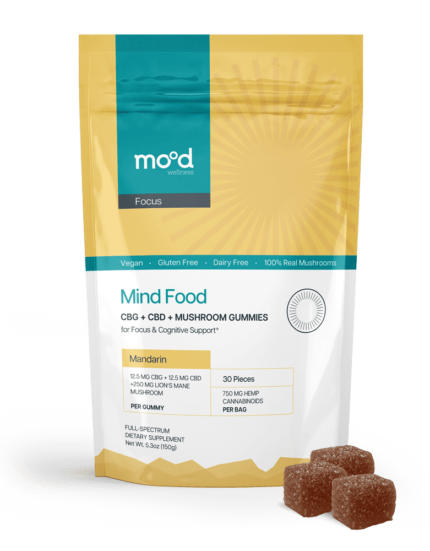
| Mind Food | 12.5 mg CBD + 12.5 mg CBG + 250 mg Lion’s Mane extract | 12.5 mg CBD + 12.5 mg CBG | 25 mg CBD + 25 mg CBG |
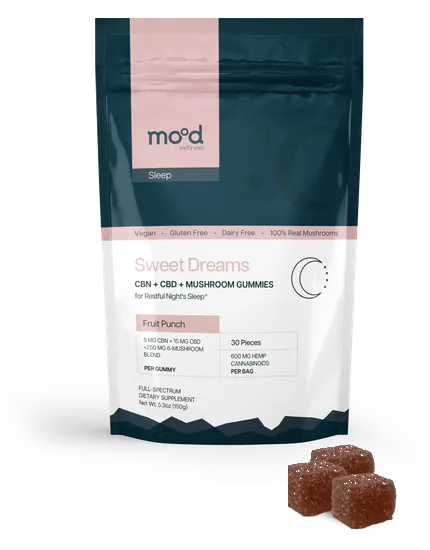
| Sweet Dreams | 15 mg CBD + 5 mg CBN + six mushroom extracts | 15 mg CBD + 5 mg CBN | 30 mg CBD + 10 mg CBN |
The two-gummy column is arithmetic, not a universal direction. Check the current page and physical package. Sweet Dreams currently instructs shoppers to start with one gummy and, if needed and well tolerated, increase to two on a subsequent night. Daily Bliss and Mind Food have their own directions and timing context.
These formulas also show why a single “potency” ranking is weak. Daily Bliss has more CBD per gummy than Mind Food, but Mind Food adds an equal labeled amount of CBG. Sweet Dreams contains less CBD than Daily Bliss and adds CBN plus an undisclosed-by-weight six-mushroom blend. Those are different formulas, not rungs on one simple ladder.
Explore the exact options in the current CBD gummies collection rather than relying on a category card alone.
Keep every cannabinoid in its own column
Suppose a gummy contains 12.5 mg CBD and 12.5 mg CBG. It contains 25 mg of those two named cannabinoids combined, but it is not a “25 mg CBD gummy.” The accurate descriptions are:
- 12.5 mg CBD per gummy;
- 12.5 mg CBG per gummy; and
- 25 mg combined CBD + CBG per gummy.
The same rule applies to 15 mg CBD + 5 mg CBN. Calling it a 20 mg CBD gummy would misstate the formula.
Ratios are also incomplete without amounts. A 1:1 gummy could contain 5 mg + 5 mg or 25 mg + 25 mg. Both have the same ratio and very different unit potency.
THC potency is a separate safety field
“Full spectrum” and “less than 0.3% THC” do not mean THC-free. The federal hemp concentration threshold is not a per-gummy disclosure and does not guarantee a negative drug test.
Record:
- delta-9 THC per gummy;
- delta-9 THC per full serving;
- other THC analytes if reported;
- reporting units and detection limits; and
- package lot and certificate match.
When a two-gummy serving doubles CBD, it generally doubles the labeled THC and other uniformly distributed cannabinoids too. Do not discuss only the desired cannabinoid while omitting the rest of the serving.
Other active ingredients scale too
Daily Bliss currently states 250 mg Cordyceps fruiting-body extract per gummy. Two gummies therefore imply 500 mg labeled extract. Mind Food similarly states 250 mg Lion’s Mane extract per gummy, implying 500 mg across two.
Sweet Dreams names six mushroom extracts, but the visible page reviewed does not state their combined weight or individual amounts. Multiplication cannot recover a missing starting value. It is valid to say two gummies contain twice the unspecified blend used in one gummy; it is not valid to invent milligrams for the blend or divide it equally among six species.
Other gummies may add melatonin, caffeine, botanicals, vitamins or sugar alcohols. Normalize every active and relevant excipient for the complete serving, not CBD alone.
Can you split a gummy for lower potency?
Cutting one gummy in half creates half the physical piece, but it does not automatically prove half the CBD. That inference assumes uniform distribution throughout the finished gummy and an accurate cut.
Manufacturing validation may support content uniformity across whole units without validating split portions. Gummies can also deform, stick or crumble, making division imprecise. If smaller increments matter, choose a product with a lower whole-unit potency or another format with appropriately marked measurement rather than assuming a knife creates a validated dose.
Keep cannabinoid products away from children and pets; candy-like appearance increases accidental-use risk.

Label potency versus tested potency
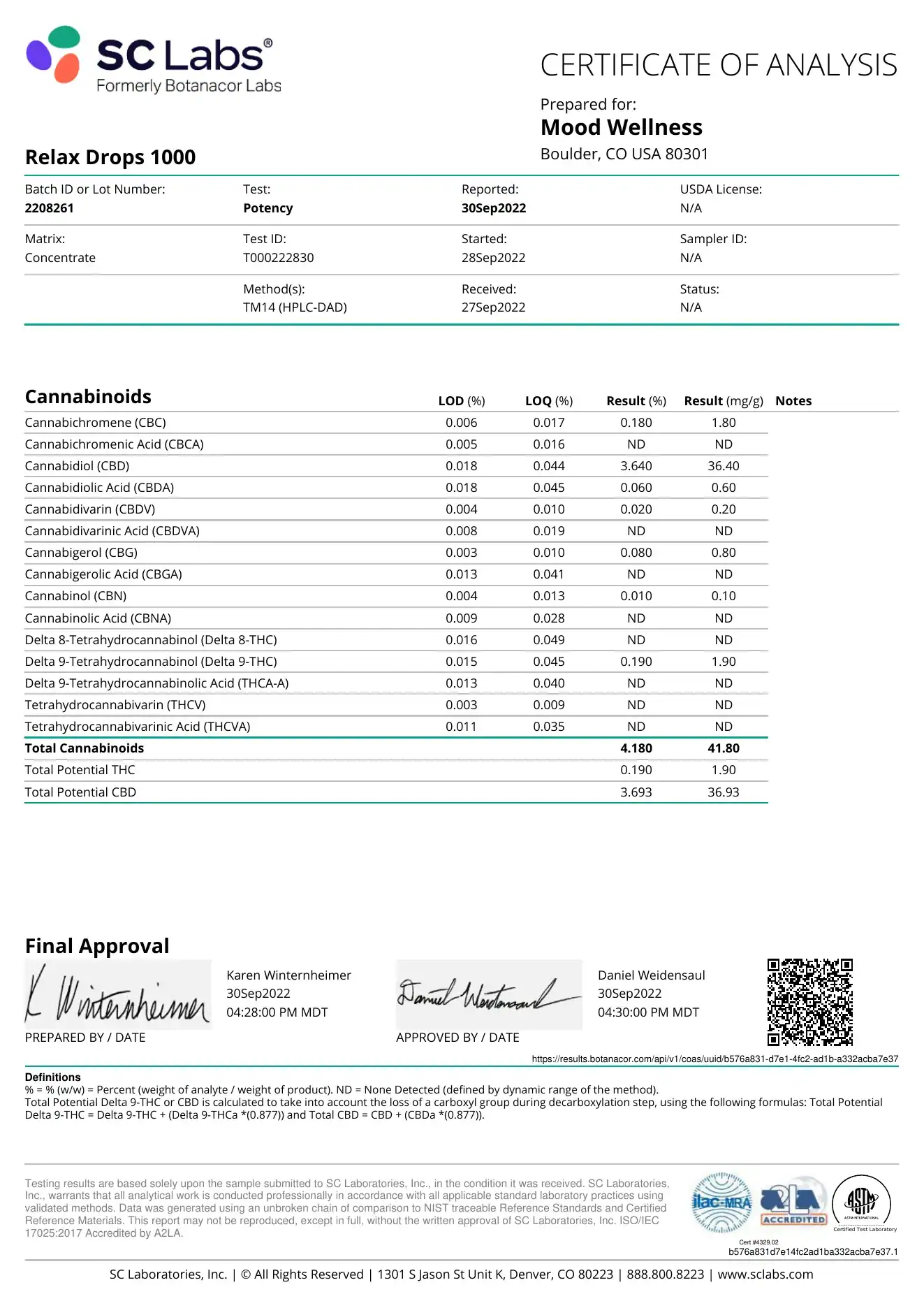
The label is a claim. A certificate of analysis reports results for a submitted sample. To compare them responsibly, confirm:
- product name and flavor;
- exact lot or batch;
- report date;
- finished-gummy sample rather than raw extract;
- result per unit, serving, gram or package;
- cannabinoid definitions and reporting limits; and
- whether the tested unit weight matches the product.
If a report gives mg/g and the gummy weight is verified, conversion may be possible. Do not assume all gummies weigh the same or treat mg/g as mg per gummy.
Mood’s lab-results page links reports for its gummy formulas. The public gummy reports sampled during this editorial project were historical cannabinoid-potency snapshots. They do not by themselves prove the composition of a current lot or comprehensive contaminant testing.
Use the CBD COA guide before converting report units.
Potency is not felt intensity
Milligrams are a label quantity. Subjective intensity can vary with the complete formula, food, digestion, prior exposure, timing and individual factors. A 50 mg serving is twice the labeled CBD of a 25 mg serving, but that arithmetic does not guarantee twice the effect.
Nor does higher CBD potency prove faster onset. Gummies are swallowed and must pass through digestion. The separate CBD gummy onset guide explains why reassessment timing matters.
Avoid rapid redosing because an initial gummy does not produce an immediate sensation. Track the exact product, amount, time, food context and next-day alertness rather than converting one experience into a universal rule.
Safety and interaction boundaries
FDA warns that CBD can affect medications, alertness and liver safety. Combining CBD with alcohol or drugs that slow brain activity can increase sedation and drowsiness. Consumer CBD products do not inherit the approval of the one prescription CBD drug authorized for specific seizure disorders.
Consult a clinician or pharmacist before use if you take medication, have liver concerns, are pregnant or breastfeeding, are preparing for surgery or have other relevant conditions. Review added mushrooms, botanicals, melatonin or other actives separately for allergies and interactions.
Do not drive until you know how the complete formula affects you. If avoiding THC is essential, a full-spectrum statement is a reason to inspect the batch result, not reassurance that the product is THC-free.
A gummy-potency comparison worksheet
| Field | Product A | Product B |
|---|---|---|
| Exact product and flavor | ||
| Gummies per container | ||
| Gummies per serving | ||
| CBD per gummy | ||
| CBD per serving | ||
| CBG per gummy/serving | ||
| CBN per gummy/serving | ||
| THC per gummy/serving | ||
| Other actives per gummy/serving | ||
| Sugar and allergens | ||
| Lot-matched report found? |
Resolve every blank that affects the decision. If a value is not disclosed, label it unknown rather than estimating it.
Keep package versions separate
Brands can sell the same product name in different strengths, counts or regional formulas. Save the exact package image, serving size and lot before calculating. Do not carry a per-gummy result from one count or strength into another variant merely because the flavor and front design look similar. Recalculate after a reformulation or package change.
Bottom Line: CBD Gummy Potency
CBD gummy potency is most useful when it is stated per gummy and per complete labeled serving. Divide serving totals by pieces per serving, or divide package totals by the verified count. Keep CBD, CBG, CBN, THC and other actives in separate columns.
Then verify the arithmetic against the physical label and a lot-matched report. Higher milligrams do not prove better quality or a stronger clinical result, and cutting a gummy does not guarantee an even fraction. The best comparison is transparent, unit-normalized and complete.
Quick answers
Frequently asked questions about How to Compare CBD Gummy Potency per Serving
What is the practical answer about How to Compare CBD Gummy Potency per Serving?
CBD gummy potency is most useful when it is stated per gummy and per complete labeled serving. Divide serving totals by pieces per serving, or divide package totals by the verified count. Keep CBD, CBG, CBN, THC and other actives in separate columns. Then verify the arithmetic against the physical label and a lot-matched report.
Which Mood product fits this topic?
Daily Bliss is the most relevant Mood option for this topic. Mood Daily Bliss offers a premeasured CBD gummy with functional mushrooms for shoppers who prefer a convenient, positive daily wellness routine.
What should I compare before choosing a gummy?
Compare the cannabinoid amount per measured serving, the complete ingredient list, spectrum or THC information, current product directions and available batch documentation. The best choice is the formula that fits the goal and is easy to use consistently.
How should I start using a new CBD or cannabinoid product?
Follow the current package directions, choose a low-demand first-use window and keep timing and meal context reasonably consistent. Review medication, pregnancy, liver and impairment considerations with a qualified clinician when relevant.
Sources
- U.S. Food and Drug Administration. Consumer guidance on CBD safety and product uncertainty. Accessed September 9, 2026.
- Mood Wellness. Daily Bliss, Mind Food and Sweet Dreams product pages. Checked September 9, 2026.
- Mood Wellness. CBD Gummies category and Lab Results pages. Checked September 9, 2026.
- U.S. Food and Drug Administration. What the FDA is Doing to Protect Consumers from Cannabidiol (CBD) in Foods. Accessed September 2026.