What full spectrum does and does not mean
“Full spectrum” generally signals that a hemp extract retains multiple cannabinoids and other plant constituents rather than isolating CBD alone. It can include delta-9 THC.
The term does not specify:
- exact THC per gummy;
- which THC analytes were tested;
- whether THC was detected in the current batch;
- whether a person will feel an effect;
- whether the product is lawful in a particular state;
- whether it complies with a future federal standard; or
- whether it can trigger a drug test.
Those questions require different evidence. The existing full-spectrum, broad-spectrum and isolate guide owns the broader format comparison; this guide stays with THC math.

The four THC fields to separate
| Field | What it represents | Common mistake |
|---|---|---|
| Delta-9 THC | The neutral delta-9 compound measured by the method | Treating it as the same as all tetrahydrocannabinols |
| THCA | Acidic precursor that can convert partly to delta-9 THC with decarboxylation | Adding all THCA without the conversion factor |
| Total THC | Usually delta-9 THC + 0.877 × THCA, when that convention applies | Recalculating and then adding the lab's total again |
| Other THC isomers | Delta-8, delta-10 or other separately measured compounds | Assuming a delta-9 line covers every isomer |
Read the report's definitions and method notes. “Total THC” can have a specific laboratory or legal meaning; do not infer it from the page layout alone.
Why the 0.877 factor appears
Heating THCA removes part of the molecule as carbon dioxide. The molecular-weight adjustment commonly used to estimate potential delta-9 THC is 0.877.
When required by the method or rule:
Total THC = delta-9 THC + (THCA × 0.877)
Example using hypothetical concentrations:
- delta-9 THC: 0.10 mg/g
- THCA: 0.20 mg/g
- converted THCA: 0.20 × 0.877 = 0.1754 mg/g
- total THC: 0.10 + 0.1754 = 0.2754 mg/g
This example teaches arithmetic only. It is not a real product result.
If a COA already reports Total THC calculated from the same analytes, use that field and verify the formula in the footnote. Do not add delta-9 and THCA to the pre-calculated total.

Read the units before calculating
The same concentration can be displayed in different units.
Percent by weight
For % w/w:
mg per g = percent × 10
Therefore 0.03% w/w equals 0.3 mg/g. This conversion works because 1% of one gram is 0.01 gram, or 10 milligrams.
Milligrams per gram
mg/g is a concentration. It is not yet the amount in one gummy. You need the mass of the gummy in grams.
Milligrams per unit
mg/unit or mg/piece can answer the shopper's question directly when the sample, unit definition and product match. Check whether the value is measured or calculated.
Milligrams per serving
A serving may contain more than one gummy. Divide by the number of gummies only if pieces are intended to be uniform and the value covers that exact serving.
Milligrams per package
A package total does not reveal piece-level variation. Divide only when the product count and basis are clear.
Convert percent to mg per gummy
Suppose a hypothetical report gives delta-9 THC as 0.02% w/w and the tested gummy mass is 4.5 g.
First convert percent to mg/g:
0.02 × 10 = 0.2 mg/g
Then multiply by gummy mass:
0.2 mg/g × 4.5 g = 0.9 mg per gummy
The result depends on the 4.5 g mass. If that mass came from a different flavor, package or average serving, the answer is not exact for the gummy in hand.
Do not use package net weight divided by count without labeling the result as an average. Coatings, moisture and manufacturing tolerances can produce piece-to-piece variation.
Convert mg/g to mg per gummy
When the lab gives 0.12 mg/g total THC and the gummy mass is 5 g:
0.12 mg/g × 5 g = 0.6 mg per gummy
For two gummies:
0.6 mg × 2 = 1.2 mg per serving
For a 30-count package:
0.6 mg × 30 = 18 mg per package
Each step assumes uniform concentration and an appropriate mass basis. Preserve more precision during calculation, then round once at the end to match the quality of the inputs.
Use mg/unit when available
A finished-product report that states THC per unit can reduce conversion uncertainty. Verify:
- “unit” means one gummy, not one serving;
- the product and flavor match;
- the report is for the finished product;
- the lot matches the package;
- the value corresponds to delta-9 or total THC as intended; and
- the result is not merely a copied label claim.
An ingredient-extract report cannot automatically be converted to the finished gummy without the manufacturing formula and mass balance.
ND is not zero
ND usually means not detected under the laboratory's method and decision rule. It does not prove that no molecule is present.
Look for:
- LOD, the limit of detection;
- LOQ, the limit of quantitation;
- reporting limit;
- result qualifier; and
- units for each threshold.
If delta-9 THC is shown as <0.01 mg/g, the result is bounded below that reporting value; it is not established as exactly 0.00 mg/g.
Do not replace ND with zero in package-total math unless the report explicitly defines that substitution for the intended purpose. For conservative screening, preserve the limit and describe the range.
A bounded <LOQ example
Assume a report lists delta-9 THC as <0.05 mg/g and a gummy weighs 4 g.
The corresponding upper reporting bound is:
0.05 mg/g × 4 g = 0.2 mg per gummy
The defensible wording is “below a reporting bound corresponding to 0.2 mg per gummy,” not “contains 0.2 mg” and not “THC-free.” The true result may be lower.
If THCA has its own bound, total-THC bounding becomes more complex. Apply the stated formula and preserve the less-than signs rather than creating false certainty.
Current federal definition: dated, not permanent
As of September 9, 2026, the operative text of 7 U.S.C. §1639o defines hemp as Cannabis sativa L. and its parts and derivatives with a delta-9 THC concentration of no more than 0.3% on a dry-weight basis.
That sentence is frequently misused. It does not say:
- every compliant serving is non-intoxicating;
- 0.3% is safe for every person;
- all states permit the product;
- food containing CBD is generally FDA-approved;
- THC below that concentration cannot accumulate across pieces; or
- a drug test will be negative.
The dry-weight denominator can make a percentage look small while a heavy edible contains a measurable milligram amount. That is why percentage-to-unit conversion matters.
A federal change is scheduled for November 12, 2026
Public Law 119-37, enacted November 12, 2025, includes a delayed amendment scheduled to take effect 365 days after enactment. The future definition materially changes how total tetrahydrocannabinols and final hemp-derived cannabinoid products are treated, including a per-container quantifiable-THC concept.
This article is not predicting whether Congress will amend, delay or replace that provision before its effective date. The only responsible action is to recheck the enrolled law, current U.S. Code and implementing guidance immediately before publication or sale.
A gummy that fits the operative September definition may not fit the scheduled future definition. A COA conversion is not a legal opinion.
USDA total THC is not finished-gummy approval
USDA's domestic hemp production program requires crop testing that considers THCA's potential conversion, commonly using delta-9 THC + 0.877 × THCA.
That framework is relevant for understanding the chemistry and crop compliance. It does not mean USDA approves a finished CBD gummy as food, validates its label or authorizes sale in every state.
FDA separately states that CBD and THC raise food and drug regulatory issues. Keep agency roles distinct.
State law can be stricter or different
States can impose product registration, age limits, serving caps, package caps, labeling requirements or bans that differ from the federal hemp definition. Shipping rules may also differ from possession or retail rules.
Before purchase:
- check the law of the delivery state;
- check local restrictions when relevant;
- confirm the product category and THC type;
- use current government sources; and
- do not rely solely on a retailer's shipping checkout.
Because law changes quickly, this guide does not maintain a 50-state legal table.
THC amount does not predict one universal effect
The same labeled or measured THC amount can affect people differently. Relevant variables include prior exposure, body composition, food, other substances, medications, product variability and individual sensitivity.
Do not convert a COA result into promises such as “no high,” “non-psychoactive” or “safe to drive.” Full-spectrum CBD products may produce impairment or unwanted effects in sensitive users.
Avoid driving or operating machinery after use until you understand how the exact product affects you. Never use arithmetic to justify combining THC-containing products with alcohol or sedatives.
Drug-test risk cannot be calculated away
Workplace and clinical drug tests differ by specimen, analyte, cutoff, timing and confirmation method. Repeated exposure to trace THC may matter.
A full-spectrum label or a COA below a legal concentration does not guarantee a negative result. ND on one report also does not establish zero exposure across every batch or serving.
If testing consequences matter, the lowest-risk choice may be avoiding cannabinoid products. Broad-spectrum and isolate labels also require verification and do not create an absolute guarantee.

Current Mood gummy evidence
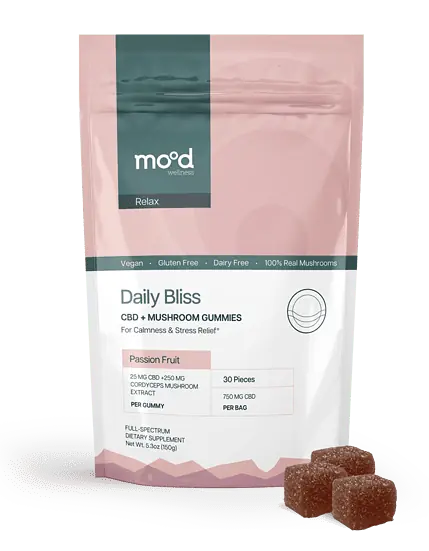
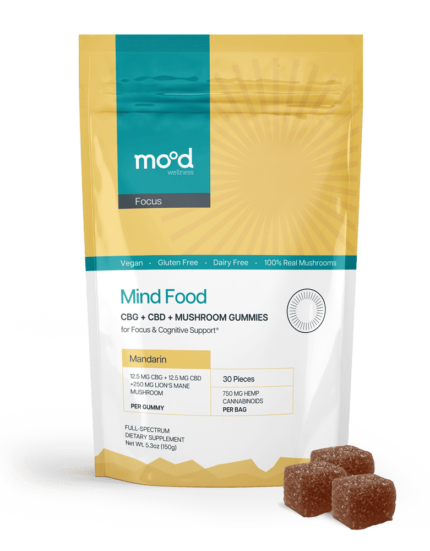
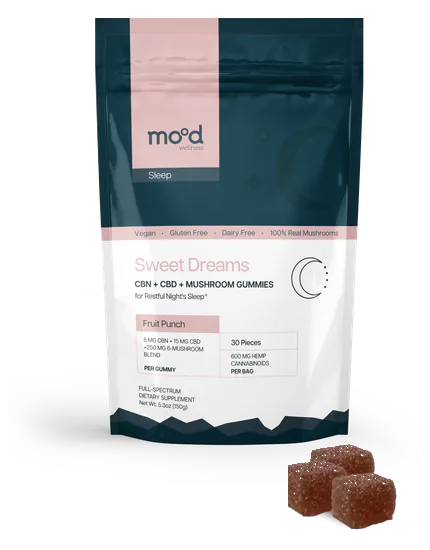
Mood's current Daily Bliss, Mind Food and Sweet Dreams pages describe the gummies as full spectrum and use “less than 0.3% THC” language.
That wording does not supply exact THC milligrams per gummy. The shopper must open the report linked to the exact product and batch, then inspect the THC analytes, units and reporting limits.
Mood's sampled public gummy reports reviewed earlier in this project were older potency documents. They should not be represented as the latest batch without an exact lot match. Product-page “no high” language is seller positioning and is not accepted here as a universal outcome.
Start at Mood's lab results directory, then follow the batch-number matching workflow.
THC worksheet
| Field | Evidence |
|---|---|
| Exact product and flavor | |
| Package lot/batch | |
| Report ID and date | |
| Finished product or ingredient | |
| Gummy mass in grams | |
| Delta-9 THC result and units | |
| THCA result and units | |
| Total THC supplied by lab | |
| LOD/LOQ/reporting limit | |
| Converted mg per gummy | |
| Gummies per serving | |
| Converted mg per serving | |
| Count per package | |
| State-law check date | |
| Federal-law check date | |
| Drug-test or impairment constraint |
Use the CBD COA reading guide for the wider report and the potency-variance guide for label-to-lab differences.
Safety Boundaries for Full-spectrum CBD Gummy THC Math
FDA warns that CBD can interact with medications, affect the liver and increase sedation with alcohol or other substances that slow brain activity. THC adds impairment and psychoactive risk. FDA advises against CBD during pregnancy and breastfeeding.
Consult a clinician or pharmacist if you take medication, have liver disease, are preparing for surgery or have another relevant condition. Keep gummies locked away from children and pets.
If someone has severe confusion, trouble breathing, loss of consciousness or another urgent reaction, seek emergency or poison-control guidance rather than relying on a COA calculator.

Bottom Line: Full-spectrum CBD Gummy THC Math
To calculate THC in a full-spectrum CBD gummy, match the exact lot, identify the analyte and units, and use either a valid mg/unit result or concentration multiplied by the gummy's mass. Convert % w/w to mg/g by multiplying by 10. When appropriate, total THC is delta-9 THC + 0.877 × THCA, but never double-count a lab's pre-calculated total.
ND is not zero, 0.3% is not a serving-safety limit, and legal hemp status does not guarantee no impairment or a negative drug test. Date every legal statement and recheck federal law before November 12, 2026 and immediately before publication.
Quick answers
Frequently asked questions about Full-Spectrum CBD Gummy THC Math
What is the practical answer about Full-Spectrum CBD Gummy THC Math?
To calculate THC in a full-spectrum CBD gummy, match the exact lot, identify the analyte and units, and use either a valid mg/unit result or concentration multiplied by the gummy's mass. Convert % w/w to mg/g by multiplying by 10. When appropriate, total THC is delta-9 THC + 0.
Which Mood product fits this topic?
Daily Bliss is the most relevant Mood option for this topic. Mood Daily Bliss offers a premeasured CBD gummy with functional mushrooms for shoppers who prefer a convenient, positive daily wellness routine.
What should I compare before choosing a gummy?
Compare the cannabinoid amount per measured serving, the complete ingredient list, spectrum or THC information, current product directions and available batch documentation. The best choice is the formula that fits the goal and is easy to use consistently.
How should I start using a new CBD or cannabinoid product?
Follow the current package directions, choose a low-demand first-use window and keep timing and meal context reasonably consistent. Review medication, pregnancy, liver and impairment considerations with a qualified clinician when relevant.
Sources
- United States Code, 7 U.S.C. §1639o. Text in effect August 1, 2026; future amendment note.
- Public Law 119-37, §781. Enacted November 12, 2025.
- Congressional Research Service. Change to Federal Definition of Hemp and Implications. IF13136. December 18, 2025.
- U.S. Department of Agriculture, Agricultural Marketing Service. Hemp FAQ and Laboratory Testing Guidelines.
- U.S. Food and Drug Administration. Regulation of Cannabis and Cannabis-Derived Products, Including CBD.
- Mood Wellness. Gummy product and Lab Results pages. Checked September 9, 2026.
- U.S. Food and Drug Administration. What the FDA is Doing to Protect Consumers from Cannabidiol (CBD) in Foods. Accessed September 2026.