
Physical halves and verified half-servings are different
A gummy is a food matrix, not a measuring instrument. It contains water, sweeteners, acids, flavors, colors, oils, a gelling system and active ingredients. Manufacturers mix, deposit, set, coat and package that matrix under their own process controls.
Even if the batch is well made, a consumer cut introduces new variation:
- the cut may miss the geometric center;
- one side may compress or stretch;
- coating and surface ingredients may not divide evenly;
- crumbs or sticky material can remain on the knife or board;
- irregular shapes are difficult to bisect by sight; and
- a soft or damaged gummy may deform instead of separating cleanly.
That is why “half the shape” and “half the labeled amount” are not interchangeable claims.
Start with the intact-unit label math
First identify whether the label reports cannabinoids per gummy or per serving. A serving can contain one gummy, two gummies or another count. Keep each active in its own column.
| Label field | What it tells you | What it does not tell you |
|---|---|---|
| CBD per gummy | Whole-unit CBD statement | Exact CBD in an untested cut piece |
| Gummies per serving | Number of intact units in the labeled serving | Whether halves were evaluated as serving units |
| CBD per serving | CBD across the labeled serving | Distribution within each gummy |
| CBG, CBN or THC | Separate cannabinoid amounts | Permission to combine them into “total CBD” |
| Mushroom or other active | Additional formula component | Equal distribution after a consumer cut |
| Package count | Number of whole pieces | Number of verified half-servings |
For a whole gummy labeled with amount (A), the arithmetic estimate for an ideal half is (A ÷ 2). That calculation is mathematically simple. The unproven step is assuming the physical half contains exactly that result.
The CBD gummy potency guide explains intact-unit calculations in detail. Use those values as label statements, not as laboratory measurements of a piece cut at home.
Equal-looking does not mean equal mass
Human vision is poor at judging small differences in irregular, curved objects. Gummies may have domes, tapered edges, embossed surfaces or rounded bases. A center line viewed from above may not divide the three-dimensional mass equally.
A kitchen scale can reveal that two pieces differ in total mass, but equal mass still does not prove equal active content. The coating, sugar, gel and cannabinoids may not all be distributed in identical patterns. A scale also has resolution and calibration limits, especially with small pieces.
Weight is therefore a useful illustration of cutting variation, not a substitute for manufacturer validation.

How active distribution is established
Content uniformity is a production and testing question. A manufacturer can control mixing time, temperature, viscosity, holding conditions, depositing, piece weight and sampling. A laboratory can then measure relevant units or portions using defined methods.
One recent research project developing vitamin C gummies assessed homogeneity through weight variation. That illustrates a broader principle: uniformity is evaluated with a specified method rather than declared from appearance. It does not prove that weight alone is sufficient for CBD gummies, and it does not validate cutting any retail product.
Commercial CBD research has also found label-accuracy problems across sampled US products, including gummies. Those market-level findings support careful product and lot verification. They do not identify Mood products, prove where material sits inside one gummy or show that a cut half contains a specific amount.
A tablet-splitting analogy, with an important limit
The FDA has detailed guidance for splitting certain approved drug tablets. When a tablet is evaluated for splitting, labeling, a functional score and data for split portions can matter. FDA consumer guidance warns that an unapproved split may not yield halves equal in weight or drug content.
That framework applies to drug tablets, not CBD gummies. Gummies are not scored tablets, and the existence of a visual center line or decorative groove is not evidence of FDA-reviewed splitability. The useful analogy is the evidence standard: if divided portions are intended as doses, equality and stability should be demonstrated rather than assumed.
Do not call a gummy “scored” unless the manufacturer identifies the mark as a functional dividing feature and supports that use. A mold seam, logo groove or decorative indentation may have no serving function.
Formulation and coating complicate the cut
Gel system and texture
Pectin, gelatin, agar, starches and gums create different textures. Firmness also changes with water, acids, sweeteners, storage and temperature. A firm square may accept a clean cut; a soft dome may compress or tear.
The ingredient list can identify the gelling system but cannot prove split-portion uniformity. Use the broader CBD gummy ingredient guide to interpret the complete formula.
Coatings and surface ingredients
Sugar, acids, oils, waxes and starches may be applied to the exterior. Cutting exposes an uncoated interior and may move or shed surface material. If an active ingredient is applied partly as a coating rather than mixed through the center, distribution questions become even more important.
Do not infer manufacturing method from appearance. Ask whether all cannabinoids and added actives are incorporated uniformly in the gummy matrix and whether the product is tested at the whole-unit or divided-unit level.
Multiple active ingredients
A CBD gummy may also contain THC, CBG, CBN, melatonin, mushroom extracts, vitamins or botanicals. Dividing the listed CBD number does not establish equal division of every other component.
Keep each active separate. A manufacturer may have evidence for whole-piece weight and cannabinoid potency without evidence that every added ingredient is uniform in a home-cut portion.

Knife, splitter or hand tearing?
No tool can create evidence that the product lacks. A sharp, clean knife may make a straighter physical cut than tearing by hand, but it does not verify distribution. A tablet splitter is designed around certain tablet shapes and can crush or squeeze a soft gummy. Scissors can compress sticky material and retain residue along the blades.
If the manufacturer expressly permits cutting, follow its method and hygiene instructions. Use a clean food-contact surface and handle the product with clean, dry hands. Cut one unit at a time. Account for visible material left on the tool or board rather than pretending there was no loss.
If the manufacturer does not support splitting, choosing a lower-strength intact product is the more defensible measurement strategy.
Crumbs, smearing and unequal pieces
A cut that creates crumbs, strings, smearing or visibly different pieces has added uncertainty. Do not scrape residue from multiple gummies into a new serving, roll fragments into a ball or combine remnants from different lots.
The freshly exposed interior can also be more vulnerable to moisture and handling than the original surface. A clean-looking interior is not a safety test, and a few coating grains do not tell you which active ingredients were lost.
Never split a melted or damaged gummy
Do not use cutting to rescue gummies that arrived fused, collapsed, leaking, unusually wet or otherwise altered. In a fused mass, original serving boundaries may be lost. Heat and pressure history may be unknown, and cutting equal-looking blocks cannot reconstruct the labeled units.
Use the dedicated CBD gummy melting guide for the documentation and manufacturer-contact workflow. Preserve the package, seal, lot and photographs before manipulating the contents.
Stop if there is package damage, foreign material, unexpected odor, dramatic color change, gas, leakage or symptoms after use. Contact the manufacturer and seek medical or poison-control guidance when appropriate.
What about storing the other half?
The original package was designed around an intact product. A cut surface may stick, dry, absorb moisture or contact the pouch and other pieces. Do not assume the remainder has the same stability as an unopened whole gummy.
Ask the manufacturer:
- whether a cut remainder may be stored;
- which container and conditions to use;
- how long the remainder may be held;
- whether it should remain in the original package;
- whether refrigeration is allowed; and
- whether the two pieces should be used consecutively rather than stored with the full supply.
Do not wrap the remainder in improvised material that could shed, transfer odor or obscure identification. Keep it secured from children, pets and anyone who might mistake it for ordinary candy.
How to ask the manufacturer
Generic customer-service language such as “people often cut them” is weaker than product-specific documentation. Provide the exact product, flavor, size, lot, date marks and purchase source.
Ask these questions:
- Is this exact gummy designed to be divided?
- Does the label give a divided-unit serving instruction?
- Is there a functional score or manufacturer-approved cutting method?
- Were split portions tested for weight and each active ingredient?
- Does the finished-product test sample intact units or a composite batch sample?
- How should a remainder be handled and stored?
- Is a lower-strength intact unit available?
Keep the written response with your label and lot record. If the answer changes by product, do not transfer instructions from one SKU to another.

What a COA can and cannot answer
A certificate of analysis may report cannabinoid potency for a batch sample. Verify product identity, lot, dates, laboratory, sample type, units and analytes using the CBD COA reading guide and batch-number matching workflow.
A matching report does not necessarily prove that two home-cut portions are equal. Determine whether testing used individual finished units, several units, a composite sample or bulk material. Ask whether divided portions were part of the protocol.
“Third-party tested” is not a complete answer unless the relevant test, sample and result are identified. Do not use a potency report to infer microbial safety, physical integrity or storage stability unless those questions were actually tested.
Current Mood gummy examples
During our September 2026 review, Mood's product pages described these whole-gummy amounts:
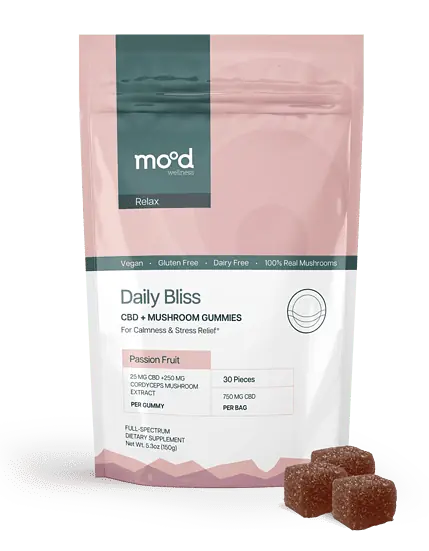
- Daily Bliss: 25 mg CBD per gummy;
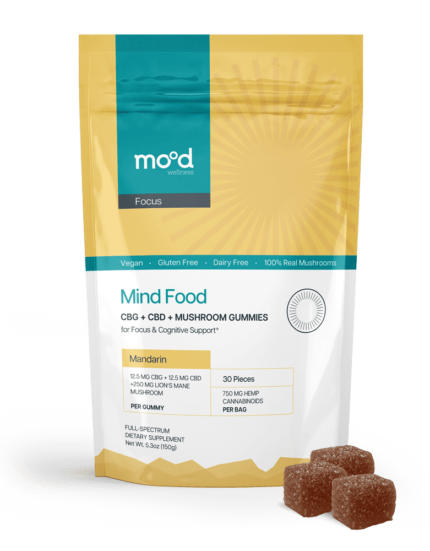
- Mind Food: 12.5 mg CBD plus 12.5 mg CBG per gummy; and
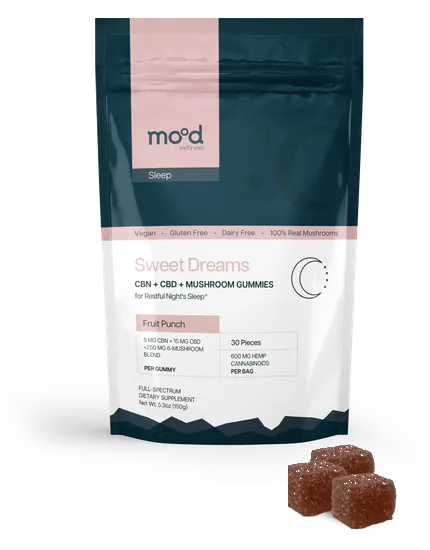
- Sweet Dreams: 15 mg CBD plus 5 mg CBN per gummy.
Those values support intact-unit label math. They do not by themselves prove that a consumer-cut half contains exactly 12.5 mg CBD, 6.25 mg CBD plus 6.25 mg CBG, or 7.5 mg CBD plus 2.5 mg CBN. That inference would require evidence about the divided portions.
Check the exact current label because formulas, serving directions and package sizes can change. Use Mood's lab-results directory only for a product- and lot-matched document. Several reports reviewed in September 2026 were older cannabinoid-potency files and did not establish split-portion uniformity.
If you need a different intact format or labeled strength, compare the current Mood CBD gummy collection by whole-unit amounts and complete formula. This is a measurement choice, not a recommendation for a particular dose or effect.
When a smaller intact unit is the cleaner choice
An intact lower-strength gummy avoids cutting geometry, crumbs and remainder storage. It also makes the label denominator clearer. Still verify serving size, other cannabinoids, THC status, added actives and batch documentation; “smaller” in physical dimensions does not necessarily mean lower potency.
Liquid products may offer graduated measurement, but they introduce concentration and device-reading questions and are not automatically more precise. Choose a format based on its labeled units, measurement method and manufacturer evidence, not a general claim that one form is better.
Safety Boundaries for Can You Cut CBD Gummies in Half
CBD can interact with medications and may involve liver and other risks. Full-spectrum products may contain THC and can contribute to impairment or a positive drug test. Dividing a gummy does not remove THC or eliminate interaction risk.
Do not drive or operate machinery when impaired. Keep all gummies and cut pieces away from children and pets. Pregnancy, breastfeeding, medication use, significant liver disease, planned surgery and safety-sensitive work deserve professional guidance.
If a gummy causes unexpected symptoms, stop using it and seek appropriate help. Do not use repeated smaller fragments to test a reaction on your own.

Bottom Line: Can You Cut CBD Gummies in Half
Many CBD gummies can be cut physically. That does not prove each piece contains half the labeled cannabinoids or other actives. Equal shape, equal mass and equal active content are three different claims.
Check whether the exact product is designed and tested for splitting. Preserve whole-unit label math, ask how divided portions were evaluated and follow product-specific remainder instructions. Do not split melted or damaged gummies. When reliable half-unit evidence is absent, an intact lower-strength product provides a clearer measurement basis.
Quick answers
Frequently asked questions about Can You Cut CBD Gummies in Half? What the Label Cannot Prove
What is the practical answer about Can You Cut CBD Gummies in Half? What the Label Cannot Prove?
Many CBD gummies can be cut physically. That does not prove each piece contains half the labeled cannabinoids or other actives. Equal shape, equal mass and equal active content are three different claims. Check whether the exact product is designed and tested for splitting. Preserve whole-unit label math, ask how divided portions were evaluated and follow product-specific remainder instructions.
Which Mood product fits this topic?
Daily Bliss is the most relevant Mood option for this topic. Mood Daily Bliss offers a premeasured CBD gummy with functional mushrooms for shoppers who prefer a convenient, positive daily wellness routine.
What should I compare before choosing a gummy?
Compare the cannabinoid amount per measured serving, the complete ingredient list, spectrum or THC information, current product directions and available batch documentation. The best choice is the formula that fits the goal and is easy to use consistently.
How should I start using a new CBD or cannabinoid product?
Follow the current package directions, choose a low-demand first-use window and keep timing and meal context reasonably consistent. Review medication, pregnancy, liver and impairment considerations with a qualified clinician when relevant.
Sources
- U.S. Food and Drug Administration. “Tablet Splitting” and “Tablet Scoring: Nomenclature, Labeling, and Data for Evaluation.” Accessed September 9, 2026. Drug-tablet analogy only; not CBD-gummy approval.
- “Development of Highly Stable Vitamin C Gummies Using Innovative In Situ Soft Sphere Integrated Liposomal Technology.” PMCID: PMC12878294.
- Gidal BE, et al. “Product labeling accuracy and contamination analysis of commercially available cannabidiol product samples.” PMID: 38562466.
- U.S. Food and Drug Administration. Consumer information on cannabis-derived compounds including CBD. Accessed September 9, 2026.
- U.S. Food and Drug Administration. What the FDA is Doing to Protect Consumers from Cannabidiol (CBD) in Foods. Accessed September 2026.