What a mushroom gummy COA can verify
A useful COA can document measured characteristics of a named sample. Depending on its scope, it may report:
- cannabinoid potency;
- total, alpha or beta glucans;
- selected botanical or fungal identity markers;
- pesticides;
- toxic elements such as lead, cadmium, arsenic or mercury;
- residual solvents;
- microbial counts or named pathogens;
- mycotoxins;
- physical fields such as unit weight or moisture; and
- compliance with stated specifications.
The words “certificate of analysis” do not guarantee that all these sections are present. One report may contain only cannabinoid potency. Another may be a supplier certificate for a mushroom extract. A third may show a finished-gummy contaminant panel. Read the analyte list rather than the filename.
What a COA cannot establish by itself
Even a detailed, authentic report does not automatically establish:
- that the sample represents every unit in the batch;
- that the report matches your package;
- that an ingredient survived formulation at the expected amount;
- clinical effectiveness or an appropriate personal serving;
- FDA approval;
- absence of every possible contaminant;
- product stability through the end of shelf life; or
- that a panel not shown elsewhere was performed.
Those questions require different records: sampling plans, batch documents, stability data, clinical evidence or additional analytical reports.

Pass 1: match the physical product
Begin with the package, not the laboratory PDF. Record the exact product name, format, count, flavor, labeled active amounts and batch or lot code. Photograph the package if you need to contact support.
Then compare those fields with the report.
| Package field | COA field to find | A defensible match |
|---|---|---|
| Product name | Sample or product description | Same named formula, not a related product |
| Gummy format | Matrix or sample type | Finished edible/gummy, when finished-product evidence is claimed |
| Strength or variant | Sample description | Same cannabinoid and mushroom formulation |
| Batch/lot code | Batch, lot, client or sample mapping | Exact match or documented cross-reference |
| Package date | Received/tested/reported dates | Consistent chronology, not identity by itself |
A report for capsules does not verify gummies. A report for a bulk Lion’s Mane extract does not verify a multi-ingredient finished gummy. A report for an old formula does not become current because the product name remained unchanged.
For the complete identifier workflow, use Mood’s batch-number and COA guide.
Batch, lot and laboratory sample IDs are not interchangeable
A manufacturing batch may describe material made in one production run. A packaged lot can identify units filled or labeled from that batch. The laboratory usually assigns its own sample or work-order number.
The codes may differ legitimately, but the relationship needs evidence. An acceptable chain might show that packaged lot B came from manufacturing batch A and laboratory sample X was drawn from batch A. Without that cross-reference, similarity is not a match.
A QR code is only a route to evidence. If it opens a generic library, select or enter the package lot and verify the returned report. If the package has no visible code, ask the seller how the retail unit maps to testing.
Pass 2: identify what was actually sampled
Look for fields such as “sample,” “matrix,” “description,” “product type” or “material.” Classify the report before reading its results.
Finished gummy
A finished-product sample can test the combined matrix the customer consumes. That matters because sugars, pectin, acids, flavors, colors, cannabinoid extracts and several mushroom ingredients may affect sample preparation and measurement.
Finished testing can address post-blending questions, but only for the listed analytes. A finished cannabinoid panel does not become a beta-glucan or contaminant panel.
Bulk mushroom blend
A blend report may characterize material before it enters the gummy. It can support incoming-ingredient or in-process controls. It does not prove the amount per finished unit, unit-to-unit uniformity or contamination introduced later.
Individual mushroom ingredient
A supplier report can support the identity or composition of a particular Lion’s Mane, Cordyceps or other ingredient lot. To connect it to a retail gummy, you still need records linking that ingredient lot to the manufacturing batch and packaged lot.
Do not rank these reports as universally “good” or “bad.” They occupy different points in the evidence chain.
Pass 3: verify the document and laboratory context
Record the laboratory name and address, client, report or work-order number, sample dates, issue date, page count and approval or signature field. Check whether the file says preliminary, final, amended or revised.
If a revised report exists, use the latest authorized version and note what changed. Cropped screenshots can hide qualifying notes, methods and additional pages, so request the complete file.
Laboratory accreditation can be relevant, but scope matters. A lab may be accredited for particular methods and matrices, not every test it offers. Accreditation also does not establish product-to-lot mapping or representative sampling.
FDA’s dietary-supplement CGMP guidance provides a useful bounded model: specifications for identity, purity, strength, composition and contaminant limits are distinct, and a supplier COA relied upon for applicable component specifications includes test methods, limits and actual results. The same guidance separates component testing, finished-batch verification and representative sampling.
This framework should not be misread as FDA approval of a gummy or as a declaration that every cannabinoid product has the same federal regulatory status.
Pass 4: build an evidence-coverage map
Instead of asking whether a product is “lab tested,” create a row for every question.
| Question | Evidence to look for | Do not substitute |
|---|---|---|
| Which fungal material is used? | Supply-chain identity records and a suitable identity method | Product name alone |
| How much mushroom ingredient is labeled? | Supplement Facts or other lawful quantitative declaration | Number of species pictured |
| Are beta-glucans measured? | Named beta-glucan analyte, method, matrix, basis and result | “Polysaccharides” or extract ratio |
| Does cannabinoid potency match? | Lot-matched cannabinoid panel with units per mass or unit | Mushroom ingredient COA |
| Were pesticides checked? | Individual pesticide analytes, limits and results | “Clean” badge |
| Were toxic elements checked? | Named elements, method, units, limits and results | Pesticide pass |
| Were microbes checked? | Counts and/or named pathogens with specifications | Mycotoxin panel |
| Were mycotoxins checked? | Named mycotoxin analytes and limits | Yeast-and-mold count |
Blank means unknown, not failed. A panel can be absent from a public page even if internal testing exists, but the public claim remains unverified until the document is available.
Mushroom composition needs its own evidence
Mushroom labels often mention species, fruiting body or mycelium, extract ratios, polysaccharides or beta-glucans. These terms are not interchangeable.
An extract ratio describes a manufacturing relationship between starting material and extract under a stated process. It is not a beta-glucan percentage. “Polysaccharides” is broader than mushroom beta-glucans and can include other carbohydrates. Species identity is not established by a high glucan number.
The 2016 McCleary and Draga method paper describes measuring total glucan and alpha glucan separately, then calculating beta-glucan by difference. The laboratory procedure, hydrolysis conditions and material influence the result. More recent analytical work also identifies challenges from modern supplement matrices containing resistant starches, trehalose and sweeteners such as maltitol.
That does not make gummy testing impossible. It means the report should identify the matrix and method, and the laboratory should have evidence that its procedure performs appropriately for that material.
Mood’s beta-glucan supplement guide owns the detailed interpretation, including total-minus-alpha calculations, dry-basis versus as-is reporting and ingredient-to-serving conversions.
Cannabinoid potency is a separate panel
When a mushroom gummy also contains CBD, CBG, CBN or THC, look for a cannabinoid panel tied to the same product and lot. Confirm whether results are reported as a percentage, milligrams per gram, milligrams per unit or milligrams per package.
Do not add cannabinoids together unless the comparison clearly calls for a combined total. Keep delta-9 THC, THCA and other isomers in separate rows. Compare laboratory results with the current label using consistent units.
The general CBD COA reading guide explains cannabinoid fields and common document red flags. A potency pass does not verify mushrooms, contaminants or health effects.
Contaminants require named panels
“Full panel” has no useful meaning until the report lists the analytes. Pesticides, toxic elements, residual solvents, microbes and mycotoxins are different groups with different methods and limits.
Finished-gummy context matters because the formula contains more than mushroom extract. Agricultural ingredients, water activity, heating, handling and packaging can introduce questions that a raw-ingredient report cannot answer.
Use the COA contaminants guide for the detailed audit of analyte lists, reporting thresholds and action limits.
How to read ND, LOD, LOQ and “pass”
Result is what the method reported for the tested sample. LOD is a stated detection threshold under defined conditions. LOQ or a reporting limit is the lowest level the method reports quantitatively with its specified performance.
“ND” generally means the analyte was not detected at or above a stated threshold. It does not establish mathematical absence. If the threshold is missing, you cannot tell how sensitive the decision was.
“Pass” means the reported result met a referenced specification or action limit. Look for that limit and its source. A result can be below the laboratory’s reporting threshold yet still be unhelpful if that threshold is above the relevant specification.
Units must match before comparison. Micrograms per gram, milligrams per kilogram and milligrams per serving are not interchangeable labels, even when a conversion is possible.
A worked document audit
Imagine a pouch lists a six-mushroom blend plus CBD and CBN. Its QR code opens a two-page cannabinoid report for a similarly named gummy.
The responsible audit would record:
- Does the lot match exactly or through a documented mapping?
- Does the sample description identify the finished gummy and current variant?
- Which cannabinoids and units appear?
- Is a mushroom identity or glucan method listed?
- Are pesticide, toxic-element, solvent, microbial or mycotoxin pages present?
- Are methods, thresholds and specifications visible?
If the file contains only cannabinoids, the cannabinoid result may be usable after identity and lot matching. Mushroom composition and contaminant coverage remain unknown. Do not mark the entire product “fully tested.”
Current Mood evidence boundary
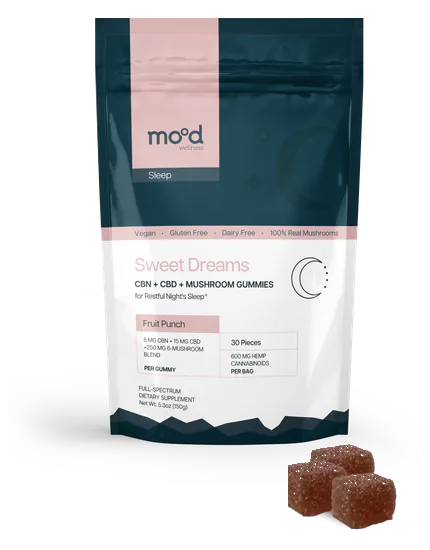
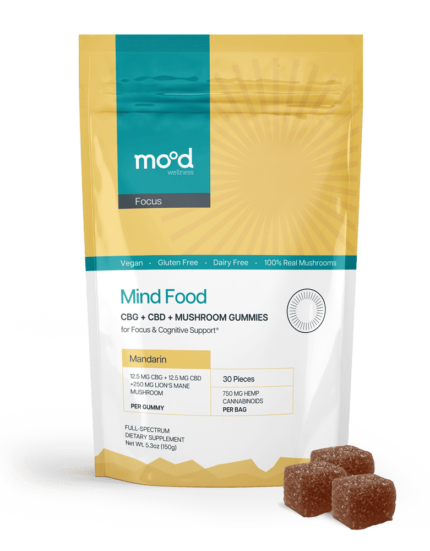
Mood’s public lab-results page was reviewed during this project. The captured Mind Food and Sweet Dreams gummy reports were cannabinoid-potency documents dated February 2023. The captured Brain Fuel oil report was dated October 2022.
Those documents provide historical evidence for the named samples and analytes they display. They do not visibly establish current-lot beta-glucan, mushroom identity, pesticide, toxic-element, residual-solvent, microbial or mycotoxin results for the current gummy formulas.
The correct conclusion is not that unshown tests failed. It is that the public evidence reviewed does not answer those questions. A shopper should request current, lot-matched documents for the panels relevant to the claim.
Questions to send customer support
- Which report matches the lot on my package?
- Is the tested sample the finished gummy or a raw ingredient?
- Can you provide the complete, final report rather than a cropped page?
- Which method was used for mushroom identity or beta-glucans?
- Is the result reported as-is or on a dry basis?
- Are current cannabinoid and contaminant panels available for this finished lot?
- What are the LOD, LOQ and applied specifications?
- If supplier and laboratory codes differ, what record maps them?
Preserve the response with the package code and report. Marketing language without the underlying document does not complete the chain.
Mushroom Gummy COA Buyer Checklist
Before relying on a mushroom gummy COA, confirm:
- [ ] exact product and variant;
- [ ] package batch or lot;
- [ ] explicit code mapping;
- [ ] finished gummy versus ingredient matrix;
- [ ] laboratory and report identity;
- [ ] complete page count and final status;
- [ ] sensible received, tested and reported dates;
- [ ] named methods;
- [ ] actual results and units;
- [ ] LOD/LOQ where relevant;
- [ ] visible specification or action limit for “pass”;
- [ ] separate mushroom-composition, cannabinoid and contaminant coverage;
- [ ] no inference from a panel that is absent.
Safety and evidence limits
A COA is a product-verification tool, not medical advice. Composition does not establish effectiveness, personal suitability or a clinical dose. Functional mushroom ingredients can cause digestive or allergic reactions, and evidence varies by species and preparation.
Cannabinoid-containing gummies add separate considerations. CBD can interact with medications and contribute to drowsiness, and full-spectrum products may contain THC. Ask a qualified clinician or pharmacist before use if you take medications, are pregnant or breastfeeding, have liver concerns, face workplace drug testing or need to avoid impairment.
Do not use a gummy when the package is damaged, the lot cannot be identified, the product appears unexpectedly altered or the documentation conflicts with the label. Contact the seller for a product-specific disposition.
Bottom Line: Mushroom Gummy COA
Read a mushroom gummy COA as a chain, not a badge. Match the retail product and lot, identify the actual sample, verify the laboratory document and then map every analyte panel. Interpret each result with its method, unit, threshold and specification.
Ingredient reports and finished-product reports answer different questions. Beta-glucans, cannabinoids and contaminants require separate evidence. When a field or panel is missing, preserve the uncertainty instead of filling it with a marketing claim.
Quick answers
Frequently asked questions about How to Read a Mushroom Gummy COA
What is the practical answer about How to Read a Mushroom Gummy COA?
Read a mushroom gummy COA as a chain, not a badge. Match the retail product and lot, identify the actual sample, verify the laboratory document and then map every analyte panel. Interpret each result with its method, unit, threshold and specification. Ingredient reports and finished-product reports answer different questions.
Which Mood product fits this topic?
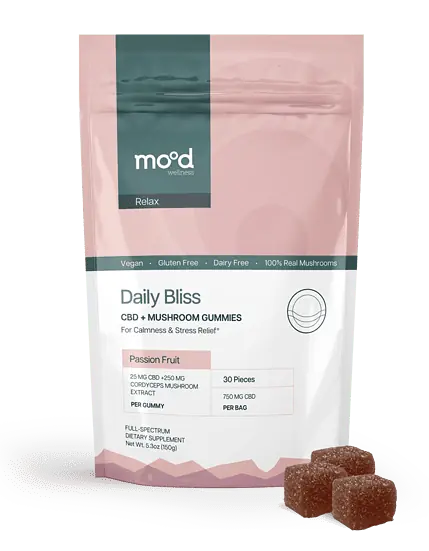
Mind Food is the most relevant Mood option for this topic. Mood Mind Food combines CBD, CBG and Lion’s Mane in a stimulant-free gummy designed for a calm, focused daytime routine.
What should I compare before choosing a gummy?
Compare the cannabinoid amount per measured serving, the complete ingredient list, spectrum or THC information, current product directions and available batch documentation. The best choice is the formula that fits the goal and is easy to use consistently.
How should I start using a new CBD or cannabinoid product?
Follow the current package directions, choose a low-demand first-use window and keep timing and meal context reasonably consistent. Review medication, pregnancy, liver and impairment considerations with a qualified clinician when relevant.
Sources
- U.S. Food and Drug Administration. Small Entity Compliance Guide: Current Good Manufacturing Practice in Manufacturing, Packaging, Labeling, or Holding Operations for Dietary Supplements. Accessed September 9, 2026.
- U.S. Food and Drug Administration. Dietary Supplement Labeling Guide: Chapter IV. Nutrition Labeling. Accessed September 9, 2026.
- McCleary BV, Draga A. “Measurement of β-Glucan in Mushrooms and Mycelial Products.” Journal of AOAC International. 2016;99(2):364–373. PMID 26957216. DOI 10.5740/jaoacint.15-0289.
- Advances in Enzymatic Measurement of β-Glucan in Mushrooms, Yeast, Algae, and Dietary Supplements. Journal of AOAC International. 2026. PMID 42152188. DOI 10.1093/jaoacint/qsag041.
- AOAC INTERNATIONAL. Official Methods of Analysis Program. Accessed September 9, 2026.
- Mood Wellness. Functional mushroom collection, lab-results page and linked reports. Captured and reviewed September 9, 2026.
- U.S. Food and Drug Administration. Dietary Supplements. Accessed September 2026.