
Beta-glucans, glucans and polysaccharides
A polysaccharide is a carbohydrate built from many sugar units. Glucans are polysaccharides composed primarily of glucose. Alpha and beta refer to the orientation of the glycosidic bonds connecting those glucose units.
That hierarchy matters:
| Label term | What it can include | What it does not prove |
|---|---|---|
| Polysaccharides | Multiple complex carbohydrates, potentially including starch and fungal glucans | A specific amount of mushroom beta-glucan |
| Total glucan | Alpha- and beta-linked glucans measured under a stated method | The beta fraction unless alpha-glucan is separated |
| Alpha-glucan | Starch, glycogen and method-dependent related glucose sources | Mushroom beta-glucan content |
| Beta-glucan | A measured beta-linked glucan fraction under a specific assay | Species identity, clinical benefit or contaminant safety |
| Mushroom extract | A processed mushroom ingredient | Extraction ratio, marker content or finished-product amount without more detail |
An impressive “total polysaccharides” figure can therefore answer a different question from a beta-glucan result. It should not be silently relabeled.

How mushroom beta-glucans are measured
There is no useful percentage without an analytical context.
The total-minus-alpha approach
McCleary and Draga published a method for mushroom and mycelial products in 2016. In simplified terms, total glucan is measured after controlled acid hydrolysis releases glucose. Alpha-glucan, principally starch and glycogen, with corrections for certain free sugars, is measured separately using enzymatic treatment. Beta-glucan is then calculated by difference:
beta-glucan = total glucan − alpha-glucan
That equation is conceptually simple, but the laboratory work is not. Sample homogenization, hydrolysis, enzyme specificity, sugar corrections, matrix interference and calculation basis all matter.
Why the method name matters
Methods are designed for particular materials. An oat or barley beta-glucan method is not automatically suitable for the differently linked glucans in fungi. Antibody or binding-protein assays may also recognize some structures more strongly than others.
For a comparison, record the exact method identifier or laboratory procedure. “Third-party tested” without the analyte and method is not enough to reproduce or interpret the result.
Dry basis versus as-is basis
A percentage may be reported on the material as received or adjusted to dry matter. Moisture changes the denominator. Two results cannot be treated as equivalent unless their basis is clear.
If a supplier certificate reports 30% beta-glucan on a dry basis but a finished gummy result is reported as-is, the percentages describe different denominators. Do not rank them without normalization.

Ingredient certificate versus finished-product certificate
An ingredient certificate may show that a bulk Lion’s Mane or Cordyceps extract met a supplier specification. It does not prove how much of that ingredient reached one finished gummy or whether manufacturing and storage preserved the same marker level.
A finished-product certificate can answer the consumer-facing question more directly, but only if it identifies:
- the finished product and lot;
- the sample matrix;
- the tested analyte;
- the method;
- the result and reporting basis;
- the laboratory and report date; and
- any limit of quantitation or qualification needed to interpret the number.
The strongest documentation chain connects the supplier ingredient record, production batch and finished package. A cropped chart with no lot or method is weak evidence even when the number looks precise.

Converting a percentage into milligrams per serving
Percent by weight can be converted only when the mass of the tested mushroom material in the serving is known and the percentage applies to that same material.
Imagine a label states 250 mg of one mushroom extract per gummy, and a matching finished-ingredient report states 25% beta-glucan by weight:
250 mg × 0.25 = 62.5 mg beta-glucan equivalent from that stated material
This is a label-math example, not a recommended intake and not a Mood product verification. It fails if:
- 250 mg describes a blend rather than the tested ingredient;
- 25% was measured on a different lot;
- the figure applies to a dry basis that was not normalized;
- the gummy contains less extract than the label states;
- the test sampled only a raw material; or
- the percentage was copied from a generic supplier specification.
For a multi-mushroom blend, one combined amount cannot reveal the contribution of each species unless the blend composition is disclosed.
A seven-field beta-glucan evidence check
Use these fields in order:
| Field | Stronger evidence | Warning sign |
|---|---|---|
| Species | Latin binomial and common name | “Mushroom complex” only |
| Material | Fruiting body, mycelium or clearly described whole material | Unspecified “biomass” |
| Amount | Milligrams per serving for each ingredient or defined blend | Front-label extract ratio without serving mass |
| Marker | Beta-glucan result, not only polysaccharides | “High in polysaccharides” |
| Method | Named method or documented laboratory procedure | “Proprietary testing” without detail |
| Basis | As-is or dry basis, percentage or mg/g | Percentage with no denominator |
| Batch | Product/ingredient lot and report date match | Undated generic certificate |
No single field replaces the others. Species identity without amount is incomplete; a percentage without a batch is not current verification.
Fruiting body, mycelium and grain
Fruiting body and mycelium describe fungal structures. They are not automatic quality grades. A mycelial ingredient can be analytically characterized, and a fruiting-body ingredient can be poorly documented.
The practical concern is substrate carryover and disclosure. Mycelium cultivated on grain may be sold with residual grain material. That can contribute alpha-glucan or starch. A method that measures alpha and total glucan separately can help characterize the sample, but it does not independently prove species or manufacturing claims.
Ask for the actual alpha-glucan and beta-glucan results rather than assuming that “no grain” follows from a marketing phrase. Likewise, “100% fruiting body” should be supported by supply-chain identity controls, not inferred from a beta-glucan percentage alone.
Mood’s scheduled guide on fruiting body versus mycelium owns the full material-choice question. This page stays focused on interpreting beta-glucan documentation.
Extraction ratio is not beta-glucan content
An 8:1 or 10:1 extract ratio generally describes a relationship between starting material and finished extract under the manufacturer’s process. It does not state how much beta-glucan is present and cannot be converted into a marker percentage without testing.
Hot-water extraction can solubilize certain mushroom polysaccharides, but the phrase “hot-water extracted” does not establish yield, structure, purity or efficacy. Extraction details and assay results are complementary facts.
Use Mood’s mushroom extraction-method guide for the broader preparation decision. That article owns process choices so this page does not become a duplicate extraction explainer.
What beta-glucan content cannot tell you
Beta-glucan testing is a composition measure. It does not by itself answer:
- whether the species is authentic;
- whether a particular molecular structure is present;
- whether the compound is bioavailable from the finished format;
- whether the tested amount produces a health outcome;
- whether the product contains heavy metals, pesticides or microbes;
- whether residual solvents are relevant;
- whether a gummy’s cannabinoids match the label; or
- whether the product is suitable with medications or a medical condition.
Different questions require different methods. Identity testing, beta-glucan quantitation, cannabinoid potency and contaminant panels should not be collapsed into a single “lab tested” badge.
How to read a mushroom gummy label
FDA guidance requires a dietary supplement label to identify the serving size and servings per container and to declare dietary ingredients in the Supplement Facts panel, subject to rules for proprietary blends. Other ingredients such as sweeteners, starches, flavors and stabilizers appear separately.
For a mushroom gummy, record:
- gummies per serving;
- mushroom species and part;
- extract or powder amount per serving;
- beta-glucan amount or percentage, if stated;
- CBD, CBG, CBN and THC status;
- sweeteners and other ingredients;
- warnings and age limits; and
- lot and date information.
Do not compare the mushroom ingredient per gummy in one product with the total per two-gummy serving in another.
Mood product claims: what is visible and what is missing
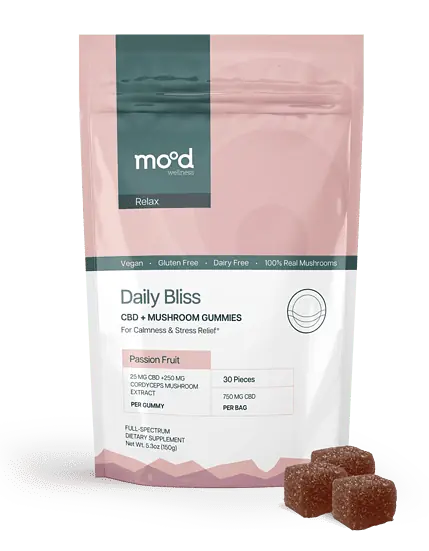
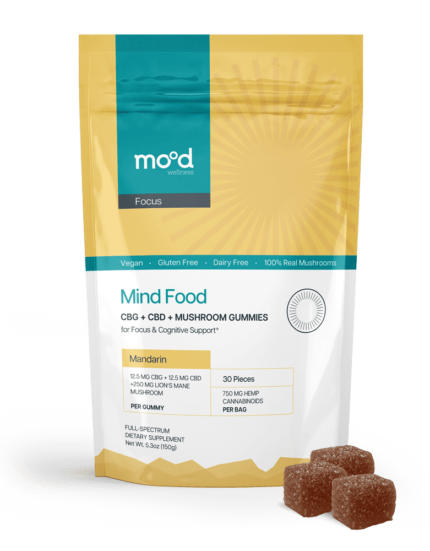
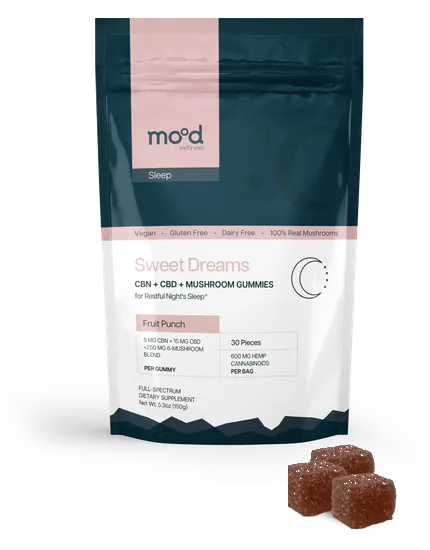
Mood’s current Mind Food page states 250 mg of Lion’s Mane fruiting-body extract per gummy and says beta-glucan content is verified above 25%. Daily Bliss states 250 mg of Cordyceps fruiting-body extract per gummy and describes the ingredient as naturally rich in beta-glucans. Sweet Dreams identifies a six-mushroom fruiting-body blend but the visible page does not provide a beta-glucan amount per species.
These are current first-party product-page statements. A buyer should still look for the matching analytical proof.
Mood’s public lab-results page links Mind Food, Daily Bliss and Sweet Dreams reports. The gummy certificates captured in the September 9 audit are older cannabinoid-potency reports, including Mind Food and Sweet Dreams files reported in February 2023. They do not visibly provide a mushroom beta-glucan assay, a method identifier or a finished-product beta-glucan result.
That means the public evidence currently supports a narrower statement: the product pages make mushroom-material and beta-glucan claims, while the captured public certificates verify selected cannabinoid potency for specific older samples. The files should not be described as independent current-batch proof of the beta-glucan percentage or a full contaminant panel.
Before purchasing, compare the functional mushroom collection with Mood’s lab-results page. Ask for a current matching beta-glucan report when the analyte, method or lot is not visible. Mood’s guide to reading a COA explains the same batch-matching principle for cannabinoid reports.
Safety and health-claim boundaries
A compositional marker is not a clinical dose. Human research on isolated or standardized beta-glucans cannot automatically be applied to every mushroom species, extract, blend or gummy. Structure, molecular weight, preparation, amount, population and endpoint all matter.
Mushroom supplements can cause digestive or allergic reactions and may create medication or condition-specific questions. Combination gummies may also contain CBD, CBG, CBN or trace THC, adding interaction, alertness, impairment and drug-test considerations.
Talk with a qualified clinician or pharmacist before use if you take medications, have a medical condition or mushroom allergy, are pregnant or breastfeeding, or are preparing for surgery. Do not use an assay percentage as permission to increase intake.
Beta-glucans in Mushroom Supplements Buyer Checklist
Before treating a beta-glucan claim as verified, confirm:
- The species is named precisely.
- The fruiting body, mycelium or other material is disclosed.
- The ingredient amount per serving is visible.
- The claim says beta-glucan rather than only polysaccharides.
- The analytical method is identified.
- The reporting basis and units are clear.
- The certificate matches the product and lot.
- The report date is current enough for the package.
- Ingredient-level and finished-product results are not confused.
- Separate identity, cannabinoid and contaminant questions are documented.

Bottom Line: Beta-glucans in Mushroom Supplements
Beta-glucan percentage can be a useful mushroom-supplement documentation signal, but it is not a universal quality or efficacy score. Interpret the number with the method, material, denominator, serving amount and batch.
Prefer a clearly named beta-glucan result over a broad polysaccharide claim. Ask whether the result comes from the raw ingredient or finished product, whether it is reported as-is or on a dry basis, and whether alpha-glucan was separated. Then verify the lot and report date.
For Mood products, the current pages provide mushroom-format and beta-glucan claims, but the older public gummy COAs captured in this audit do not independently show the relevant beta-glucan assay. Request the matching documentation rather than assuming that a cannabinoid potency report proves every ingredient claim.
Quick answers
Frequently asked questions about Beta-Glucans in Mushroom Supplements
What is the practical answer about Beta-Glucans in Mushroom Supplements?
Beta-glucan percentage can be a useful mushroom-supplement documentation signal, but it is not a universal quality or efficacy score. Interpret the number with the method, material, denominator, serving amount and batch. Prefer a clearly named beta-glucan result over a broad polysaccharide claim. Ask whether the result comes from the raw ingredient or finished product, whether it is reported as-is or on a dry basis, and whether alpha-glucan was separated.
Which Mood product fits this topic?
Mind Food is the most relevant Mood option for this topic. Mood Mind Food combines CBD, CBG and Lion’s Mane in a stimulant-free gummy designed for a calm, focused daytime routine.
What should I compare before choosing a product?
Compare the cannabinoid amount per measured serving, the complete ingredient list, spectrum or THC information, current product directions and available batch documentation. The best choice is the formula that fits the goal and is easy to use consistently.
How should I start using a new CBD or cannabinoid product?
Follow the current package directions, choose a low-demand first-use window and keep timing and meal context reasonably consistent. Review medication, pregnancy, liver and impairment considerations with a qualified clinician when relevant.
Sources
- McCleary BV, Draga A. “Measurement of β-Glucan in Mushrooms and Mycelial Products.” Journal of AOAC International. 2016;99(2):364–373. View source
- Kanno T, et al. “Quantification of β-Glucan from Culinary-Medicinal Mushrooms Using Novel Artificial β-Glucan Recognition Protein.” International Journal of Medicinal Mushrooms. 2020;22(3):269–276. View source
- U.S. Food and Drug Administration. “Questions and Answers on Dietary Supplements.” View source
- National Institutes of Health Office of Dietary Supplements. “Dietary Supplements: What You Need to Know.” View source
- Mood Wellness. Mind Food, Daily Bliss, Sweet Dreams and lab-results pages. Checked September 9, 2026.