What the Supplement Facts panel does
FDA’s dietary-supplement labeling guidance defines serving size around the maximum amount recommended on the label per eating occasion, or one unit when no recommendation exists. NIH’s Office of Dietary Supplements explains that the panel lists serving size, dietary ingredients and amounts per serving, while excipients such as fillers, binders and flavorings appear under “Other Ingredients.”
That structure answers disclosure questions. It does not mean FDA has evaluated the finished product for effectiveness before sale, and it does not turn a suggested serving into personalized medical advice.
Start by copying the panel exactly:
| Label field | Record |
|---|---|
| Serving size | Capsules, scoops, gummies, mL or another unit |
| Servings per container | Stated count, not assumed count |
| Dietary ingredient | Exact name shown |
| Amount per serving | Weight for the complete serving |
| Daily Value | Often not established for mushroom ingredients |
| Other ingredients | Carriers, capsule material, sweeteners and flavors |
Species comes before benefit language
“Mushroom blend” is less specific than a list of named species. Common names can also be ambiguous, so look for a scientific binomial when available: for example, Hericium erinaceus for Lion’s Mane or Cordyceps militaris for one commonly sold Cordyceps species.
The species name does not prove identity on its own. It tells you what the manufacturer claims is present and what identity test should target. A blend that lists six common names but no scientific species gives less reproducible information than one that provides both.
Do not transfer evidence among species because their common names or marketing categories sound similar. Study material, species and preparation must match before clinical findings can be considered relevant.
Fruiting body, mycelium and substrate
Fruiting body is the familiar reproductive structure. Mycelium is the fungal network. Some commercial mycelial materials are harvested with cultivation substrate; other mycelial preparations are produced and characterized differently.
These are material descriptions, not automatic quality grades. A well-characterized mycelial ingredient can disclose identity and measured composition. A fruiting-body ingredient can still lack species verification, marker data or contaminant testing.
Ask:
- Is the material fruiting body, mycelium or both?
- If mycelium is used, does substrate remain in the harvested material?
- Is “biomass” defined?
- Does an identity method distinguish the claimed fungal material?
- Are alpha- and beta-glucan results available on the relevant sample?
The scheduled Mood article on fruiting body versus mycelium owns the full material comparison. Here, the essential rule is to record the label claim without treating it as a verdict.
Powder, extract and tincture are not synonyms
A powder may be milled whole material. An extract uses water, ethanol or another process to recover selected soluble constituents. A liquid tincture includes solvent or carrier volume in addition to extracted solids.
For any extract, look for:
- starting material and species;
- extraction solvent or process;
- finished extract mass per serving;
- extract ratio and its defined convention;
- carrier or excipient content;
- measured marker compounds; and
- residual-solvent testing when relevant.
The word “extract” does not prove concentration, bioavailability or preservation of every constituent. The mushroom extraction-method guide explains hot-water, ethanol, dual and assisted processes in more detail.

Read milligrams before ratios
The most useful quantity is the mass of the ingredient actually delivered in the labeled serving.
If one capsule contains 300 mg extract and a serving is two capsules:
300 mg × 2 = 600 mg extract per serving
If a two-gummy serving lists 500 mg of a named extract:
500 mg ÷ 2 = 250 mg extract per gummy
These calculations require a disclosed amount. A front-panel “six mushroom” claim without blend mass cannot be divided into milligrams per species.
Use the dedicated mushroom-extract serving-math guide when comparing per-serving and per-unit disclosures.
What an extract ratio means, and does not mean
An extract ratio such as 8:1 or 10:1 generally describes a relationship between starting material and finished extract under the manufacturer’s process. Its exact convention and whether it uses dry or fresh input should be defined.
A 10:1 label does not automatically prove:
- ten times the clinical effect;
- ten times the beta-glucan content;
- a specific extraction yield;
- zero carrier material;
- equivalence to ten grams of another company’s powder; or
- superior species identity or contaminant control.
Do not multiply finished extract mass by the ratio and relabel the result as an “active dose.” You may report a manufacturer’s clearly defined raw-material equivalent, but keep it separate from the physical extract mass and measured marker content.
Beta-glucans, polysaccharides and alpha-glucans
Beta-glucans are glucose polymers found in fungal cell walls, but their structures vary. “Polysaccharides” is broader and may include alpha-glucans such as starch. The terms are not interchangeable.
McCleary and Draga described an analytical approach for mushroom and mycelial products in which total glucan and alpha-glucan are measured and beta-glucan is calculated by difference. The result still depends on the sample, method and reporting basis.
For a beta-glucan claim, record:
| Question | Why it matters |
|---|---|
| What was tested? | Raw ingredient and finished product are different samples |
| Which method? | Methods can respond differently across matrices |
| Total, alpha or beta glucan? | Broad carbohydrate results are not equivalent |
| As-is or dry basis? | Moisture changes the denominator |
| Percentage or mass? | A percentage needs ingredient mass for serving conversion |
| Which lot and date? | Old or unmatched results may not describe the package |
A high percentage is not automatically better. It does not establish species identity, absorption, clinical effect or contaminant safety. The beta-glucan evidence guide covers the analytical details.
Converting a marker percentage carefully
Suppose a label states 250 mg of a specific mushroom extract per gummy and a matching ingredient report states 25% beta-glucan on a compatible basis:
250 mg × 0.25 = 62.5 mg calculated beta-glucan in that extract amount
That calculation is supported only when the percentage applies to the same ingredient lot and the reporting basis matches. It does not work when the page gives 250 mg finished gummy weight, 25% total polysaccharides or a report for a different supplier batch.
If the assay is on a dry basis but the ingredient amount is as supplied with moisture or carrier, additional information is required. Do not hide that uncertainty behind decimal precision.
Proprietary blends preserve uncertainty
A proprietary blend may disclose total blend weight while listing components without individual amounts. If a two-capsule serving contains 1,000 mg total blend across five mushrooms, you know the combined mass, not 200 mg of each.
Ingredient order may provide limited relative context under applicable labeling rules, but it does not supply exact amounts. Do not reverse-engineer species doses from list order, photographs or marketing emphasis.
For a blend, record:
- total blend mass per serving;
- all named species;
- material and form for each, if stated;
- any individually disclosed amounts;
- markers tested on the blend; and
- what remains undisclosed.
Other ingredients are part of the product
Read beyond the mushroom line. Capsules may contain cellulose, gelatin, flow agents or colorants. Powders may contain flavors, sweeteners or carriers. Gummies add gelling agents, sugars, acids and oils. Extract powders may use maltodextrin or another drying carrier.
Other ingredients can affect allergens, dietary preferences, tolerability and comparison by weight. A 500 mg “blend” and a 500 mg mushroom extract are not equivalent if one number includes unspecified carriers and the other excludes them.
Check statements such as vegan, gluten-free, kosher or organic against product-specific certification when those attributes matter. A certification scope should identify the exact product and current validity; it does not prove mushroom composition or clinical effect.
How to read a certificate of analysis
“Third-party tested” is incomplete unless the report is accessible and relevant. Different questions require different tests:
| Question | Evidence type |
|---|---|
| Species identity | Appropriate identity method and reference material |
| Beta-glucan content | Named quantitative assay |
| Heavy metals | Element-specific contaminant panel |
| Microbes | Microbiological panel and limits |
| Pesticides | Analyte list, methods and limits |
| Residual solvents | Solvent panel relevant to extraction |
| Cannabinoids in a gummy | Cannabinoid potency panel |
A cannabinoid report does not verify mushroom species or beta-glucans. A supplier beta-glucan specification does not verify contaminants or the finished gummy.
Match product name, lot, sample type, laboratory, dates, units and pass/fail limits. The COA-reading workflow applies the same document discipline, even when the analytes differ.
Current Mood label examples
Mood’s current functional-mushroom pages illustrate three disclosure levels.
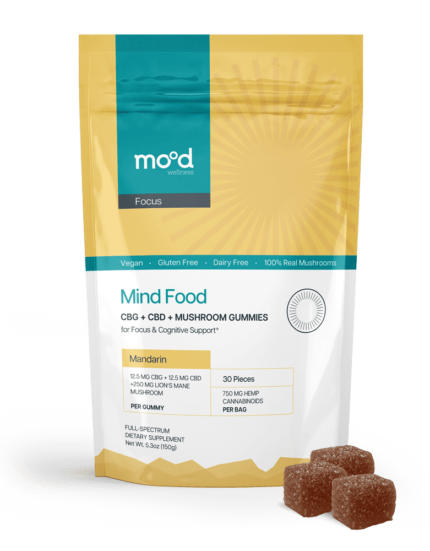
Mind Food
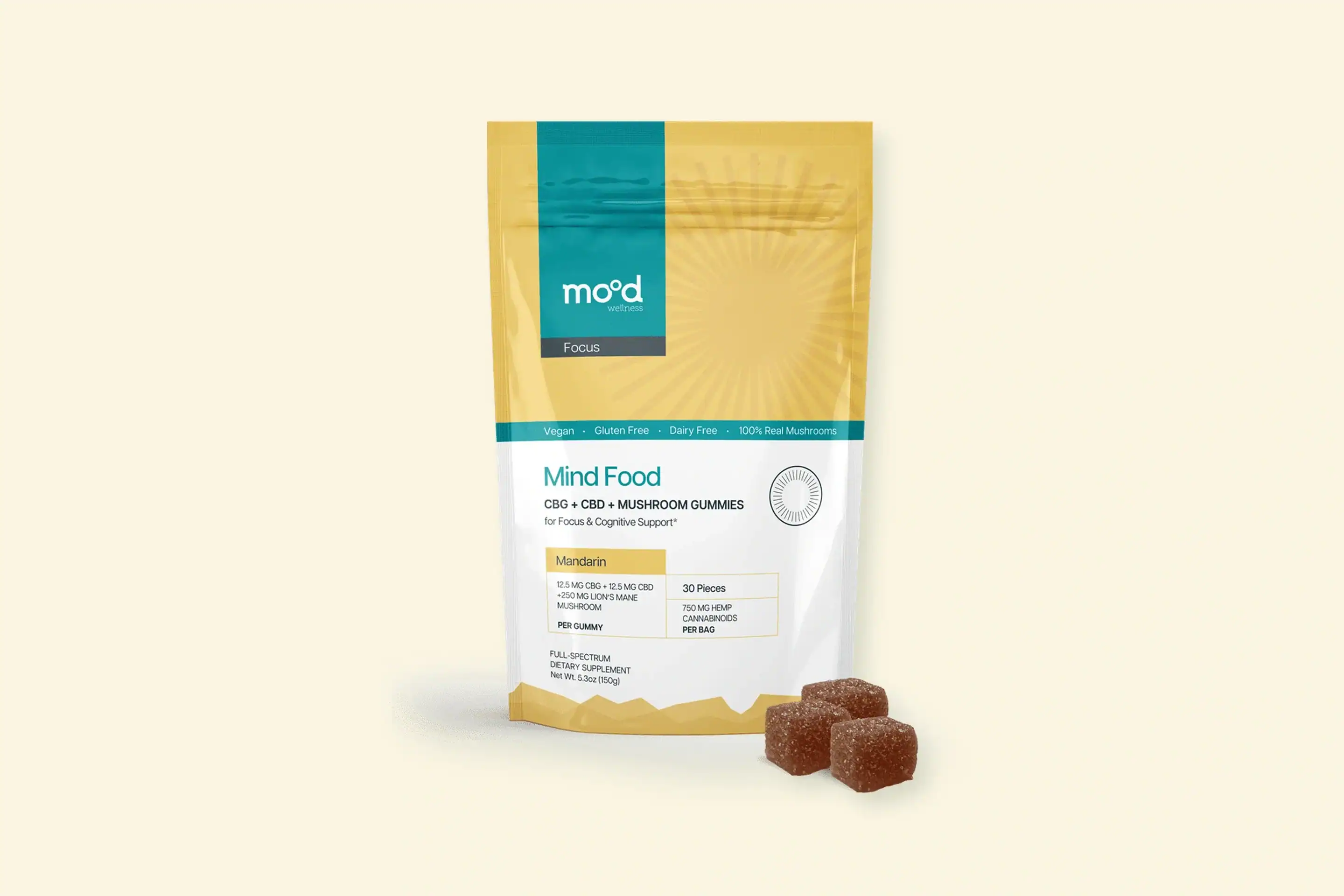
The page states 250 mg Lion’s Mane fruiting-body extract per gummy and says beta-glucan content is verified above 25%. It also contains CBD and CBG. The publicly linked report reviewed during this project was an older cannabinoid-potency document; it did not visibly provide the mushroom beta-glucan assay. Treat the percentage as a product-page claim unless the matching mushroom report is supplied.
Daily Bliss
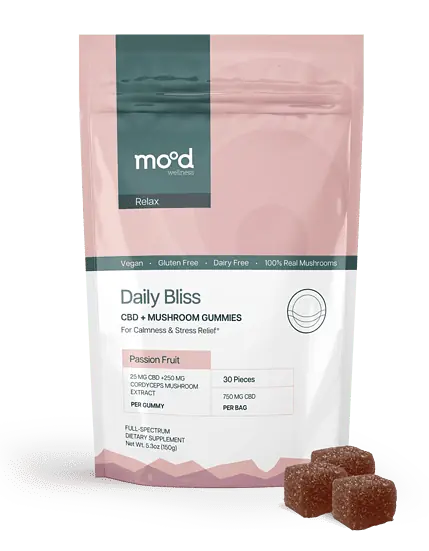
The page states 250 mg Cordyceps militaris fruiting-body extract per gummy and 25 mg CBD. The extract mass does not reveal beta-glucan, cordycepin, extract ratio or solvent. Those require separate documentation.
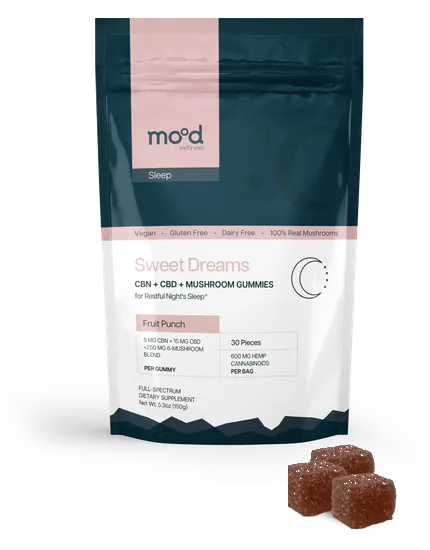
Sweet Dreams
The page names Reishi, Cordyceps, Turkey Tail, Maitake, Shiitake and Agaricus blazei fruiting-body extracts. The visible page reviewed does not state total mushroom-blend mass or individual species amounts. The number of species therefore cannot be converted into a dose.
Compare current options in the functional mushroom collection while keeping seller claims and independent evidence distinct.
Claims and human evidence
A label can help determine whether a product resembles research material, but resemblance is not identity. Human studies differ by species, strain, fungal part, cultivation, extraction, marker composition, daily amount, duration, population and outcome.
Do not cite a study of a standardized mycelial preparation to validate an unspecified fruiting-body blend, or a study of grams of powder to support a small amount of a differently processed extract. Finished multi-ingredient gummies add further differences.
FDA does not evaluate ordinary dietary supplements for effectiveness before they are marketed. Structure/function wording is not the same as an approved disease-treatment claim.
Safety and interaction checks
Mushrooms can cause allergy or gastrointestinal reactions, and products may interact with medical conditions or medications depending on species and other actives. Consult a clinician or pharmacist if you:
- take anticoagulants, immunosuppressants, diabetes medication or other prescriptions;
- have mushroom or mold allergies;
- have autoimmune, liver or kidney conditions;
- are pregnant or breastfeeding;
- are preparing for surgery; or
- are using a multi-ingredient product with cannabinoids or sedating botanicals.
Inspect contamination panels because fungi and agricultural materials can introduce heavy-metal, microbial or pesticide concerns. Stop use and seek appropriate advice after an adverse reaction.
A reusable label worksheet
| Field | Product A | Product B |
|---|---|---|
| Exact product and format | ||
| Serving size | ||
| Species/common name | ||
| Scientific name | ||
| Fruiting body/mycelium/other | ||
| Powder/extract/tincture | ||
| Extract mass per serving | ||
| Defined extract ratio | ||
| Beta-glucan result and method | ||
| Other markers | ||
| Other ingredients/carriers | ||
| Product and lot matched? | ||
| Identity/contaminant panels | ||
| Warnings and allergens |
Leave missing fields visibly blank or mark them unknown. Transparency is part of the comparison result.

Bottom Line: How to Read a Mushroom Supplement Label
Read a mushroom supplement label from serving size outward: species, fungal material, form, physical amount, extract ratio, measured markers, other ingredients and lot-specific evidence. Keep each field separate.
Fruiting body is not an efficacy guarantee. Mycelium is not automatically inferior. An extract ratio is not beta-glucan content, and a polysaccharide number is not necessarily a mushroom beta-glucan result. The strongest label is not the one with the largest front-panel number; it is the one whose terms, quantities and evidence can be followed without guesswork.
Quick answers
Frequently asked questions about How to Read a Mushroom Supplement Label
What is the practical answer about How to Read a Mushroom Supplement Label?
Read a mushroom supplement label from serving size outward: species, fungal material, form, physical amount, extract ratio, measured markers, other ingredients and lot-specific evidence. Keep each field separate. Fruiting body is not an efficacy guarantee. Mycelium is not automatically inferior. An extract ratio is not beta-glucan content, and a polysaccharide number is not necessarily a mushroom beta-glucan result.
Which Mood product fits this topic?
Mind Food is the most relevant Mood option for this topic. Mood Mind Food combines CBD, CBG and Lion’s Mane in a stimulant-free gummy designed for a calm, focused daytime routine.
What should I compare before choosing a product?
Compare the cannabinoid amount per measured serving, the complete ingredient list, spectrum or THC information, current product directions and available batch documentation. The best choice is the formula that fits the goal and is easy to use consistently.
How should I start using a new CBD or cannabinoid product?
Follow the current package directions, choose a low-demand first-use window and keep timing and meal context reasonably consistent. Review medication, pregnancy, liver and impairment considerations with a qualified clinician when relevant.
Sources
- U.S. Food and Drug Administration. Dietary Supplement Labeling Guide, Chapter IV.
- NIH Office of Dietary Supplements. Dietary Supplements: What You Need to Know.
- McCleary BV, Draga A. “Measurement of β-Glucan in Mushrooms and Mycelial Products.” Journal of AOAC International. 2016;99(2):364–373.
- Mood Wellness. Functional Mushrooms and Lab Results. Checked September 9, 2026.
- U.S. Food and Drug Administration. Dietary Supplements. Accessed September 2026.