
Start with the category
The main difference is what sits beside the CBD
A regular CBD gummy is a cannabinoid product. A CBD mushroom gummy is a combination product, so it should answer two separate questions: what is in the hemp extract, and what mushroom material was added?

The names are easy to blur together, so it helps to separate three product types. Regular CBD gummies contain CBD and may also contain other cannabinoids such as CBG or CBN, but they do not contain a functional mushroom ingredient. Mushroom-only gummies contain mushroom extracts or powders without CBD. CBD mushroom gummies put both categories into the same serving.
This distinction matters because the ingredients do different jobs in the formula and require different proof. A batch report may confirm how much CBD and THC are present. That same report usually does not establish whether a mushroom is Lion’s Mane or Cordyceps, whether the product uses fruiting body or mycelium, or how much beta-glucan it contains.
The useful shortcut
If the front panel says only “mushroom blend,” keep reading. A useful label should name the species and state an amount per gummy or per serving.
Side by side
CBD mushroom gummies vs regular CBD gummies
| Question | Regular CBD gummies | CBD mushroom gummies |
|---|---|---|
| Main active category | CBD, sometimes with CBG, CBN or other cannabinoids | Cannabinoids plus one or more functional mushroom ingredients |
| Best label signal | Cannabinoids stated per gummy, hemp spectrum and THC are clear | The same cannabinoid details plus named mushroom species and amounts |
| Testing to look for | Current, product-matched cannabinoid potency and appropriate contaminant panels | Cannabinoid testing plus separate mushroom identity and specification evidence where claimed |
| Formula complexity | Usually easier to isolate and evaluate | More variables and greater risk of an opaque blend |
| Routine fit | Useful when a simple cannabinoid formula is the priority | Useful when a specific mushroom and routine are part of the decision |
| Main misconception | That all CBD gummies are THC-free | That more mushroom species automatically means more value |
A combination formula is not an upgrade by default. It is a different design choice. If you already know which CBD amount and hemp spectrum suit your needs, a named mushroom may add a useful reason to choose one product over another. If you cannot tell how much of each mushroom is present, the extra ingredients may add uncertainty rather than value.
There is also a serving-size trap. A package may advertise a large total across the entire pouch while the useful comparison is the amount in one gummy and in the intended daily serving. Compare equivalent units and never combine CBD milligrams with mushroom milligrams as though they were the same substance.
The second half of the formula
What functional mushrooms add to a CBD gummy
Functional mushrooms give a formula a more specific ingredient story, but the story should begin with identity and amount, not a promised result.
Lion’s Mane
Lion’s Mane is commonly positioned in focus and cognitive wellness products. A useful label identifies Lion’s Mane by name and explains whether the ingredient is a fruiting-body extract, mycelium or another material. Research on a particular extract does not prove that every Lion’s Mane gummy produces the same result.
Cordyceps
Cordyceps often appears in daytime and active-routine products. Products may use different Cordyceps species and preparations, so the species and amount matter. The presence of Cordyceps does not turn a CBD gummy into a stimulant and does not guarantee energy or exercise performance.
Reishi and multi-mushroom blends
Reishi is frequently used in evening or balance-oriented formulas. Multi-mushroom blends may also include Turkey Tail, Maitake, Shiitake and Agaricus blazei. A longer list can broaden the formula, but it can also hide very small individual amounts. Look for disclosure that lets you understand what each serving actually contains.
Named species, amount per gummy, mushroom material and extract details.
A large blend total, no species-level amounts and broad wellness promises.
For a deeper category explanation, read what counts as a functional mushroom. If a product hints at euphoria, hallucination or a “legal trip,” it belongs in a different safety conversation.
Two evidence trails
Testing a CBD mushroom gummy requires more than one checkbox
A certificate of analysis can be valuable when it matches the exact product, strength and batch. It may show CBD, CBG, CBN and THC amounts and, depending on the panel, pesticides, heavy metals, solvents or microbes. It should not be treated as proof of mushroom identity unless the mushroom testing is actually included.

1
Match the product
The name, strength, format and lot on the report should match the package in your hand.
2
Check the cannabinoid panel
Confirm measured CBD and THC rather than relying on front-label language such as hemp-derived or broad-spectrum.
3
Find the mushroom specification
Ask whether species identity, material used and any beta-glucan claim have separate documentation.
Mood provides a public lab-results library. Use the guide to read a CBD COA if the batch report is unfamiliar.
A routine-led range
How Mood builds CBD mushroom gummies differently
Mood does not use one generic mushroom blend across every gummy. The range changes the cannabinoid and mushroom pairing according to the intended point in the day.
| Product | Formula per gummy | Named mushrooms | Intended routine |
|---|---|---|---|
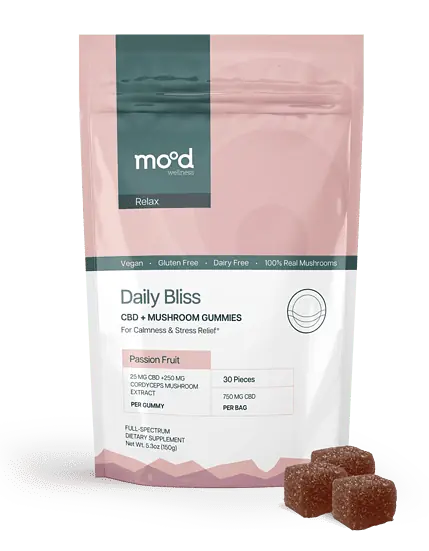
| Daily Bliss | 25 mg CBD + 250 mg Cordyceps | Cordyceps | Relax and daytime balance |
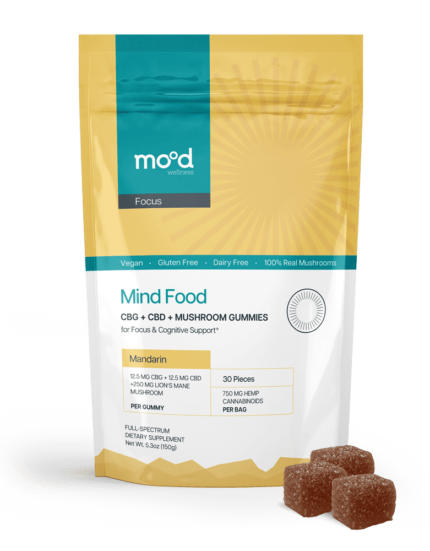
| Mind Food | 12.5 mg CBD + 12.5 mg CBG + 250 mg Lion’s Mane | Lion’s Mane | Focus-oriented daytime routine |
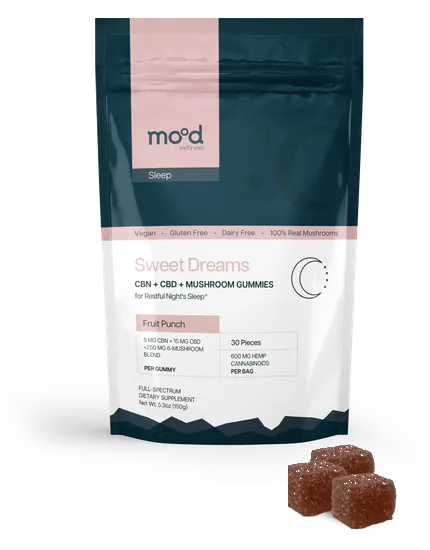
| Sweet Dreams | 15 mg CBD + 5 mg CBN + six-mushroom blend | Reishi, Cordyceps, Turkey Tail, Maitake, Shiitake and Agaricus blazei | Evening routine |
These are label facts and product positioning, not guaranteed outcomes. Sweet Dreams names six species, but the current public page does not state the amount of each mushroom, so we do not estimate the split. Daily Bliss and Mind Food use one named mushroom, which makes the mushroom portion easier to read.
The value of this system is choice by formula rather than by packaging alone. Someone who wants a simpler CBD product may still prefer a regular CBD gummy. Someone who wants CBD plus a specific mushroom can compare the three Mood options by cannabinoid profile and time of day.
A practical decision
Which type of gummy makes more sense for you?
Choose a regular CBD gummy when
- You want the fewest active ingredients to evaluate.
- Your main decision is CBD amount, THC status or hemp spectrum.
- You already use mushroom supplements and want to avoid overlap.
- You prefer to introduce one new ingredient category at a time.
Consider a CBD mushroom gummy when
- You want a named mushroom as part of the same daily routine.
- The product states each active amount per gummy or serving.
- You understand the mushroom material and the limits of the evidence.
- The combined formula reduces complexity elsewhere in your routine.
Do not choose by ingredient count alone
A seven-mushroom blend is not automatically more useful than one clearly disclosed mushroom. The best comparison is the formula you can understand, verify and fit into a specific routine.
Once you decide that the combination category fits, use the CBD mushroom gummy buying guide to compare finished products.
Safety first
CBD and mushroom safety questions belong on the same page
The FDA warns that CBD can cause drowsiness, gastrointestinal effects, mood changes, liver injury and drug interactions. Full-spectrum products can contain THC and may create drug-test risk. Do not drive until you know how a product affects you.
Ask a clinician or pharmacist to review the full ingredient list if you take prescription or over-the-counter medication, have liver disease, use immunosuppressants, have a mushroom allergy or combine several sleep, focus or mushroom supplements. The FDA advises against CBD use during pregnancy and breastfeeding.
Functional mushrooms such as Lion’s Mane, Cordyceps and Reishi are not psilocybin. Still, the CDC has reported acute illness associated with some gummies marketed as mushroom products, including products with undisclosed substances. Avoid vague products that do not identify their mushroom ingredients or that imply psychoactive effects. The detailed guide to functional versus psychoactive mushroom gummies explains that boundary.
Quick answers
Frequently asked questions
Are CBD mushroom gummies stronger than regular CBD gummies?
Not necessarily. Strength depends on the cannabinoid amount and the specific ingredients, not the length of the formula. Mushroom milligrams should not be added to CBD milligrams as one potency number.
Do CBD mushroom gummies make you high?
CBD is not intoxicating, but full-spectrum hemp can contain THC. Check the current batch report and do not assume a CBD product is THC-free.
Are functional mushroom gummies psychedelic?
No. Functional species such as Lion’s Mane, Cordyceps and Reishi are not psilocybin mushrooms. Avoid products that blur the categories or fail to name their ingredients.
Can I take CBD and mushroom supplements together?
A combination may not be appropriate for everyone. Medication, liver health, allergies, pregnancy, THC exposure and overlapping supplements should be reviewed with a qualified professional.
Is a multi-mushroom blend better than one mushroom?
Not automatically. One named mushroom with a clear amount can be easier to evaluate than a blend that hides the amount of each species.
Evidence and disclosure
Sources
- U.S. FDA. What You Need to Know About Products Containing CBD.
- U.S. FDA. Cannabis and CBD during pregnancy and breastfeeding.
- CDC. Acute illnesses associated with mushroom-containing gummies.
- NCCIH. Considering a complementary health approach.
- Mood Wellness. CBD gummies category.
- Mood Wellness. Lab Results.
Mood Wellness sells the Mood products discussed in this guide. This educational content does not diagnose, treat, cure or prevent disease. Formulas can change, so check the current product label and batch report.