Extraction solvent versus residual solvent
A solvent helps dissolve or separate constituents during processing. Water and ethanol are common examples in mushroom extraction, and manufacturers may use a sequence or mixture. After extraction, concentration and drying steps are designed to remove liquid. A residual solvent is the portion of a relevant volatile organic chemical that remains in an ingredient or finished product.
The two facts should not be collapsed. “Ethanol extracted” describes a process input, not the final residual concentration. “No ethanol detected” describes a particular test result, not proof that ethanol was never used. A well-controlled process can use a solvent and remove it to a defined specification.

Why mushroom extract processing matters
Mushroom ingredients may be milled powders, hot-water extracts, alcohol extracts or products of sequential extraction. Concentrates may be dried on their own or with a carrier. Each path produces a different matrix for testing and a different list of plausible process chemicals.
Start with the process map: raw mushroom, solvent or solvents, concentration, drying, carrier addition, blending and finished dosage form. Then ask which volatile chemicals could reasonably enter at each stage. The mushroom extraction methods guide explains the process categories; this article stays focused on verifying what remains.
What ICH Q3C classes mean
ICH Q3C is a pharmaceutical residual-solvent guideline organized around risk. Class 1 solvents are generally to be avoided because of unacceptable toxicity or environmental hazard. Class 2 solvents are to be limited because of inherent toxicity. Class 3 solvents have lower toxic potential, but “lower” does not mean beneficial or unlimited.
The class tells you how a solvent is treated within that framework; it does not tell you whether it was used in a particular mushroom extract. Ethanol, acetone and several other familiar solvents appear in Class 3. Methanol, hexane and acetonitrile are examples listed in Class 2. Benzene is Class 1. A brand should not use a lower-risk class as a reason to skip process control or report interpretation.
What permitted daily exposure means
Permitted daily exposure, or PDE, is an exposure-based value. It is not identical to a concentration result such as parts per million. To relate concentration to exposure, you need the amount of product consumed per day.
For illustration only, if a result is reported in micrograms per gram and the labeled daily intake is two grams, multiply concentration by two grams to estimate micrograms per labeled daily amount. If a gummy serving contains only part of a tested blend, the sample basis and serving composition still matter. Never compare a concentration directly with a daily-exposure value without converting compatible units and stating the intake assumption.
Why a single universal ppm limit is misleading
Some summaries present one concentration threshold as if it applied to every solvent and every product. Risk-based frameworks are more specific. Different solvents can have different exposure limits. Some calculations use a default daily product mass; another option uses the product's actual maximum daily dose.
A laboratory report should therefore identify the analyte-specific specification and its source. If the report applies an internal supplier limit, say so. If it references USP or ICH, confirm that the calculation and product scope match rather than borrowing the authority of a standard by name.
What USP <467> contributes
USP describes residual solvents as volatile organic chemicals used or produced during manufacturing of drug substances, excipients or dietary ingredients, or in pharmaceutical and dietary-supplement products. The chapter provides compendial approaches for relevant official articles and is closely aligned with risk-based solvent classification.
This is useful context for reading a report, but “tested using USP <467>” should not be treated as FDA approval. Ask whether the laboratory used a compendial procedure as written, verified it for this matrix or validated an alternative procedure. Mushroom powders, carriers, flavors and gummy matrices can affect sample preparation and analytical performance.
How laboratories test residual solvents
Headspace gas chromatography is commonly used because volatile compounds can be driven into the gas phase above a prepared sample and separated chromatographically. A detector then responds to compounds as they elute. A result is defensible only when identity, calibration, selectivity and matrix performance are controlled.
A consumer does not need to become a chromatographer, but can look for method clarity. The report should name the method or procedure, identify the laboratory, show dates and connect results to a sample. A decorative chromatogram without axes, standards or analyte identification is not stronger evidence than a clear table.

Panel scope comes before pass or fail
A report can test one solvent, a targeted group or a broad screen. “Residual solvents: pass” leaves the most important question unanswered: which ones? The sensible panel follows the manufacturing risk assessment.
| Report field | Why it matters | Weak substitute |
|---|---|---|
| Analyte list | Shows which solvents were evaluated | “Solvent tested” badge |
| Result and unit | Enables comparison | Pass with no value |
| Detection/reporting limit | Defines what non-detect means | Zero |
| Specification | Shows acceptance basis | Green check mark |
| Method | Supports matrix-appropriate interpretation | “Lab tested” |
| Sample and lot | Connects evidence to product | Generic product name |
If ethanol is the only expected process solvent, a targeted ethanol result may answer a narrow supplier question. It cannot support “tested for all residual solvents.” Conversely, a broad panel may include irrelevant analytes and still miss a chemical unique to the actual process.
How to read ND, LOQ and numerical results
ND usually means not detected under the method conditions, below a stated detection threshold. LOQ is the lowest concentration the method can quantify with defined performance. Laboratories may use symbols such as less-than signs or abbreviations, so read the legend.
Do not convert ND to zero in a calculation. Record it as below the stated detection limit. If the report omits that limit, the claim is less informative because a sensitive and an insensitive method could both print ND.
A numerical result needs units. Parts per million by mass often corresponds to micrograms per gram, but verify the report's definition. Results for a liquid, powder and finished gummy may use different sample bases. Compare like with like before drawing a conclusion.
Ingredient COA versus finished-product COA
An extract supplier can test the ingredient immediately after drying. That result is close to the extraction process and can be appropriate for release. The finished manufacturer then blends that extract with other ingredients. Those ingredients and later processing may introduce different risks, while dilution can also change the measured concentration.
The strongest file connects both stages: supplier specification and lot result for the extract, qualification of other ingredients, manufacturing records and an appropriate finished-product control strategy. A finished gummy cannabinoid report does not silently cover the mushroom extract's residual solvents. A supplier powder result does not automatically represent every subsequent retail lot.
Does the label have to name the extraction solvent?
FDA's dietary-supplement labeling guide explains that liquid extracts are declared using the volume or weight of the total extract and the starting-material condition, and that concentration and solvent information may be included. Product forms and label facts vary. A voluntary statement such as “extracted in 70% ethanol” can clarify process identity.
That statement is not a residual-solvent assay. It tells you what was used, not what remained after concentration and drying. Likewise, an ingredient list naming water does not establish that no organic solvent was used earlier in a supplier process.
“Alcohol free” and “solvent free” need definitions
Marketing phrases can refer to formulation, processing or test result. “Alcohol free” might mean no alcohol is intentionally present in the finished liquid, but it may not answer whether ethanol was used upstream. “Solvent free” can be especially confusing because water is itself a solvent in ordinary chemistry.
Ask the brand to restate the claim operationally: no organic solvent used during extraction; no listed alcohol intentionally added to the finished formula; or specified targets not detected above named limits. Precise language prevents a process claim from masquerading as a laboratory result.
Residual solvents are not the same as other contaminant panels
Gas-chromatography solvent testing does not replace heavy-metal analysis, pesticide screening, microbial tests or mycotoxin testing. Each panel has different analytes, methods and reporting logic. A broad “clean” badge can hide these distinctions.
Use the mushroom gummy COA guide to match product, lot, sample and panel. If cannabinoids are present, those potency and contaminant questions remain separate from the fungal ingredient's composition.
What a defensible residual-solvent report includes
Begin with the broader mushroom supplement label guide when the species, material, extract amount or serving basis is still unclear; a solvent result cannot repair an ambiguous ingredient identity.
Look for:
- Product or ingredient name and physical form.
- Supplier, manufacturer or client identifier.
- Lot or batch number.
- Sample received and test dates.
- Laboratory identity and, where relevant, accreditation scope.
- Analytical method and matrix preparation.
- Every solvent included in the panel.
- Results with units.
- Detection or quantitation limits.
- Analyte-specific specification and source.
- Authorized report status and complete pages.
Then compare the lot identifier with the pouch or supplier record. A technically excellent report for a different batch does not verify the one in hand.
How Mood's current evidence fits
Mood's mushroom product pages describe extract ingredients and certain formula attributes. The public lab-results materials reviewed for this project were primarily historical cannabinoid-potency reports for selected products. We did not locate a current, mushroom-specific residual-solvent panel matched to the retail lots under review.
That means the public evidence cannot support a statement that every relevant solvent was tested and passed. It also does not prove a failure. The accurate status is simply not publicly verified in the reviewed materials. Shoppers can compare the functional mushroom collection and ask support for the extract supplier specification, target solvent list, method, limits and lot linkage.
A practical review sequence
First identify the extraction method and every plausible organic solvent. Second inspect the supplier specification. Third match the test sample to the ingredient lot. Fourth confirm panel scope, method, units and limits. Fifth translate concentration to the labeled daily amount only when necessary and with compatible units. Finally, review the finished-product evidence for other ingredients and contaminant classes.
This sequence avoids two common errors: assuming an ethanol extraction is unsafe because ethanol was used, and assuming a water-extraction claim proves that no residual organic solvent could be present anywhere in the supply chain.
Bottom Line: Residual Solvents in Mushroom Extracts
Residual-solvent verification is a specific analytical job. The report should tell you what was tested, on which sample and lot, by what method, at what sensitivity and against which specification. Extraction language, an ND result and a pass badge each answer only part of that job.
Use ICH Q3C and USP <467> as careful interpretive frameworks, not as borrowed approval seals. Pair the solvent panel with process records, identity and composition evidence, other contaminant tests and finished-lot matching. If the scope or limit is missing, the conclusion should remain correspondingly narrow.
Quick answers
Frequently asked questions about Residual Solvents in Mushroom Extracts
What is the practical answer about Residual Solvents in Mushroom Extracts?
Residual-solvent verification is a specific analytical job. The report should tell you what was tested, on which sample and lot, by what method, at what sensitivity and against which specification. Extraction language, an ND result and a pass badge each answer only part of that job.
Which Mood product fits this topic?
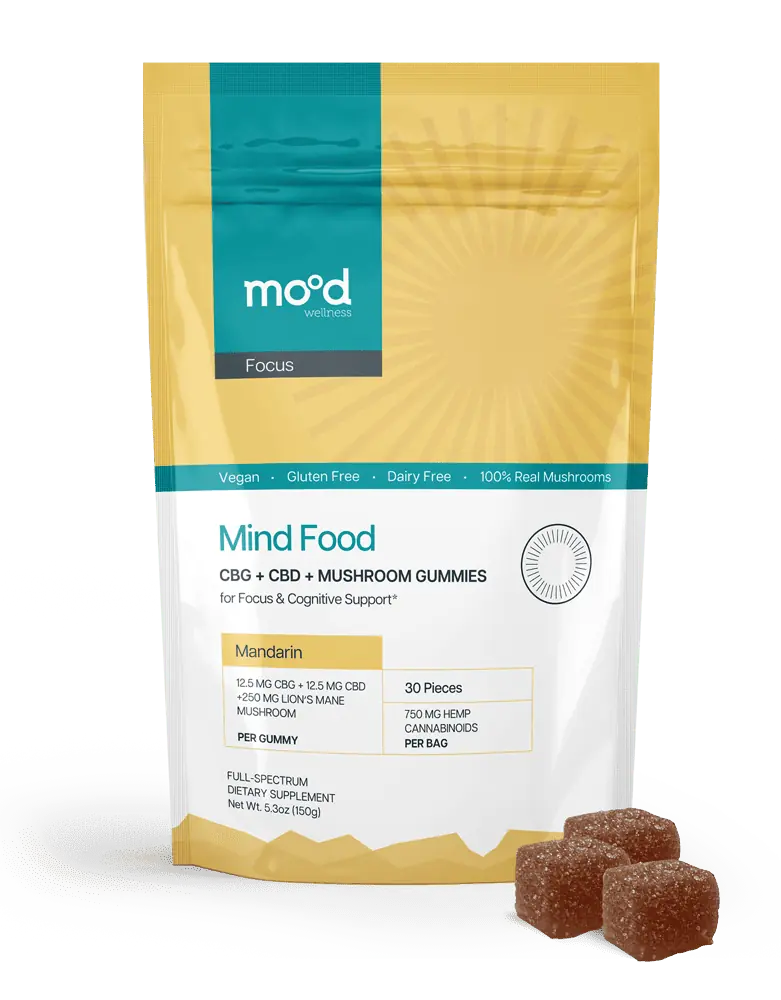
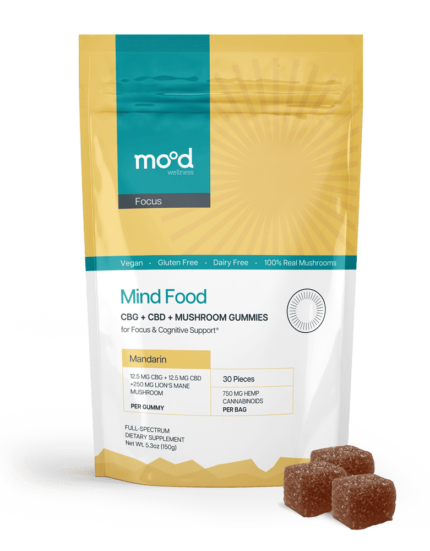
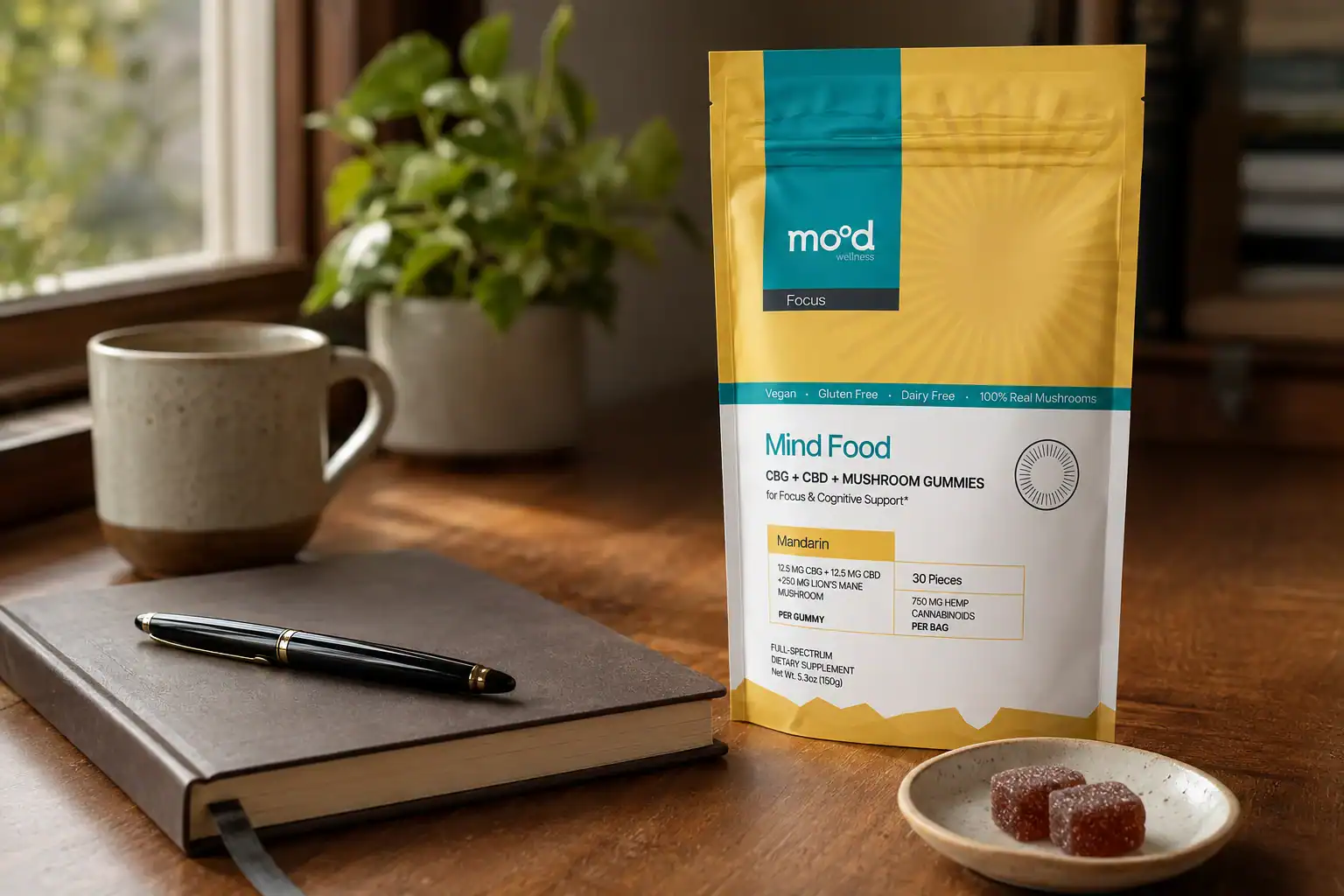
Mind Food is the most relevant Mood option for this topic. Mood Mind Food combines CBD, CBG and Lion’s Mane in a stimulant-free gummy designed for a calm, focused daytime routine.
What should I compare before choosing a product?
Compare the cannabinoid amount per measured serving, the complete ingredient list, spectrum or THC information, current product directions and available batch documentation. The best choice is the formula that fits the goal and is easy to use consistently.
How should I start using a new CBD or cannabinoid product?
Follow the current package directions, choose a low-demand first-use window and keep timing and meal context reasonably consistent. Review medication, pregnancy, liver and impairment considerations with a qualified clinician when relevant.
References
- International Council for Harmonisation. Q3C(R8): Impurities, Guideline for Residual Solvents.
- United States Pharmacopeia. General Chapter <467>, Residual Solvents. USP–NF.
- FDA. Dietary Supplement Labeling Guide: Chapter IV.
- FDA. Revised Draft Guidance for Industry: Dietary Supplements, New Dietary Ingredient Notifications and Related Issues.