

What “with THC” and “without THC” actually mean
The front label rarely gives enough information. A CBN product can fall into several practical categories.
| Product description | What it may indicate | What still needs verification |
|---|---|---|
| Explicit CBN + delta-9 THC | THC is an intended active ingredient | Milligrams per gummy and serving; other THC isomers; lot result |
| Full-spectrum hemp extract + CBN | Multiple hemp constituents may be present | Actual measured THC; serving size; current legal and workplace fit |
| Broad-spectrum extract + CBN | THC was intended to be removed or minimized | Whether the finished lot is nondetectable and at what limits |
| CBN isolate formula | CBN supplied as an isolated ingredient | Finished-product THC panel and other hemp ingredients |
| “THC-free” CBN gummy | Seller makes an absence claim | Which analytes were tested, method, reporting limits and lot match |
| CBN gummy with no THC statement | Unknown, not zero | Full label and cannabinoid report |
“Without THC” should describe evidence, not an assumption. If a report says ND, read the legend: ND usually means not detected at the laboratory's stated threshold. It does not mean that every conceivable quantity is scientifically impossible.
Likewise, “with THC” is incomplete without a number. An explicit THC gummy and a full-spectrum gummy can expose the user to very different quantities. For the detailed denominator and federal dry-weight arithmetic, use Mood's guide to THC amounts in full-spectrum gummies.
The decision matrix
Start with the constraint that would change your answer even if every other feature looked appealing.
| Your priority or constraint | More appropriate starting category | Why |
|---|---|---|
| You must avoid intentional THC | Verified THC-free CBN | Removes deliberately added THC; testing evidence still matters |
| You are subject to drug testing | Avoid cannabinoid products unless your policy or clinician supports use | Labels and COAs cannot guarantee a negative test |
| You need to drive or operate machinery | Avoid THC-containing products | THC can impair; individual response is not a safety test |
| You intentionally want THC | Clearly quantified CBN + THC | The dose can be evaluated rather than inferred from “spectrum” |
| You want CBN but not CBD | CBN-focused formula | CBD and THC status must each be checked separately |
| You prefer a multi-cannabinoid formula | Fully quantified blend | A blend is a preference, not evidence of synergy |
| You take medications or have a health condition | Clinician/pharmacist review before selection | Cannabinoids can create interaction and safety questions |
This matrix does not diagnose a sleep problem or select a dose. It filters out categories that conflict with the reader's real-world constraints.
Normalize the label before comparing products
Make one row for every active ingredient. Copy the labeled figures without converting a package total into a per-gummy claim until the denominator is clear.
| Field | Product A | Product B |
|---|---|---|
| Gummies per labeled serving | ||
| CBN per gummy | ||
| CBN per serving | ||
| Delta-9 THC per gummy | ||
| Delta-9 THC per serving | ||
| CBD per gummy/serving | ||
| Other cannabinoids | ||
| Mushrooms, melatonin or botanicals | ||
| Spectrum/THC wording | ||
| Batch number and report date | ||
| Relevant analytes and reporting limits |
Keep “not stated,” zero and not detected separate. They are different findings:
- Not stated: the page or label did not provide a number.
- Zero: a numerical claim that needs a defined basis.
- Not detected: the laboratory did not detect an analyte under a particular method and reporting limit.
If the bottle says 300 mg CBN but contains 30 gummies, 10 mg per gummy is a mathematical inference only if 300 mg truly refers to total CBN in the package. It does not tell you the THC amount, serving size or measured potency. Do not use package-level hemp-extract weight as cannabinoid weight.

Verify the finished lot, not just the marketing category
A useful certificate of analysis should connect to the product in hand. Check:
- Product name, flavor and strength match.
- Batch or lot number matches the package.
- Sample type is the finished gummy rather than only a raw ingredient.
- Laboratory and report date are visible.
- CBN, CBD, delta-9 THC and relevant additional THC analytes are listed.
- Units can be connected to one gummy or the labeled serving.
- ND and reporting-limit definitions are shown.
- The tested panels support only the claims you are evaluating.
A cannabinoid potency panel does not establish contaminant safety unless the relevant contaminant panels are also reported. A raw CBN-isolate report does not prove the composition of every finished gummy. A QR code is only a route to evidence; it is not evidence by itself.
Mood's CBD COA reading guide explains product, lot, unit and panel matching in more detail.

What the human evidence can and cannot tell us
The studies are easier to interpret when kept in separate evidence lanes.
CBN with or without CBD is not a THC comparison
A randomized, double-blind, placebo-controlled trial enrolled adults reporting poor sleep and tested 20 mg CBN alone or with three CBD amounts. In the modified intention-to-treat population of 293 participants, the prespecified primary sleep-quality comparison for 20 mg CBN versus placebo was not statistically significant. Some secondary outcomes differed, while adding CBD did not positively augment CBN's effects in that study.
The trial did not test THC. It therefore cannot show whether a CBN gummy with THC is better or worse than one without THC. The publication also reports affiliations and funding connected to Canopy Growth and Wana Brands, which readers should consider alongside the study design and results.
A THC + CBD pilot does not establish a CBN-gummy effect
A randomized controlled pilot in 20 adults with insomnia tested a single oral dose containing 10 mg THC and 200 mg CBD. The dose reduced total sleep time and changed aspects of REM sleep relative to placebo in that study. The formula contained no CBN and used a CBD amount unlike many retail gummies.
That result is relevant because it challenges the assumption that an oral THC-containing cannabinoid formula will necessarily improve every sleep measure. It is not a verdict on low-dose retail CBN + THC gummies.
A mixed-formula pilot is formula-specific
A separate randomized, double-blind crossover pilot evaluated a proprietary softgel containing 3 mg THC, 6 mg CBN and 10 mg CBD. Research on an exact mixture can inform questions about that tested mixture. It cannot isolate which cannabinoid produced an outcome, establish that the same ratio works in a gummy or prove that all CBN products with THC outperform THC-free options.
CBN-alone data do not create a consumer dose
A small randomized crossover trial in 20 participants tested much larger CBN-only amounts, 30 mg and 300 mg. The primary wake-after-sleep-onset endpoint did not significantly differ, although selected secondary observations were reported. Those experimental amounts and findings should not be converted into a retail serving recommendation.
Taken together, the evidence supports restraint: formulation, amount, population and endpoint matter. It does not support a simple “THC adds the missing effect” story.
Impairment, driving and next-day plans
THC can be intoxicating and impairing. Do not drive, cycle in traffic, operate machinery or perform safety-sensitive work after using a THC-containing product. A familiar brand, a low-sounding number or prior experience does not prove unimpaired performance on a particular occasion.
Edible cannabinoid effects can be delayed and prolonged. Taking more because nothing is felt immediately can stack exposure. The correct waiting and serving instructions are product-specific; follow the label and do not turn another person's experience into your schedule.
CBN is often marketed with “sleepy” language, but that does not make it a neutral background ingredient. Mood's CBN psychoactivity guide owns the fuller distinction between CBN, intoxication and sedation claims.
Avoid combining THC products with alcohol or other substances that can increase impairment or drowsiness. If you use prescription or over-the-counter medication, ask a clinician or pharmacist about the complete formula, not just CBN.
Drug-test risk is not solved by hemp legality
A product can be sold under a hemp framework and still be unsuitable for someone subject to testing. Drug tests, policies, analytes, cutoffs, exposure patterns and individual biology vary. A compliant product label does not guarantee a negative result.
An explicit THC product presents the clearest exposure concern. Full-spectrum products can also matter. Even a product marketed as THC-free cannot provide an absolute outcome guarantee: documentation, cross-contamination, reporting limits and product consistency all affect the risk assessment.
If employment, sport, probation, clinical treatment or another high-consequence policy applies, the conservative option may be to avoid cannabinoid products unless the responsible authority and your clinician say otherwise. See Mood's CBD and drug-testing guide for the detailed testing discussion.
Safety questions before either choice
The FDA has not generally approved retail CBD, CBN or THC gummies as sleep treatments. Its consumer guidance warns that CBD can cause adverse effects, including drowsiness and liver injury, and can interact with medications. Products can also contain contaminants or inaccurate cannabinoid levels.
Seek individualized medical advice if you are pregnant or breastfeeding, take medications, have liver concerns, have a history of problematic substance use, or are managing persistent sleep symptoms. Keep cannabinoid gummies away from children and pets; familiar candy form is a storage hazard.
Stop and seek appropriate help for a severe or unexpected reaction. This comparison is product-literacy information, not diagnosis or treatment.
How Mood Sweet Dreams fits the comparison
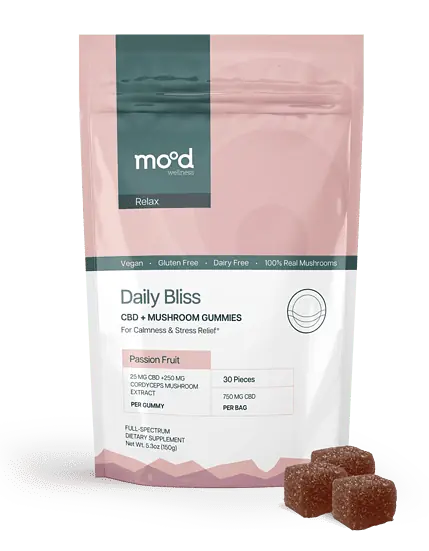
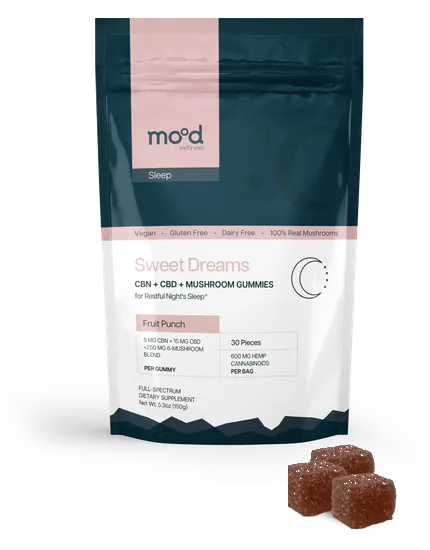
Mood's current Sweet Dreams CBD + CBN mushroom gummy page states 15 mg CBD and 5 mg CBN per gummy, six mushroom ingredients and organic full-spectrum hemp extract.
That makes it a multi-ingredient, full-spectrum option, not a verified THC-free CBN gummy. “Full-spectrum” should not be converted into an invented THC number. Before purchase or use, check the current package and matching batch documentation for the measured cannabinoid profile, serving instructions and any formula changes.
The product may fit a shopper intentionally seeking its disclosed combination. It does not fit someone whose non-negotiable requirement is a verified THC-free CBN product. The article's comparison method applies to Mood as it does to any other seller.
A five-step selection checklist
- Set the THC boundary. Decide whether THC is wanted, acceptable or disqualifying before comparing benefit language.
- Copy exact amounts. Record CBN, THC, CBD and every other active per gummy and serving.
- Match the batch evidence. Verify identity, date, units, analytes and reporting limits.
- Screen real-world constraints. Include driving, work, testing, medications, alcohol and household storage.
- Reject the universal-winner claim. Select a documented formula that fits the boundary; do not infer better sleep from THC inclusion or exclusion.

Bottom Line: CBN Gummies with vs without THC
The difference between CBN gummies with and without THC is not a marketing nuance. It changes cannabinoid exposure, the possibility of intoxication and impairment, and the relevance of driving and drug-test constraints.
A THC-free choice is only as credible as its finished-product evidence. A THC-containing choice is only as interpretable as its per-gummy amount and current report. Neither label category proves better sleep, and the current human literature does not establish a universal winner.
Define the THC boundary first, normalize every active ingredient second, and use the current batch evidence, not “nighttime,” “full-spectrum” or “entourage” language, to make the comparison.
Quick answers
Frequently asked questions about CBN Gummies With vs Without THC
What is the practical answer about CBN Gummies With vs Without THC?
The difference between CBN gummies with and without THC is not a marketing nuance. It changes cannabinoid exposure, the possibility of intoxication and impairment, and the relevance of driving and drug-test constraints. A THC-free choice is only as credible as its finished-product evidence. A THC-containing choice is only as interpretable as its per-gummy amount and current report.
Which Mood product fits this topic?
Sweet Dreams is the most relevant Mood option for this topic. Mood Sweet Dreams combines CBD, CBN and functional mushrooms in a premeasured gummy for shoppers who prefer a simple nighttime format.
What should I compare before choosing a gummy?
Compare the cannabinoid amount per measured serving, the complete ingredient list, spectrum or THC information, current product directions and available batch documentation. The best choice is the formula that fits the goal and is easy to use consistently.
How should I start using a new CBD or cannabinoid product?
Follow the current package directions, choose a low-demand first-use window and keep timing and meal context reasonably consistent. Review medication, pregnancy, liver and impairment considerations with a qualified clinician when relevant.
References
- US Food and Drug Administration. What You Need to Know About Products Containing Cannabis or Cannabis-derived Compounds, Including CBD.
- Kaufmann CN, et al. A randomized controlled trial of cannabinol with and without cannabidiol for sleep. Sleep Medicine. 2024.
- Walsh JH, et al. Acute effects of oral THC and CBD on sleep in people with insomnia. Randomized controlled pilot study.
- Evaluation of a proprietary THC, CBN and CBD softgel in adults with sleep disturbance. Randomized double-blind crossover pilot.
- Cannabinol-alone crossover trial in adults with insomnia. Randomized double-blind placebo-controlled study.
Editorial boundary: Evidence was evaluated at the level of the tested formula, amount, route, population and endpoint. No cited study supports a general claim that THC-containing CBN gummies are superior to THC-free CBN gummies.