What each ingredient is, and why “together” matters
CBN, or cannabinol, is a cannabinoid. It is often marketed for nighttime use, but direct human evidence remains limited and formula-specific. Melatonin is a hormone involved in circadian timing and is sold as a dietary supplement in the United States.
Using them together creates at least three separate questions:
- Effectiveness: does the combination improve a defined sleep outcome more than either relevant comparator?
- Pharmacodynamic safety: could drowsiness, dizziness or impaired alertness add up?
- Pharmacokinetic interaction: could one ingredient change how the body metabolizes or is exposed to the other?
A trial that measures sleep disturbance may inform the first question and report common side effects, but it cannot exhaust every interaction with every medication. A laboratory metabolism study can identify a mechanism worth investigating, but it cannot predict a person's outcome by itself.

What the direct human combination trial found
A double-blind randomized trial enrolled 1,793 adults with symptoms of sleep disturbance. Participants received one of six capsule products for four weeks. The products contained 15 mg CBD or 5 mg melatonin, alone or combined with minor cannabinoids.
One arm contained 15 mg CBD, 15 mg CBN and 5 mg melatonin. This is direct human exposure to the three-ingredient combination, but it is not a CBN-plus-melatonin-only study and it did not use gummies.
All groups improved from their own baselines on the self-reported PROMIS Sleep Disturbance measure. Yet the central comparative result was less dramatic: the researchers found no significant difference between 15 mg CBD isolate and formulations containing 5 mg melatonin, alone or combined with 15 mg CBD and 15 mg CBN. Adding 15 mg CBD and 15 mg CBN also did not significantly improve the melatonin formulation's overall sleep-disturbance effect.
Across all formulations, 12% of participants reported a side effect, and none were classified as severe. That is useful short-term group evidence. It is not proof that a different gummy, dose, duration or user will have the same experience.
The study used remote weekly surveys and commercially relevant but specific capsules. It did not establish driving safety, test every medication combination or isolate whether CBN changes melatonin exposure in humans.
What the preclinical interaction study adds
Melatonin is metabolized substantially through the liver enzyme CYP1A2. A 2024 study examined whether CBN could inhibit CYP1A2-mediated melatonin metabolism. The researchers reported inhibition in preclinical systems, including in vitro and animal work.
This matters because slowing metabolism could theoretically alter melatonin exposure. But the evidence boundary is essential:
- it is not a controlled human interaction trial;
- it does not establish a consumer dose threshold;
- it does not quantify how much a person's melatonin level would change;
- it does not prove a particular symptom or adverse event; and
- it does not show that every retail combination is unsafe.
The correct conclusion is “plausible interaction requiring human study and individualized caution,” not “proven dangerous interaction” and not “no interaction.”
Why more ingredients do not prove better sleep
Combination marketing often implies that two nighttime ingredients must reinforce one another. The human trial does not support that assumption. The CBD + CBN + melatonin arm did not significantly outperform the relevant isolate or comparator arms on the primary comparative framework.
This does not prove the ingredients can never help any individual. It does show why “synergy,” “enhanced” and “works better together” require direct product-matched evidence rather than ingredient reputation.
For the broader comparison between cannabinoid and melatonin evidence, use Mood's CBD gummies without melatonin guide. For CBN sleep claims specifically, see the CBD and CBN sleep evidence review.

Build the complete-formula inventory
Before asking whether two ingredients can be mixed, determine whether the product already contains both, and what else it contains.
| Field | Product one | Product two | Combined total or finding |
|---|---|---|---|
| CBN per unit/serving | |||
| Melatonin per unit/serving | |||
| CBD | |||
| Delta-9 THC/other THC | |||
| Other cannabinoids | |||
| Sedating medicines | |||
| Botanicals or mushrooms | |||
| Alcohol | Avoid combining | ||
| Serving directions | Follow each label; do not invent a stack | ||
| Current batch evidence | Product and lot must match |
Do not add package totals. Convert only when the denominator is clear, and keep unlike ingredients in separate rows. “Sleep blend” is not a melatonin or CBN amount.
If the same active appears in two products, accidental duplication is possible. If an amount is missing, record “not stated,” not zero.
Melatonin label accuracy is part of the safety question
A 2023 analysis measured melatonin in 25 gummy products sold in the United States. Twenty-two did not contain melatonin within 10% of the quantity declared on the label; measured amounts ranged from 74% to 347% of the labeled quantity among products containing detectable melatonin. One product contained no detectable melatonin, and several products also declared CBD.
This was a sample of products, not every melatonin gummy. It nevertheless shows why a label-based combination calculation can be falsely precise. Independent finished-product testing is more informative than a front-panel promise, although a certificate only supports the lot and analytes actually tested.
Mood's COA reading guide explains product, lot, sample, units and panel matching.

Who should pause and obtain individualized advice
Do not treat this as an exhaustive contraindication list. A clinician or pharmacist should review the complete formula when:
- you use prescription or over-the-counter medicines;
- you use blood thinners or have epilepsy, specifically highlighted in NIH melatonin guidance;
- you use sedatives, sleep medicines, antihistamines or other products that cause drowsiness;
- you have liver concerns or are preparing for surgery;
- you are pregnant or breastfeeding;
- you are an older adult or already experience daytime sleepiness;
- you have a history of unusual reactions to cannabinoids or melatonin;
- the product contains THC;
- you must drive, supervise others or perform safety-sensitive work the next morning; or
- sleep difficulty is persistent, worsening or associated with another symptom.
NIH's NCCIH notes that short-term melatonin use appears safe for most people, but long-term safety is not established. It also highlights medication interactions, pregnancy uncertainty and the possibility of longer activity and daytime drowsiness in older people.
Drowsiness, alcohol, driving and next-morning uncertainty
Both the intended use and possible adverse effects matter. Melatonin may cause sleepiness, dizziness, headache or nausea. CBN products often contain CBD, THC or other ingredients that can add their own drowsiness or impairment concerns.
Do not combine the mixture with alcohol or other substances that increase drowsiness without qualified guidance. Do not drive, operate machinery or perform safety-sensitive work while affected or uncertain. Feeling that it is “morning already” is not a test of alertness.
If a product contains THC, use the product-specific impairment warning and review drug-test constraints separately. A full-spectrum hemp label does not guarantee zero THC or a negative test.
Mood's CBN gummy duration guide explains why onset, felt duration, elimination and next-morning baseline are separate timelines.
Children, pregnancy and household storage
This article addresses adult product literacy, not pediatric use. NCCIH advises parents to work with a health care provider when considering melatonin for a child and documents increased reports of unsupervised pediatric ingestion. Flavored gummies should be stored out of children's sight and reach, ideally in secure packaging.
Pregnancy and breastfeeding lack adequate safety evidence for melatonin, and retail cannabinoid products create additional uncertainty. Seek qualified medical advice rather than combining them independently.
If you are already using one ingredient
Do not add the second ingredient simply to make the first “stronger.” First ask:
- What problem or endpoint are you trying to address?
- Is the current product fully characterized?
- Could the symptom require evaluation rather than another supplement?
- What medications and other sedating ingredients are already present?
- Is there a lower-complexity option that avoids an unnecessary combination?
Changing one variable at a time may make an experience easier to interpret, but this is not permission to self-experiment where clinician review is needed. Never stop or replace a prescribed treatment based on a supplement article.
How Sweet Dreams fits
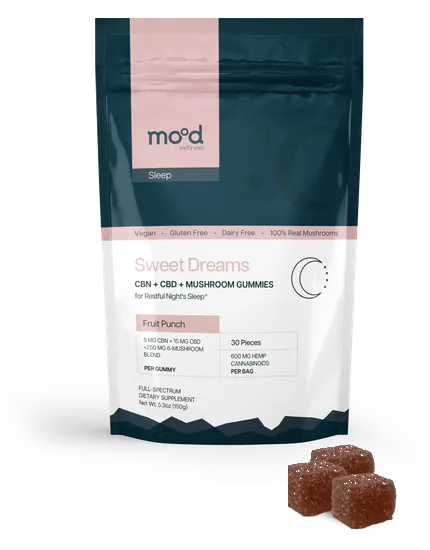
Mood's current Sweet Dreams CBD + CBN mushroom gummy states 15 mg CBD, 5 mg CBN, six mushroom ingredients and organic full-spectrum hemp extract per gummy. It is labeled melatonin-free.
That makes it an option for shoppers who specifically prefer not to add melatonin; it is not a CBN-only or interaction-free product. Full-spectrum hemp, CBD, CBN and six mushrooms still require complete-formula and medication review. The product page warns about drowsiness, driving, alcohol and other sedating substances.
Do not add a separate melatonin product because this article discusses the combination trial. The study used a different capsule formula and does not validate a home-built Sweet Dreams + melatonin stack.
Mood's melatonin-free CBD gummy guide owns the broader label comparison for shoppers avoiding melatonin.
Bottom Line: CBN and Melatonin Together
CBN and melatonin have been used together in a randomized human capsule trial, but the combination did not show a significant advantage over the relevant comparison formulations. Group-level short-term tolerability is not personal clearance, particularly when medication, THC, alcohol, older age, pregnancy or next-day safety is involved.
Preclinical research also raises a plausible CYP1A2-mediated interaction question that has not been quantified in people. That uncertainty argues for a complete label inventory and clinician or pharmacist review, not a confident universal yes or no.
Use the simplest documented formula that fits the decision. If avoiding melatonin matters, select a verified melatonin-free product rather than creating an unmeasured combination.
Quick answers
Frequently asked questions about Can You Take CBN and Melatonin Together? Evidence and Safety
What is the practical answer about Can You Take CBN and Melatonin Together? Evidence and Safety?
CBN and melatonin have been used together in a randomized human capsule trial, but the combination did not show a significant advantage over the relevant comparison formulations. Group-level short-term tolerability is not personal clearance, particularly when medication, THC, alcohol, older age, pregnancy or next-day safety is involved.
Which Mood product fits this topic?
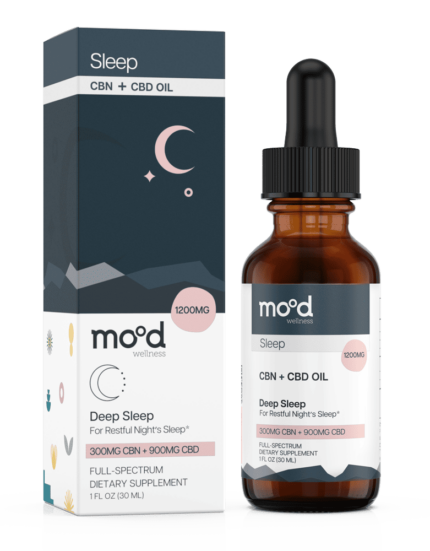
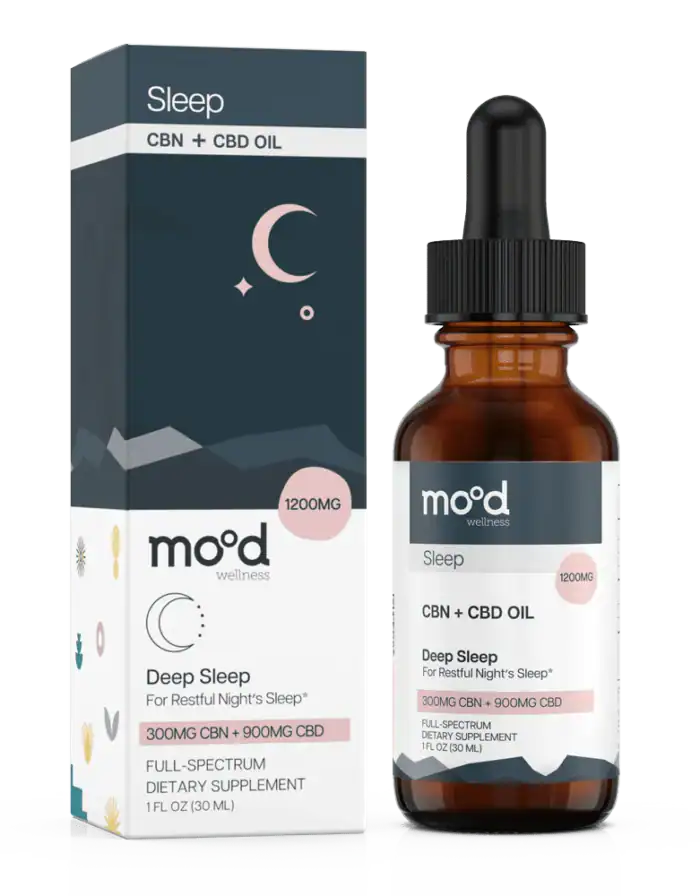
Deep Sleep is the most relevant Mood option for this topic. Mood Deep Sleep combines 900 mg CBD with 300 mg CBN in a CBD-forward 3:1 formula for shoppers who want broad evening calm and targeted nighttime support together.
What should I compare before choosing a product?
Compare the cannabinoid amount per measured serving, the complete ingredient list, spectrum or THC information, current product directions and available batch documentation. The best choice is the formula that fits the goal and is easy to use consistently.
How should I start using a new CBD or cannabinoid product?
Follow the current package directions, choose a low-demand first-use window and keep timing and meal context reasonably consistent. Review medication, pregnancy, liver and impairment considerations with a qualified clinician when relevant.
References
- National Center for Complementary and Integrative Health. Melatonin: What You Need To Know.
- Saleska JL, et al. The safety and comparative effectiveness of non-psychoactive cannabinoid formulations for sleep. Journal of the American Nutrition Association.
- Anderson LL, et al. Preclinical evidence for a drug–drug interaction between cannabinol and melatonin. Basic & Clinical Pharmacology & Toxicology.
- Cohen PA, et al. Quantity of melatonin and CBD in melatonin gummies sold in the US. JAMA.
- Kaufmann CN, et al. Cannabinol with and without cannabidiol for sleep. Randomized controlled trial.
Editorial boundary: The human trial tested defined capsules containing CBD, CBN and melatonin; the interaction study was preclinical. Neither establishes a universal recommendation, an individualized dose or a clinically quantified human interaction.