Hericenones and erinacines are not opposing ingredients
The names are often placed in a marketing face-off: hericenones equal fruiting body, erinacines equal mycelium, and one side supposedly wins. Chemistry is less tidy.
“Hericenones” refers to a related family rather than one single molecule. The same is true of “erinacines.” A paper may study hericenone C, hericenone E, erinacine A or another member, each with its own analytical identity and experimental context. A generic statement about the family should not be treated as proof about every member.
Researchers also study whole powders, extracts, fractions and enriched preparations. Results from an isolated molecule do not automatically describe a whole mushroom powder. Results from an erinacine A-enriched mycelial extract do not automatically describe ordinary mycelium. The tested material is part of the evidence, not a footnote.
| Comparison field | Hericenones | Erinacines |
|---|---|---|
| What the name describes | A family of aromatic Lion’s Mane metabolites | A family of cyathane diterpenoid Lion’s Mane metabolites |
| Common research association | Frequently isolated and discussed in fruiting-body research | Frequently isolated and discussed in mycelial culture research |
| What the name does not prove | Amount, bioavailability, clinical effect or finished-product content | Amount, enrichment, clinical effect or finished-product content |
| Strong retail evidence | Named analyte, validated method, unit, sampled material and matching lot | Named analyte, validated method, unit, sampled material and matching lot |
| Common overreach | “Fruiting body therefore high in hericenones” | “Mycelium therefore clinically potent erinacines” |

What the tissue association really means
A 2025 natural-products paper describes the research group’s earlier isolation of hericenones C through H from fruiting bodies and erinacines A through I from mycelia. That is a useful description of those investigations. It is not a universal law that every fruiting body contains a declared amount of every hericenone or that every mycelial ingredient contains a declared amount of every erinacine.
Species, strain, substrate, growth conditions, harvest timing, tissue, extraction solvent and processing can all influence what an analysis finds. Recent work comparing tissues and culture conditions also treats erinacine production as variable, not as a binary switch activated by writing “mycelium” on a label.
Use tissue as the first branch in a verification tree:
- Confirm the species as Hericium erinaceus.
- Identify fruiting body, mycelium, myceliated substrate or a defined combination.
- Identify whether the sample was raw material, extract or finished product.
- Ask which individual compounds were targeted.
- Read the actual result and reporting basis.
That sequence avoids two opposite mistakes: assuming fruiting bodies contain no relevant secondary metabolites beyond hericenones, or assuming any mycelium is an erinacine-enriched research material.
Presence is not quantity
An analytical method may detect a compound without establishing a standardized amount per serving. “Detected,” “quantified” and “standardized to” are different claims.
- Detected means the method found a signal meeting its identification criteria.
- Quantified means the laboratory estimated an amount under a stated method and unit.
- Standardized should identify a target or range that manufacturing controls are intended to meet.
Even a number needs a denominator. Milligrams per gram of dry extract, micrograms per gram of powder and milligrams per serving are not interchangeable. If a result is below the method’s limit of quantification, it should not be promoted as a precise serving amount.
A screenshot of a chromatogram without the method, analyte list, units, sample identity and laboratory conclusion is not enough for a shopper to reproduce the claim. Likewise, a supplier specification is not the same document as an independent result for the lot used in the finished product.
Compound amount is not biological potency
“Potency” is especially slippery in mushroom marketing. It can mean analyte concentration, a response in a laboratory assay, or a claimed effect in a person. Those are three different endpoints.
Suppose one extract reports erinacine A in milligrams per gram. That is a composition result. A cell experiment measuring nerve growth factor-related activity is a biological assay. A randomized human study measuring cognition or mood is a clinical experiment. No arithmetic converts the first result into the third.
The same caution applies to hericenones. Mechanistic interest is a reason for more research, not permission to promise memory improvement, nerve repair or protection from disease. Dose, preparation, route, population, duration and endpoint all need to align before evidence can support a specific human statement.
What human studies can and cannot settle
Human Lion’s Mane studies do not form a single standardized evidence package. Researchers have tested different preparations, doses, populations and durations. Some reports do not provide the compound-level characterization a shopper would need to match a commercial supplement.
A 2025 double-blind randomized placebo-controlled crossover study tested an acute three-gram dose of a standardized 10:1 fruiting-body extract in 18 healthy adults aged 18 to 35. The study assessed cognition and mood and reported limited acute findings. It did not compare a hericenone-standardized product with an erinacine-standardized product, and it cannot establish that one compound family is superior.
Reviews of erinacine-enriched mycelium discuss promising neurobiological findings while emphasizing that much of the evidence is preclinical and difficult to extrapolate to clinical use. “Enriched with erinacines” is also a preparation-specific description. It should not be shortened to “all mycelium works this way.”
When a brand cites research, match at least these fields:
| Research field | Matching question |
|---|---|
| Species | Was the tested organism H. erinaceus? |
| Material | Fruiting body, cultured mycelium, isolated compound or mixture? |
| Preparation | Powder, water extract, alcohol extract or enriched fraction? |
| Characterization | Were named hericenones or erinacines actually measured? |
| Amount | Physical amount and any verified marker amount? |
| Population | Healthy adults, older adults or a clinical group? |
| Schedule | One dose or repeated use over weeks? |
| Endpoint | Laboratory mechanism, questionnaire, cognitive task or diagnosis? |
If several fields do not match, describe the study as background research rather than product proof.
Keep beta-glucan and extract ratio in separate columns
Beta-glucans are polysaccharides. Hericenones and erinacines are different kinds of secondary metabolites. A beta-glucan percentage does not calculate either compound family, and a hericenone or erinacine result does not replace beta-glucan testing.
The beta-glucan label guide explains method, dry-versus-as-is basis and per-serving math. That is the right place for the broader beta-glucan decision.
An extract ratio is different again. A value such as 8:1 or 10:1 describes a manufacturing mass relationship under a convention. It cannot reveal retained compounds by itself. Mood’s Lion’s Mane extract-ratio guide explains why the input, fresh/dry basis, native extract and added carriers matter.
Use three columns:
- Process: fungal material, extraction method and ratio.
- Composition: measured beta-glucan and any named secondary metabolites.
- Evidence: what the exact preparation has been tested to do.
Collapsing those columns is how “10:1,” “30% polysaccharides” or “contains erinacines” becomes an unsupported outcome claim.

How to verify a hericenone or erinacine claim
Start with a complete claim sentence. “Tested for erinacines” is incomplete. A useful statement would identify a specific sample and say which named analytes were measured, by which laboratory method, in what units and with what result.
Use this worksheet:
| Field | What to record |
|---|---|
| Product and lot | Exact finished product, batch or lot number |
| Mushroom identity | Scientific species and fungal material |
| Ingredient form | Powder, extract or enriched preparation |
| Named analyte | Specific hericenone(s) or erinacine(s), not only a family word |
| Method | Chromatographic or other validated procedure and reference |
| Result | Value, units, basis and any limit of quantification |
| Sample | Raw ingredient or finished gummy/capsule |
| Date and lab | Test date, laboratory identity and report authorization |
| Connection | Evidence that the tested sample belongs to the purchased lot |
Advanced natural-products analysis may use liquid chromatography and mass spectrometry or nuclear magnetic resonance during compound identification. A consumer report does not need to teach the full instrumentation, but it should not hide behind “proprietary testing.” The method must be suitable for the named analyte and matrix.

Why a cannabinoid COA may not answer the mushroom question
A combined CBD, CBG and Lion’s Mane product can have a legitimate cannabinoid potency report that says nothing about hericenones or erinacines. Laboratories analyze requested panels. Passing one panel does not imply that every ingredient was characterized.
Check the analyte table rather than the “third-party tested” badge. If the report lists cannabinoids, solvents, pesticides, metals or microbes but no named Lion’s Mane compounds, record the marker result as not tested or not shown, not zero, and not verified.
Mood’s mushroom gummy COA guide explains how to match product, lot, matrix and panel. The mushroom extraction guide separately explains what the manufacturing process can and cannot imply.
How Mind Food fits
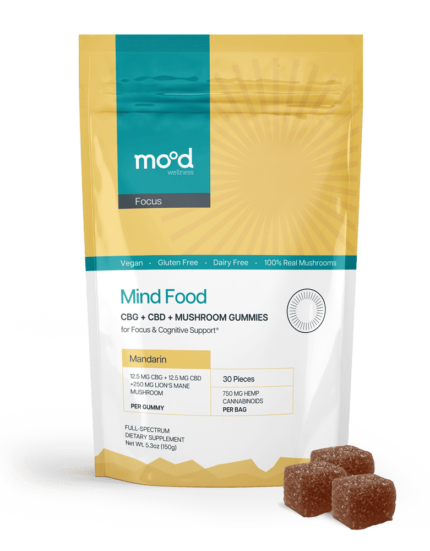
The current Mood Mind Food product page describes each gummy as containing 250 mg of Lion’s Mane fruiting-body extract, together with 12.5 mg CBD and 12.5 mg CBG. It also states no mycelium, grain or fillers for the Lion’s Mane material.
Those are first-party product facts. They support the statements “fruiting-body extract” and “250 mg per gummy” for the current page. They do not, by themselves, verify a hericenone concentration. Because the formula is described as fruiting-body extract rather than mycelium, this guide also does not imply an erinacine amount.
Mood’s lab-results hub links a report for Mind Food, but the reviewed public information did not provide a verified finished-product hericenone or erinacine assay that can be responsibly quoted here. The honest entries are:
- fungal material: fruiting-body extract, according to the current product page;
- physical amount: 250 mg per gummy, according to the current product page;
- hericenone amount: not verified in the reviewed public materials;
- erinacine amount: not verified in the reviewed public materials; and
- clinical equivalence: not established.
That disclosure is more useful than decorating the product with research vocabulary it has not documented.
A practical selection rule
Choose based on the claim you can verify, not the compound story you prefer.
If a product makes no hericenone or erinacine claim, assess its species, material, physical serving amount, extraction documentation, beta-glucan evidence and contaminant panels on their own terms. Do not penalize it for omitting an unverified marker.
If a product makes a quantified marker claim, require a matching analytical chain. Confirm the specific compound, method, unit, sample and lot. Then keep that composition result separate from any claim about focus, memory, mood or neurological health.
If a product cites a human trial, compare the tested preparation against the product. A shared mushroom name or tissue type is not enough. The closer the claim moves toward a medical or cognitive outcome, the closer the evidence match must be.

Bottom Line: Hericenones vs Erinacines
Hericenones and erinacines are scientifically interesting Lion’s Mane compound families with different chemical identities and commonly reported tissue associations. They are not rival badges that let shoppers rank every fruiting-body and mycelium product.
Read the nouns before the promise: species, tissue, preparation, named analyte, method, unit, sample and lot. Treat preclinical mechanisms as preclinical. Treat one human study as evidence about its tested preparation. Keep beta-glucan percentage, extract ratio, secondary-metabolite content and human outcomes in separate columns.
For Mind Food, the reviewed page supports fruiting-body extract and 250 mg per gummy. It does not support a quantified hericenone or erinacine statement. Leaving that field unknown is not a weakness in the analysis; it is the line between documentation and inference.
Quick answers
Frequently asked questions about Hericenones vs Erinacines
What is the practical answer about Hericenones vs Erinacines?
Hericenones and erinacines are scientifically interesting Lion’s Mane compound families with different chemical identities and commonly reported tissue associations. They are not rival badges that let shoppers rank every fruiting-body and mycelium product. Read the nouns before the promise: species, tissue, preparation, named analyte, method, unit, sample and lot.
Which Mood product fits this topic?
Mind Food is the most relevant Mood option for this topic. Mood Mind Food combines CBD, CBG and Lion’s Mane in a stimulant-free gummy designed for a calm, focused daytime routine.
What should I compare before choosing a product?
Compare the cannabinoid amount per measured serving, the complete ingredient list, spectrum or THC information, current product directions and available batch documentation. The best choice is the formula that fits the goal and is easy to use consistently.
How should I start using a new CBD or cannabinoid product?
Follow the current package directions, choose a low-demand first-use window and keep timing and meal context reasonably consistent. Review medication, pregnancy, liver and impairment considerations with a qualified clinician when relevant.
References
- Friedman M. Chemistry, Nutrition, and Health-Promoting Properties of Hericium erinaceus Fruiting Bodies and Mycelia. Journal of Agricultural and Food Chemistry. 2015.
- Wang J, et al. Uncovering Hericenones from the Fruiting Bodies of Hericium erinaceus. Journal of Natural Products. 2025.
- Li IC, et al. Neurohealth Properties of Hericium erinaceus Mycelia Enriched with Erinacines. International Journal of Molecular Sciences. 2018.
- Docherty S, et al. Acute effects of a standardised extract of Hericium erinaceus on cognition and mood. Randomized placebo-controlled crossover study.
- Mood Wellness. Mind Food CBD + CBG + Lion’s Mane Gummies. Current first-party product information reviewed September 10, 2026.
- Mood Wellness. Lab Results. Current first-party report index reviewed September 10, 2026.
Evidence boundary: Compound isolation, cell experiments and animal studies do not establish a consumer health result. Human research on one specified preparation does not validate a whole compound family or an unmatched retail product.