Start with the mushroom name
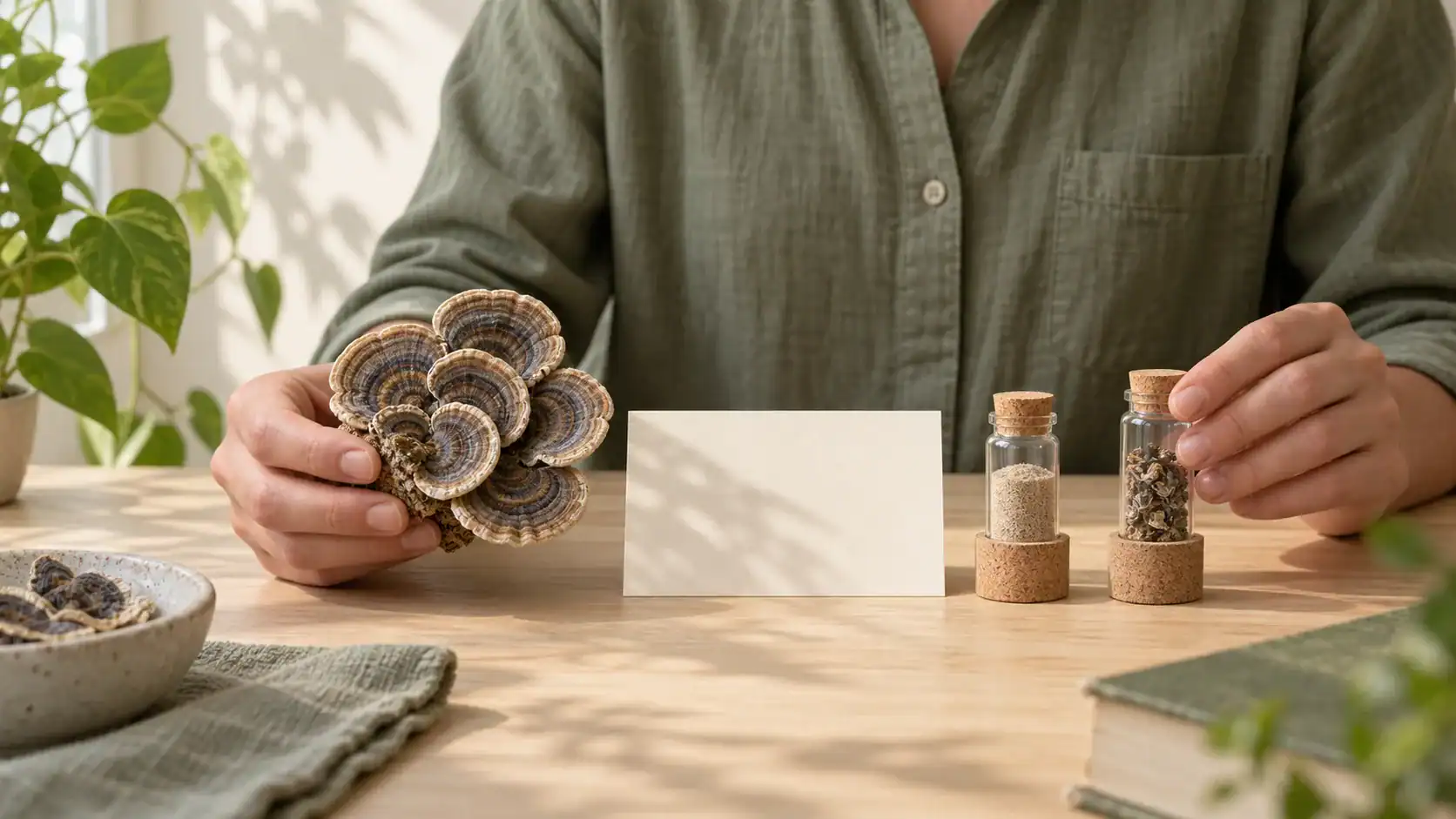
Turkey Tail’s accepted scientific name is Trametes versicolor. Older medical and natural-products literature often uses Coriolus versicolor. Seeing those two names in citations does not by itself indicate two different mushrooms.
The organism name is only the first layer. A study may use cultivated mycelium, fruiting bodies, a hot-water extract, a fermented product or a purified fraction. Two interventions can share the same species while differing substantially in production and composition.
For research matching, record:
- current and historical species name;
- strain identifier, if provided;
- fruiting body, mycelium or other material;
- cultivation and fermentation details;
- extraction and purification process;
- compositional specification; and
- actual administered product.
Mood’s Turkey Tail evidence guide owns the broad benefits, safety and research overview. This page addresses only the PSK/PSP identity problem.
What PSK is
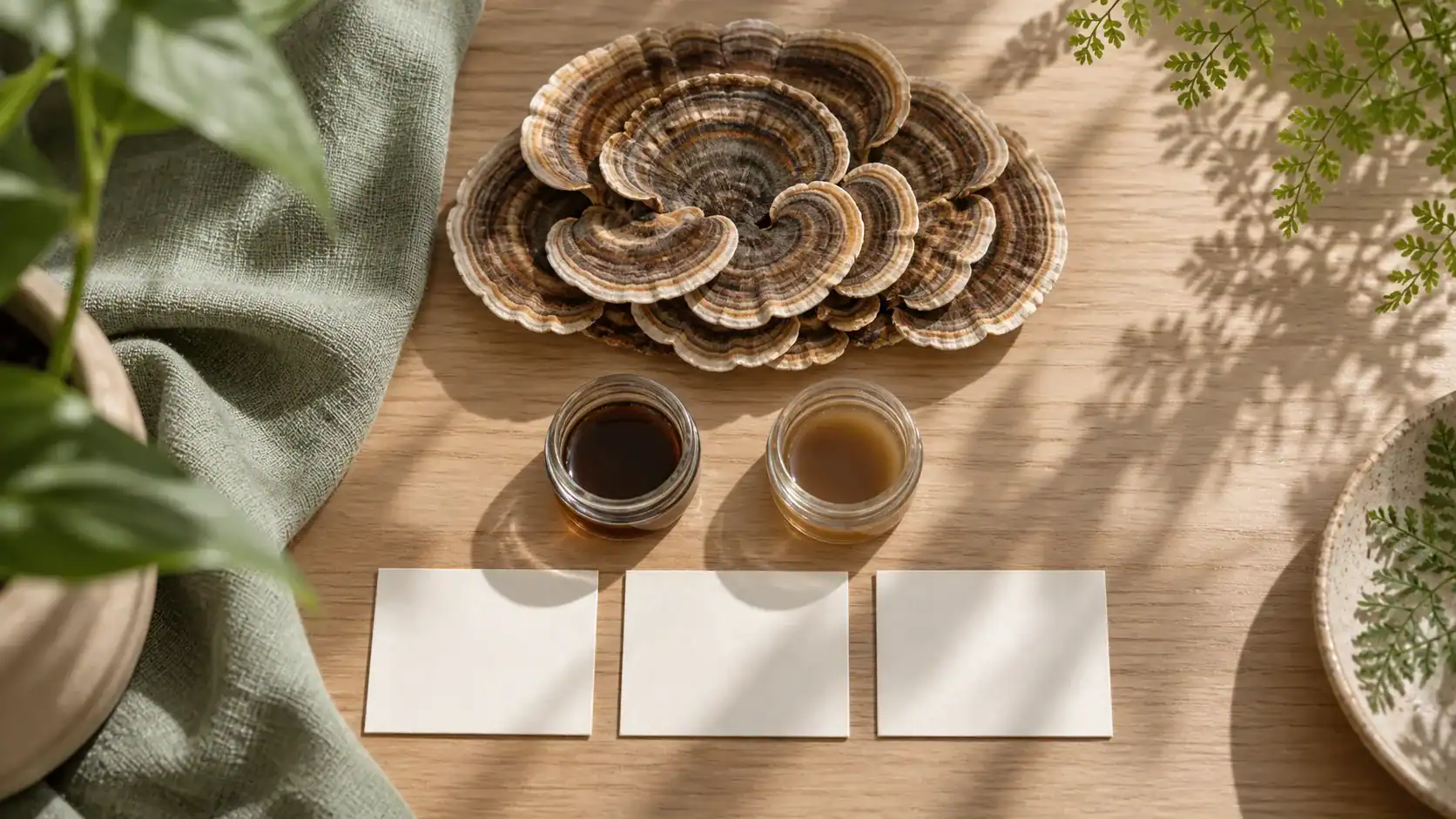
The National Cancer Institute describes PSK as a purified hot-water extract prepared from cultivated T. versicolor mycelium and used in Japan as an adjunct to conventional cancer treatment. PSK is also called krestin and is associated with a proprietary formulation.
“Adjunct” matters. The research context generally does not involve substituting PSK for surgery, chemotherapy, radiotherapy or other standard treatment. Studies examine it alongside conventional care in defined patient groups.
PSK is a complex mixture rather than one small, simple molecule. Calling it “polysaccharide-K” does not mean that any isolated polysaccharide with a similar linkage pattern becomes PSK. The strain, manufacturing and product specification are part of its identity.
Japan’s clinical and regulatory history also cannot be imported into a US product page by implication. An ingredient used as a regulated therapeutic adjunct in one jurisdiction is not automatically an FDA-approved drug, generally recognized treatment or equivalent dietary supplement in another.
What PSP is
PSP stands for polysaccharopeptide. Reviews describe it as a protein-containing polysaccharide preparation isolated from a different C. versicolor strain than PSK. PSP has been produced and studied extensively in China, including preclinical work and clinical studies in oncology settings.
An older chemistry review describes PSK and PSP as chemically similar but notes differences in their sugar composition. That supports treating them as related, not identical.
PSP is also not a generic name for “Turkey Tail polysaccharides.” A retail ingredient can contain polysaccharides and peptides without being the defined PSP preparation used in a paper. The acronym carries a preparation history, not merely a chemical category.
PSK and PSP side by side
| Field | PSK | PSP |
|---|---|---|
| Expanded name | polysaccharide-K / krestin | polysaccharopeptide |
| Species naming in literature | Trametes or Coriolus versicolor | Trametes or Coriolus versicolor |
| Source described by NCI/reviews | cultivated mycelial hot-water extract; proprietary product | cultured mycelial preparation from a different strain |
| Development context | Japan | China |
| Main clinical context | adjunctive oncology research/use | preclinical and limited clinical oncology research |
| Same product? | No | No |
| Equivalent to generic Turkey Tail extract? | No | No |
| Established by beta-glucan percentage? | No | No |
This table does not rank effectiveness. Head-to-head superiority cannot be inferred from separate studies conducted in different diseases, treatment regimens, eras and health systems.
Why beta-glucans do not establish PSK or PSP
Beta-glucans are a broad group of glucose polymers found in fungal materials. PSK and PSP include protein-bound polysaccharide components, but that overlap does not make every beta-glucan material PSK or PSP.
A beta-glucan assay may estimate a defined carbohydrate fraction. It generally does not identify a proprietary PSK product, a specific PSP preparation, strain or protein-polysaccharide architecture. Conversely, a PSK or PSP name does not reveal the result of a modern total-minus-alpha beta-glucan assay unless that test is supplied.
Keep four claims separate:
- “contains Turkey Tail” identifies an organism ingredient at a broad level;
- “contains beta-glucans” describes a chemical class;
- “tested at X% beta-glucan” is a quantitative method-dependent result; and
- “contains PSK” or “contains PSP” asserts a specific preparation identity.
Mood’s beta-glucan guide owns assay method, dry/as-is basis and serving calculations.
“Polysaccharide” is too broad for research matching
Older mushroom literature and marketing sometimes use total polysaccharides as a quality proxy. That category can include beta-glucans, alpha-glucans and other carbohydrates. In myceliated grain products, starch from substrate can contribute to broad carbohydrate results.
PSK and PSP are chemically complex, preparation-linked materials. A high total-polysaccharide percentage does not show that the same structure, protein association or manufacturing history is present.
If a seller cites a PSK trial beside a label that states only “Turkey Tail extract,” the missing bridge includes:
- strain;
- mycelial versus fruiting-body source;
- extraction and purification;
- compositional fingerprint;
- physical amount;
- clinical context; and
- concurrent therapy.
Without that bridge, the trial is background about a different intervention.

What the clinical evidence actually studies
The NCI’s professional evidence summary describes PSK research primarily in cancer patients receiving conventional treatment. It notes PSK’s use as an adjunctive cancer treatment in Japan and summarizes studies across several cancer types. This is not a finding that grocery-store Turkey Tail prevents or treats cancer.
A 2003 double-blind placebo-controlled randomized pilot study enrolled people with advanced non-small-cell lung cancer who had completed conventional treatment and tested a specified PSP preparation for 28 days. It assessed immune and clinical measures in a small, highly specific patient population. It does not establish benefits for healthy adults, preventive use, a generic Turkey Tail capsule or a CBD/CBN gummy.
A 2023 systematic review of medicinal mushroom supplements in cancer concluded that the clinical evidence was inconclusive for routine recommendation. That high-level caution is important because positive individual studies may differ in quality, preparation, endpoints and treatment context.
Never translate an oncology-adjunct dose into consumer serving advice. The appropriate question for a patient is not “How many gummies equal the trial?” but “Does my oncology team consider this exact product appropriate with my treatment?”
Jurisdiction and regulatory context matter
PSK’s use in Japan is often presented online as if it were a universal approval. Regulatory decisions are product- and jurisdiction-specific. A medicine, adjunct or standardized product recognized in Japan does not confer FDA approval on a US dietary supplement.
In the United States, a retail supplement cannot become a cancer treatment merely by citing foreign use or mushroom research. Disease-treatment claims trigger a different legal and evidentiary context from ordinary supplement structure/function language.
For consumer content, use precise wording:
- “used as an adjunct in Japan” is not “approved worldwide”;
- “studied alongside conventional treatment” is not “replaces treatment”;
- “Turkey Tail-derived” is not “all Turkey Tail products”; and
- “research suggests” is not a direction for an individual patient.
Because product regulation and clinical guidance can change, oncology decisions require current professional review.
A research-to-product matching checklist
Use one row for the cited intervention and one for the product being sold.
| Match field | Research preparation | Retail product |
|---|---|---|
| Exact product name/manufacturer | ||
| Species and historical synonym | ||
| Strain | ||
| Fruiting body or mycelium | ||
| Fermentation/extraction | ||
| PSK or PSP identity specification | ||
| Composition/marker profile | ||
| Amount and schedule | ||
| Population and diagnosis | ||
| Concurrent treatment | ||
| Endpoint and duration | ||
| Jurisdiction/status |
A blank in the retail-product PSK/PSP identity row is decisive: do not describe it as the studied preparation.
What a COA can and cannot verify
A routine consumer COA might cover microbes, heavy metals, pesticides, residual solvents, beta-glucan or species identity. It will not prove PSK or PSP unless a suitable preparation-specific specification and method are explicitly included.
A report for incoming Turkey Tail ingredient does not independently verify how much of that ingredient was placed in each finished gummy. A cannabinoid potency report does not measure PSK, PSP or beta-glucan unless those appear as analytes.
For a strong chain, require:
- exact product and lot;
- sample type and matrix;
- named panel and method;
- result, units and specification;
- report date and laboratory; and
- explicit linkage between ingredient and finished production record.
Mood’s mushroom gummy COA guide explains this chain in detail.
How Mood’s current Turkey Tail formula fits
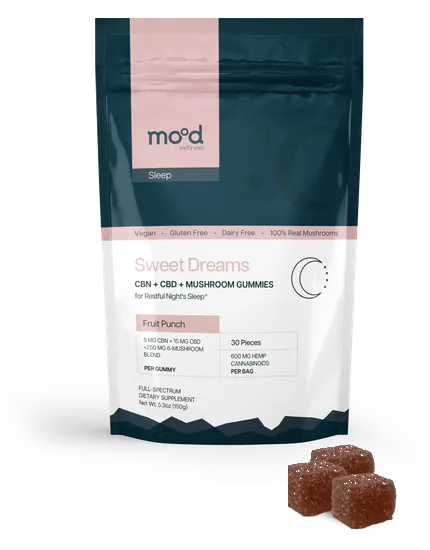
Mood’s current Sweet Dreams product information lists Turkey Tail among six mushroom fruiting-body extracts alongside Reishi, Cordyceps, Maitake, Shiitake and Agaricus blazei. The formula also contains CBD and CBN.
The reviewed visible page does not provide an individual Turkey Tail amount or state that the ingredient is PSK or PSP. It also does not establish a preparation-specific match to oncology research.
The accurate row is:
- species/common ingredient: Turkey Tail stated by the seller;
- material: fruiting-body extract stated by the seller;
- individual amount: not verified in the visible information reviewed;
- PSK identity: not claimed or verified;
- PSP identity: not claimed or verified;
- beta-glucan result: not verified here; and
- clinical equivalence: not established.
Because PSK and PSP are commonly described as mycelial preparations, a fruiting-body blend should especially not borrow their names without direct evidence. “Same species” would still be insufficient.
Safety for patients is not a generic disclaimer
Someone receiving chemotherapy, immunotherapy, radiation, surgery-related care or other cancer treatment should not rely on a retail article to add Turkey Tail. Immune effects, liver function, bleeding risk, product contamination, cannabinoid interactions and treatment-specific considerations may matter.
Bring the exact package, full ingredient list, serving information and lot report to the oncology team. Ask whether the evidence concerns the exact preparation, whether use could affect treatment or monitoring, and whether the clinician wants it stopped before a procedure.
Do not delay diagnosis or replace prescribed care with PSK, PSP or a mushroom supplement.
Bottom Line: PSK vs PSP in Turkey Tail
PSK and PSP are different, preparation-linked Turkey Tail products with distinct strain and development histories. They are related protein-bound polysaccharide materials, but they are not generic synonyms for Turkey Tail extract, beta-glucans or polysaccharides.
Match the exact product, strain, material, process, composition, amount, population and treatment context before transferring research. Preserve the jurisdiction boundary: Japanese adjunctive use of PSK does not make a US supplement an approved cancer therapy.
Mood’s current Turkey Tail-containing gummy is described as a six-mushroom fruiting-body blend. The reviewed public information does not identify PSK, PSP or an individual Turkey Tail amount. It should be evaluated as the product it is, not as a proxy for an oncology research preparation.
Quick answers
Frequently asked questions about PSK vs PSP in Turkey Tail
What is the practical answer about PSK vs PSP in Turkey Tail?
PSK and PSP are different, preparation-linked Turkey Tail products with distinct strain and development histories. They are related protein-bound polysaccharide materials, but they are not generic synonyms for Turkey Tail extract, beta-glucans or polysaccharides. Match the exact product, strain, material, process, composition, amount, population and treatment context before transferring research.
Which Mood product fits this topic?
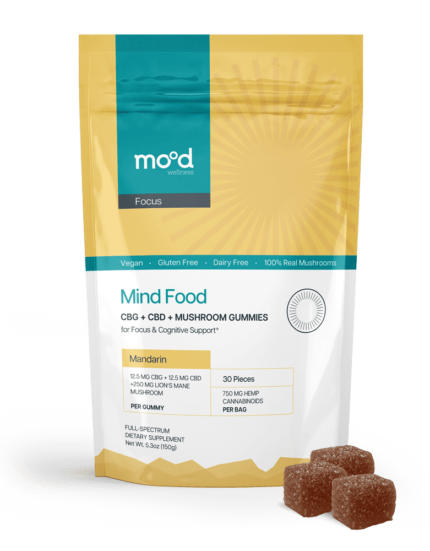
Mind Food is the most relevant Mood option for this topic. Mood Mind Food combines CBD, CBG and Lion’s Mane in a stimulant-free gummy designed for a calm, focused daytime routine.
What should I compare before choosing a product?
Compare the cannabinoid amount per measured serving, the complete ingredient list, spectrum or THC information, current product directions and available batch documentation. The best choice is the formula that fits the goal and is easy to use consistently.
How should I start using a new CBD or cannabinoid product?
Follow the current package directions, choose a low-demand first-use window and keep timing and meal context reasonably consistent. Review medication, pregnancy, liver and impairment considerations with a qualified clinician when relevant.
References
- National Cancer Institute. Medicinal Mushrooms (PDQ®), Health Professional Version. Current evidence summary reviewed September 10, 2026.
- Ng TB. A review of research on the protein-bound polysaccharide PSP from Coriolus versicolor. General Pharmacology. 1998.
- Saleh MH, et al. Preclinical and clinical studies of Coriolus versicolor polysaccharopeptide in China. 2017.
- Tsang KW, et al. Coriolus versicolor polysaccharide peptide in advanced non-small-cell lung cancer. Randomized pilot study, 2003.
- Hennicke F, et al. Medicinal Mushroom Supplements in Cancer: A Systematic Review of Clinical Studies. 2023.
- Mood Wellness. Sweet Dreams CBD + CBN 6-Mushroom Gummies. Current first-party information reviewed September 10, 2026.
Evidence boundary: Defined PSK or PSP findings cannot be generalized to an unmatched Turkey Tail powder, extract, blend or gummy. Oncology evidence must remain attached to the studied preparation, conventional-care context and clinician oversight.