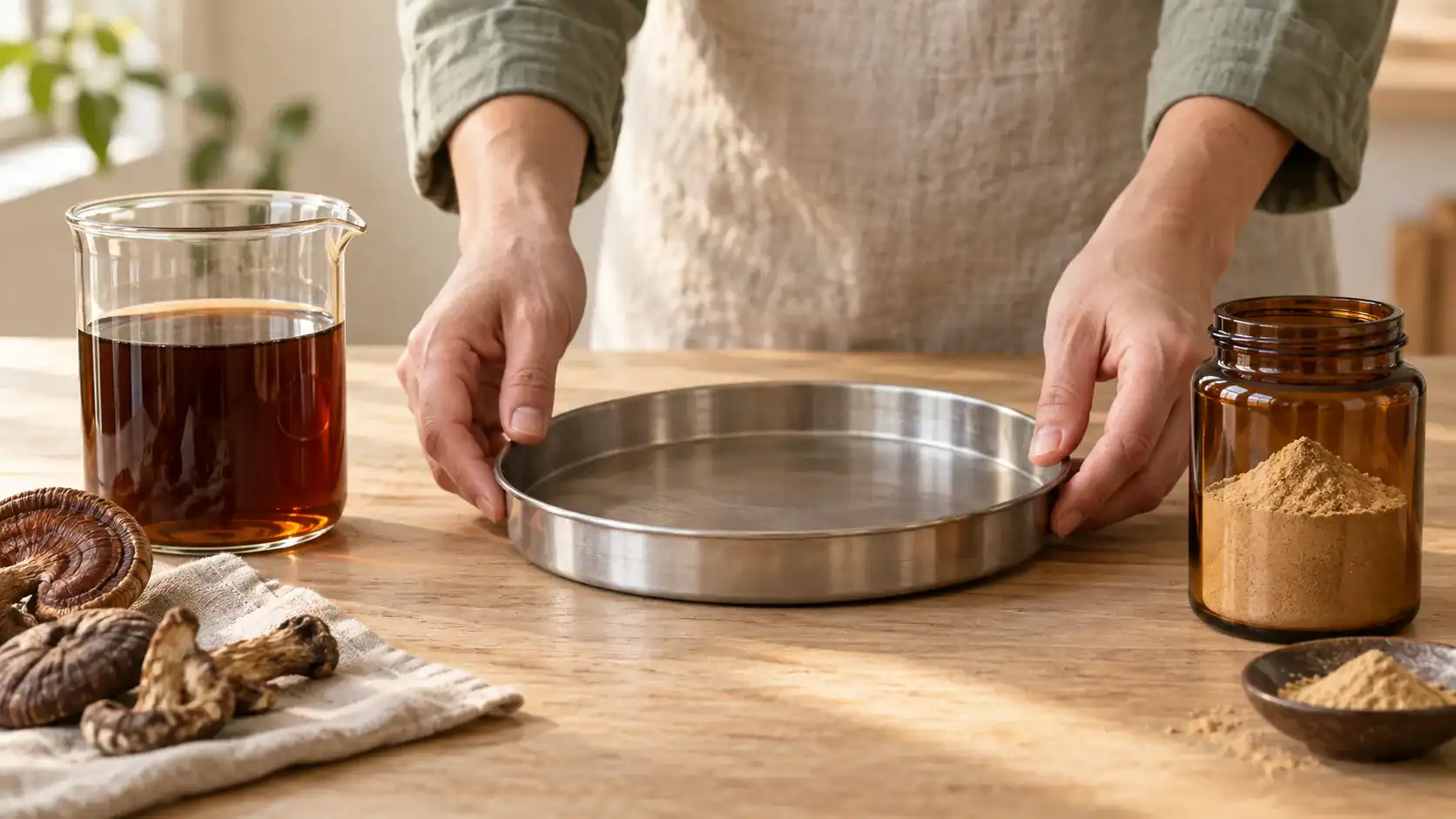
Why liquid extracts may need a carrier
Extracting mushrooms with water, alcohol or another permitted process produces a liquid containing dissolved and suspended solids. Removing the solvent does not always yield a powder that flows, stores or redisperses well. Some concentrates are sticky, hygroscopic or prone to clumping.
In spray drying, liquid feed is atomized into heated air so water evaporates quickly and particles are collected. A carrier can increase solids, reduce wall sticking, help protect components, improve powder recovery or create a more manageable finished material.
Peer-reviewed food research has used maltodextrin to microencapsulate mushroom extracts during spray drying. That establishes a plausible technical role. It does not prove that every commercial addition is necessary, optimally sized or transparently labeled.
Other carrier materials may include gum arabic, starch-derived ingredients or proteins. “Carrier-free” is not automatically superior if the resulting extract is unstable or cannot be manufactured consistently. The comparison should focus on disclosure, specification and verified composition.
Mood’s mushroom extraction-method guide owns the broader water, alcohol and process comparison.
Carrier versus filler is not a laboratory distinction
“Carrier” usually emphasizes function: the ingredient carries, encapsulates, stabilizes or enables drying. “Filler” usually suggests that material adds bulk without delivering the ingredient a shopper expects.
There is no simple concentration threshold at which maltodextrin chemically changes from carrier to filler. Context matters:
- Was it required for the process?
- Was the amount minimized or optimized?
- Is it declared?
- Does the stated extract mass include it?
- Are marker claims based on the carrier-containing powder?
- Does the product imply “pure mushroom” or “no fillers”?
Two suppliers could use the same amount for the same technical reason while describing it differently. Conversely, the word “carrier” should not shield a large, undisclosed mass contribution from scrutiny.
Use neutral language until documentation establishes intent and amount. “Maltodextrin is listed as an other ingredient” is evidence. “The company is padding the product” is an inference that needs more support.
Native extract and total extract powder
The cleanest mass model separates three objects:
- Native extract solids: material originating from the extracted mushroom after solvent removal.
- Carrier/excipient: maltodextrin or another material added for manufacturing or stability.
- Total extract powder: native extract plus added carrier and any other constituents in the supplied powder.
If a supplier combines 80 kilograms of native extract solids with 20 kilograms of maltodextrin, the total powder is 100 kilograms and the native fraction is 80%. A 500 mg serving of that exact total powder would contain 400 mg native extract solids and 100 mg carrier, assuming uniform mixing.
That example illustrates arithmetic, not an acceptable or typical industry ratio. Real products require the supplier’s actual specification and batch records.
The word “extract” on a label may refer to the total standardized powder rather than carrier-free native solids. Ask which definition the milligrams use.
Why the denominator changes marker percentages
Suppose 80 kg of native mushroom extract contains 20 kg of a measured marker. On a native-extract basis, the marker is 25%. After adding 20 kg of carrier, the same 20 kg marker is 20% of the 100 kg total powder.
Nothing disappeared; the denominator changed.
This is why two certificates can show different percentages for related material without proving that one test failed. One may report before carrier addition and the other after. Moisture basis can create another difference.
Before comparing percentages, record:
- native extract or total powder;
- dry basis or as-is basis;
- ingredient or finished product;
- method and analyte definition;
- lot and sample date; and
- any dilution during formulation.
Do not multiply a native-extract marker percentage by total-powder milligrams unless the specification explicitly connects them.
Worked label examples
Example A: carrier amount disclosed
A supplier states that an extract powder is 75% native mushroom extract and 25% maltodextrin. A capsule contains 600 mg of that powder.
- Native extract solids: 600 × 0.75 = 450 mg.
- Maltodextrin: 600 × 0.25 = 150 mg.
This is a composition calculation, not a potency or clinical-effect claim.
Example B: only “600 mg extract” appears
The Other Ingredients list includes maltodextrin, but the supplier does not state whether it is part of the 600 mg dietary-ingredient amount or added elsewhere in the capsule. Native extract mass cannot be calculated.
Example C: marker result has the wrong basis
A raw native extract is tested at 30% beta-glucan, then combined with carrier and placed in a gummy. Using 30% against the total gummy’s extract-powder milligrams overstates the marker unless the carrier fraction and formulation chain are accounted for.
When a required field is absent, label it unknown rather than choosing the most favorable interpretation.
What US supplement labels should disclose
FDA consumer guidance explains that dietary supplement labels include a Supplement Facts panel and a list of other ingredients not declared there. Other ingredients may include fillers, binders, excipients, preservatives, sweeteners and flavorings.
FDA’s ingredient-labeling guide also describes the placement of the Other Ingredients statement. The exact declaration can depend on how an ingredient and its source are presented, so a manufacturer should obtain qualified regulatory review rather than relying on this article.
For shoppers, inspect both places:
- Supplement Facts for the named dietary ingredient and amount per serving;
- Other Ingredients for maltodextrin, starches, flow agents and capsule/gummy components;
- parenthetical source or processing descriptions attached to the dietary ingredient; and
- front-panel claims such as “no fillers” against the full list.
An ingredient can be present in a compound raw material supplied to the finished-product manufacturer. The supplier documentation must carry that composition through to the final label decision.

Supplier specification versus retail label
The retail label is the public summary. The supplier specification usually contains the deeper manufacturing definition.
A useful extract specification states:
- scientific species and fungal material;
- input material and extraction solvent;
- native extract ratio or range, if used;
- total powder composition;
- carrier identity and percentage or range;
- moisture limits;
- physical characteristics;
- marker methods and acceptance criteria; and
- contaminant specifications.
The finished-product manufacturer should know whether the incoming 100 kg is 100 kg native extract or a carrier-containing powder. Batch formulation records then connect the supplied material to the number of gummies or capsules produced.
A supplier certificate without finished-product linkage cannot confirm the amount per unit. A retail label without the supplier definition cannot reveal a hidden denominator.
Can alpha-glucan testing reveal maltodextrin?
Maltodextrin is made from starch hydrolysis and consists of glucose polymers. Mushroom beta-glucan methods may separately estimate alpha-glucans and beta-glucans. An unexpectedly high alpha-glucan or starch-related result can prompt questions about substrate or added carbohydrate.
It does not uniquely identify maltodextrin. Alpha-linked carbohydrate can come from grain substrate, starch, other excipients or the material itself. The assay result must be interpreted with the formula and method.
Likewise, a low beta-glucan percentage does not prove filler. It could reflect species, tissue, extraction selectivity, carrier, moisture, analytical method or a genuine low-concentration material.
Use Mood’s beta-glucan supplement guide for the total-minus-alpha method and reporting basis. Do not turn one carbohydrate result into an ingredient-identification test.
“No grain” and “no fillers” are different claims
Grain can refer to substrate associated with mycelial production. Maltodextrin can be derived from starch crops and used after extraction as a carrier. A product could avoid myceliated grain yet still use maltodextrin, or use mycelium grown in liquid culture without either.
Therefore:
- “fruiting body” does not mean carrier-free;
- “no grain” does not necessarily mean no maltodextrin;
- “no maltodextrin” does not mean no other carrier;
- “extract” does not state carrier percentage; and
- “100% mushroom” needs a clear denominator and formula basis.
Ask the manufacturer to define each claim in terms of the ingredient supplied and the finished product.
What a COA can verify
A COA can report identity, marker content, moisture or contaminants for a specified sample. A routine certificate may not quantify maltodextrin unless the panel includes an appropriate targeted method.
The strongest evidence chain connects:
- supplier specification defining the carrier fraction;
- incoming ingredient lot certificate;
- batch formulation record;
- finished product and lot; and
- finished-product testing relevant to the claim.
A cannabinoid potency panel for a CBD mushroom gummy does not establish mushroom carrier content. A beta-glucan result for raw extract does not independently prove the per-gummy marker amount.
Mood’s mushroom gummy COA guide explains how to match product, lot, matrix and panel.
How Mood’s current mushroom claims fit
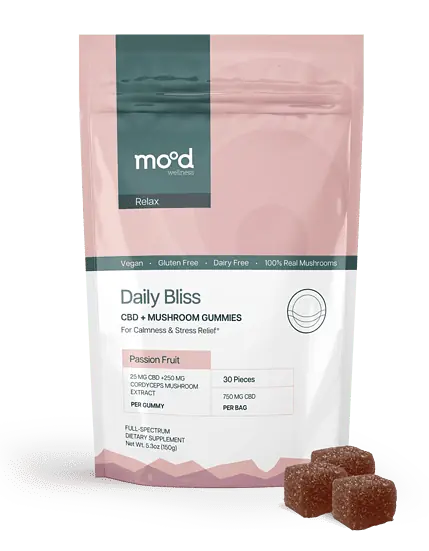
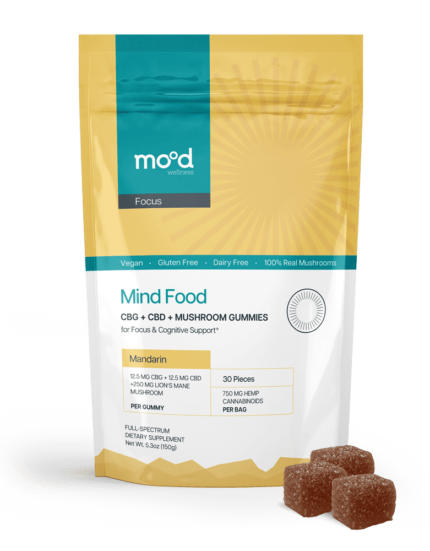
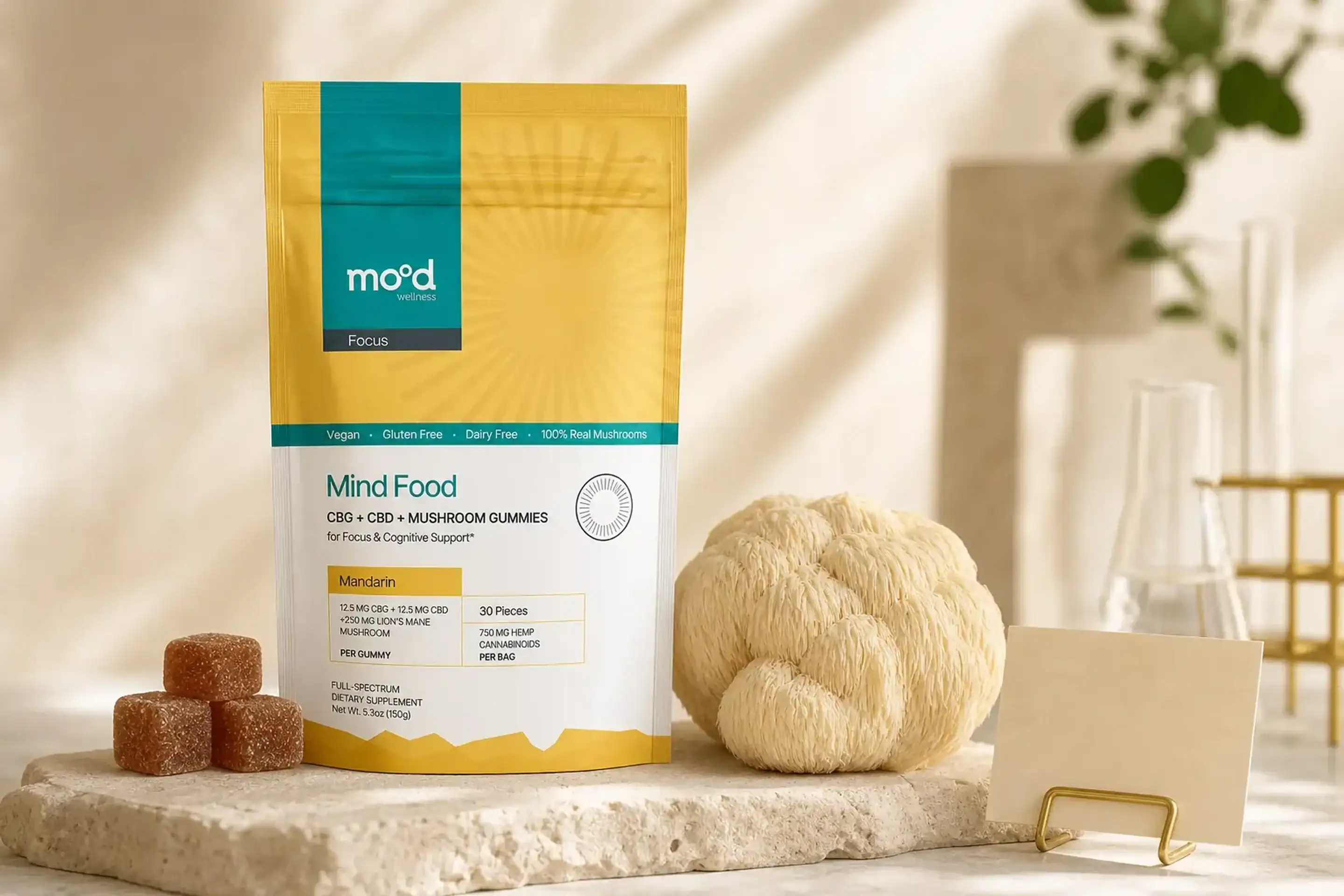
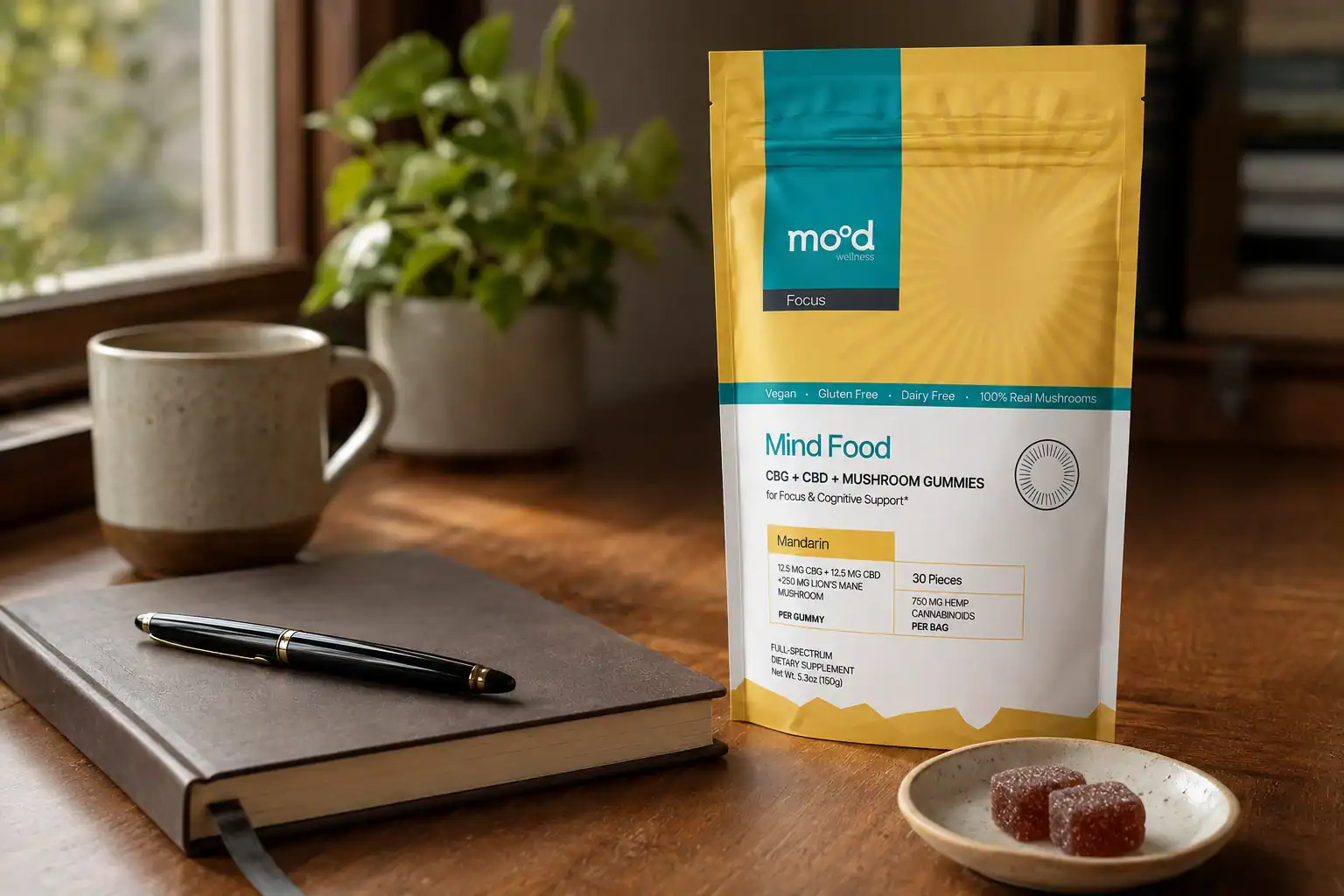
Mood’s current Daily Bliss page describes 250 mg Cordyceps militaris fruiting-body extract per gummy and states no mycelium, grain or starch fillers. The Mind Food page similarly describes 250 mg Lion’s Mane fruiting-body extract and states no mycelium, grain or fillers.
Those are current first-party seller statements. In the public material reviewed for this article, a supplier specification showing native-extract solids, carrier identity and carrier percentage was not available. Therefore:
- seller claim: no listed grain/fillers in the mushroom material;
- stated physical amount: 250 mg extract per gummy for each named product;
- maltodextrin percentage: not verified from a supplier specification;
- native-extract mass: not independently calculated; and
- finished-product mushroom-marker assay: not verified here.
Do not interpret missing carrier documentation as proof that maltodextrin is present. Do not convert “no fillers” into a verified supplier-level composition beyond what the reviewed page states.
A practical decision checklist
Ask these questions before ranking products:
- Is maltodextrin listed in Supplement Facts, a parenthetical source or Other Ingredients?
- Does the supplier call it a spray-drying carrier, encapsulant, flow aid or diluent?
- Is its fraction stated?
- Do labeled mushroom milligrams refer to native extract or total powder?
- Is the extract ratio based on native or total material?
- Are marker percentages before or after carrier addition?
- Is the basis dry or as-is?
- Was the ingredient or finished product tested?
- Does the report match the purchasable lot?
- Are “no grain,” “no fillers” and “carrier-free” defined separately?
If two products do not disclose the same fields, do not rank them by the largest extract number.
Bottom Line: Maltodextrin in Mushroom Extracts
Maltodextrin can perform a legitimate technical role in turning a liquid mushroom extract into a stable, manageable powder. It can also contribute substantial mass. “Carrier” does not make that mass disappear, and “filler” should not be alleged without evidence about use and disclosure.
Separate native extract solids, carrier and total powder. Match marker percentages to the correct denominator. Read both Supplement Facts and Other Ingredients, then ask for the supplier specification and lot connection when a claim depends on carrier-free or high-concentration material.
For Mood’s Daily Bliss and Mind Food, current pages state fruiting-body extracts, 250 mg per gummy and no grain/fillers. The supplier-level carrier percentage and native-extract calculation were not publicly verified in the materials reviewed, so those fields remain unknown rather than inferred.
Quick answers
Frequently asked questions about Maltodextrin in Mushroom Extracts
What is the practical answer about Maltodextrin in Mushroom Extracts?
Maltodextrin can perform a legitimate technical role in turning a liquid mushroom extract into a stable, manageable powder. It can also contribute substantial mass. “Carrier” does not make that mass disappear, and “filler” should not be alleged without evidence about use and disclosure. Separate native extract solids, carrier and total powder.
Which Mood product fits this topic?
Mind Food is the most relevant Mood option for this topic. Mood Mind Food combines CBD, CBG and Lion’s Mane in a stimulant-free gummy designed for a calm, focused daytime routine.
What should I compare before choosing a product?
Compare the cannabinoid amount per measured serving, the complete ingredient list, spectrum or THC information, current product directions and available batch documentation. The best choice is the formula that fits the goal and is easy to use consistently.
How should I start using a new CBD or cannabinoid product?
Follow the current package directions, choose a low-demand first-use window and keep timing and meal context reasonably consistent. Review medication, pregnancy, liver and impairment considerations with a qualified clinician when relevant.
References
- U.S. Food and Drug Administration. Questions and Answers on Dietary Supplements.
- U.S. Food and Drug Administration. Dietary Supplement Labeling Guide: Chapter V, Ingredient Labeling.
- Heleno SA, et al. Spray-drying microencapsulation of mushroom extracts. Food Chemistry. 2015.
- Šibul F, et al. Impact of freeze- and spray-drying microencapsulation on beta-glucan powder. 2022.
- Mood Wellness. Daily Bliss CBD + Cordyceps Gummies and Mind Food CBD + CBG + Lion’s Mane Gummies. Current first-party pages reviewed September 10, 2026.
Evidence boundary: A carrier’s technical function, laboratory composition and product value are different questions. No carrier calculation establishes a health outcome or the clinical superiority of an extract.