

The terminology hierarchy
Reishi chemistry is often compressed into one word: “triterpenes.” A better hierarchy is:
- Triterpenes/triterpenoids: a broad structural category found across many organisms.
- Ganoderma triterpenoids: compounds reported from species in the Ganoderma genus.
- Ganoderic acids: a named family of lanostane-type triterpenoids.
- Individual analytes: ganoderic acid A, B, C2, D and many others.
A 2023 review cataloged hundreds of triterpenoids reported across multiple Ganoderma species. That diversity makes the umbrella term useful for orientation but poor as a stand-alone specification.
| Claim wording | What it may mean | What is still missing |
|---|---|---|
| “Contains triterpenes” | broad qualitative statement | identity, amount, method and sample |
| “High in triterpenes” | undefined relative claim | comparator, method, basis and threshold |
| “30% total triterpenes” | assay-dependent estimate | reference standard, calculation and matrix |
| “Standardized ganoderic acids” | target for a named or grouped marker | analyte list, range, method and lot result |
| “Ganoderic acid A: x mg/g” | analyte-specific quantitative result | method, uncertainty, sample and lot match |
Do not convert a family statement into a named-compound amount. “10% triterpenes” does not mean 10% ganoderic acid A.
First verify what “Reishi” means
The Ganoderma lucidum complex has a complicated taxonomic history. Multilocus research has resolved numerous distinct species within material once grouped under the same name. In North American commerce, products sold as Reishi or G. lucidum may be associated with Ganoderma lingzhi or another species depending on source and naming practice.
This is not a reason to declare every label wrong. It is a reason to require a full scientific name and source documentation before applying species-specific chemistry.
DNA barcoding of the internal transcribed spacer region can support Ganoderma identity in suitable materials. A published product study amplified and sequenced powdered Reishi samples and interpreted them using phylogenetic analysis. That method answers an identity question; it does not quantify triterpenes.
Highly processed extracts can create different authentication challenges from intact or powdered tissue. A chemical fingerprint may help, but a marker profile and a species barcode are not the same evidence.
Mood’s mushroom supplement label guide covers the broader identity workflow.

Total-triterpene assays are estimates under a convention
One common research approach extracts material with an organic solvent, reacts the extract with color-forming reagents and reads absorbance against a reference compound such as ursolic acid. The result may be reported as equivalents of that reference per gram.
This can be useful for controlled comparisons when preparation, calibration and matrix are consistent. But the result is not a direct census of every molecular triterpene. Other substances may influence broad color reactions, individual triterpenes may respond differently, and laboratories may use different standards or calculation conventions.
Before comparing total-triterpene percentages, ask:
- What extraction solvent and sample preparation were used?
- Which color reaction or other total method was used?
- What reference standard defined the calibration curve?
- Is the result reported as equivalents of that standard?
- What material is the denominator?
- Was the same method used for both products?
If Product A reports “ursolic acid equivalents” and Product B reports a sum of six ganoderic acids by HPLC, their percentages are not head-to-head scores.
Targeted chromatography counts selected analytes
High-performance liquid chromatography separates compounds before detection. A published method quantified six named triterpenoids, ganoderic acids C2, B, AM1, K, H and D, in G. lucidum and related species. Other methods target nine compounds, dozens of compounds or untargeted features.
A sum from a targeted panel means “the analytes measured and reported by this method.” It does not equal all triterpenoids present in the sample. Expanding the panel can change the sum even if the underlying material is identical.
Mass spectrometry can add structural evidence and sensitivity, while authentic reference standards strengthen identification and quantitation. Tentative identification based on mass features is not the same as confirmation against an authentic standard.
For each targeted result, record:
- the named analytes;
- separation and detector type;
- reference standards;
- calibration range;
- identification criteria;
- limit of detection and quantification;
- unit and reporting basis; and
- whether values were individual or summed.
A chromatogram image without those fields is decoration, not enough evidence for a consumer claim.
Why the reference standard matters
In a broad assay, a reference standard provides the relationship between instrument response and reported “equivalents.” If the sample compounds do not respond exactly like the reference, the result remains a conventional estimate.
Suppose a report states 100 mg ursolic acid equivalents per gram. It does not mean the sample contains 100 mg of ursolic acid, and it does not establish 100 mg of named ganoderic acids. It means the measured response was translated through that calibration under the laboratory’s procedure.
In targeted chromatography, each authentic compound can have its own calibration curve. Where one reference is used to estimate related compounds, the report should disclose that approach. Different response factors can otherwise create false precision.
The phrase “lab tested” does not resolve the method. The report must show what was tested and how the number was defined.
Percentage needs a denominator
A percentage is a ratio, and the denominator determines its meaning. Reishi claims may be based on:
- dry whole fruiting-body powder;
- dry mycelial material;
- spores or broken-spore powder;
- native extract solids;
- total extract powder including carriers;
- an as-is ingredient with moisture; or
- a finished capsule or gummy.
Ten percent of a concentrated dry extract is not directly comparable with ten percent of whole powder if the methods and materials differ. A result reported per gram of extract cannot be multiplied by a serving unless the serving contains that exact extract at a verified mass.
If a capsule contains 500 mg of an ingredient genuinely tested at 4% of a specified marker, the label-based estimate is 20 mg of that marker in the ingredient portion. That arithmetic is valid only when the result, lot and basis match. It does not turn 20 mg into a clinical dose recommendation.
Material and cultivation influence the profile
Fruiting bodies, mycelia, primordia and spores are biologically different materials. Research has found differences in triterpenoid profiles across developmental stages and cultivation conditions. Some ganoderic acids are frequently associated with fruiting bodies, while carefully managed mycelial cultures can also produce varied ganoderic-acid profiles.
Avoid absolute shortcuts such as “mycelium has no triterpenes” or “fruiting body always has more.” Strain, substrate, growth stage, induction, harvest, extraction and analysis all matter. One controlled cultivation experiment cannot define every commercial ingredient.
The mushroom extraction-method guide explains water, alcohol and dual-extraction logic. Extraction solvent can influence which fractions move into the final extract, but the phrase “dual extracted” does not prove a marker amount.
An extract ratio is also separate. A 10:1 claim describes mass flow under a convention, not a ganoderic-acid result. Keep process specifications and composition tests in different columns.
A claim-verification worksheet
Use this table for any “triterpene” or “ganoderic acid” statement.
| Field | Evidence to capture |
|---|---|
| Common and scientific name | Reishi plus authenticated Ganoderma species |
| Fungal material | fruiting body, mycelium, spores or mixture |
| Ingredient form | powder, native extract, total extract or enriched fraction |
| Extraction | solvent, ratio and carrier if stated |
| Claim type | presence, total estimate, targeted analyte or standardized range |
| Method | full method name and laboratory procedure/reference |
| Reference standard | compound used for calibration and whether results are equivalents |
| Analyte list | every named compound included in a targeted sum |
| Result | value, units, basis and uncertainty/LOQ where relevant |
| Sample | incoming ingredient or finished product |
| Lot connection | explicit mapping to the product being sold |
If the report says only “triterpenes: pass,” ask for the specification and numerical method. If it gives a percentage but no basis, do not calculate milligrams per serving.

What a COA can verify
A COA can support a composition claim only when its sample, method and result align with the claim. A report for raw Reishi extract may characterize the ingredient, but it does not independently confirm how much was added to every finished gummy. A finished-product cannabinoid report does not verify Reishi markers unless they are named in the analyte table.
Identity, composition and contaminants are different panels:
- DNA or other authentication addresses organism identity under method limits.
- Total or targeted chemistry addresses selected composition.
- Heavy metals, microbes, pesticides and solvents address specified contaminants.
Passing one panel cannot stand in for the others. Mood’s mushroom gummy COA guide explains how to connect product, lot, sample and panel.
Marker content is not clinical potency
Ganoderic acids have extensive cell and animal research, and reviews discuss varied biological mechanisms. Those studies are valuable for hypothesis building. They do not establish that a retail percentage will produce a specific effect in a person.
Human Reishi studies use different species assignments, preparations, amounts, populations and endpoints. Many do not provide a compound-level profile that allows a shopper to match the study to a product. A marker can help define an intervention, but it cannot substitute for a controlled human comparison.
Do not use a triterpene result to promise sleep, immunity, cancer treatment, liver protection or another clinical outcome. Such claims require appropriate human evidence for the matched preparation and regulatory context.
How Mood’s current Reishi formula fits
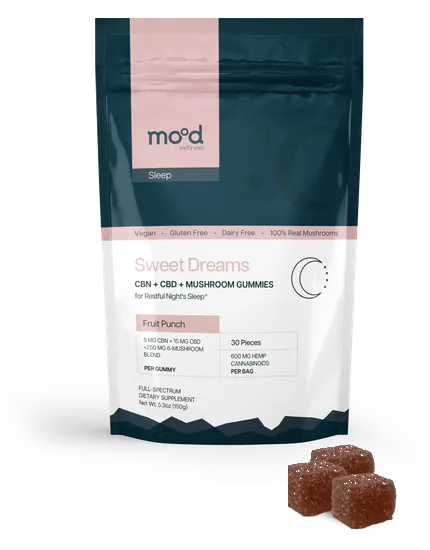
Mood’s current Sweet Dreams page lists Reishi among six mushroom fruiting-body extracts combined with CBD and CBN. The visible page reviewed does not state how many milligrams of Reishi are present individually or provide a verified triterpene/ganoderic-acid result for the finished gummy.
The responsible product row is therefore:
- Reishi present: stated by the current seller page;
- fungal material: fruiting-body extract, according to that page;
- individual Reishi amount: not verified in the visible product information reviewed;
- total triterpene method/result: not verified;
- named ganoderic-acid panel/result: not verified; and
- clinical equivalence to a Reishi study: not established.
The number of mushrooms in a blend cannot be divided into equal amounts unless the formulation discloses that allocation. A cannabinoid COA cannot fill the mushroom-marker cells.
A practical selection rule
If a product makes no triterpene claim, evaluate its identity, material, physical amount, extraction documentation and contaminant testing without inventing a marker result.
If it states total triterpenes, require the method, reference standard, result basis, sample and lot. Compare only with products tested using a sufficiently aligned convention.
If it lists named ganoderic acids, check exactly which analytes are included and whether authentic standards were used. Do not compare a six-analyte sum with a 20-analyte sum as though the larger number represents a stronger product.
Finally, keep composition and outcomes separate. A well-documented marker claim is better evidence of what is in the sample, not proof of what it will do.

Bottom Line: Reishi Triterpenes
Reishi triterpenes are a broad chemical category. Ganoderic acids are a diverse, more specific group within that chemistry. A total-triterpene estimate, an analyte-specific chromatographic result and a marketing percentage can look similar on a label while representing different measurements.
Verify species, material, extraction, method, standard, analytes, units, denominator, sample and lot. Compare broad assays only under aligned conventions and targeted panels only when their analyte lists match. Never convert a marker percentage into clinical potency.
For Mood’s current multi-mushroom gummy, Reishi fruiting-body extract is stated, but an individual amount and triterpene or ganoderic-acid result were not verified in the public materials reviewed. Those fields remain unknown.
Quick answers
Frequently asked questions about Reishi Triterpenes vs Ganoderic Acids
What is the practical answer about Reishi Triterpenes vs Ganoderic Acids?
Reishi triterpenes are a broad chemical category. Ganoderic acids are a diverse, more specific group within that chemistry. A total-triterpene estimate, an analyte-specific chromatographic result and a marketing percentage can look similar on a label while representing different measurements. Verify species, material, extraction, method, standard, analytes, units, denominator, sample and lot.
Which Mood product fits this topic?
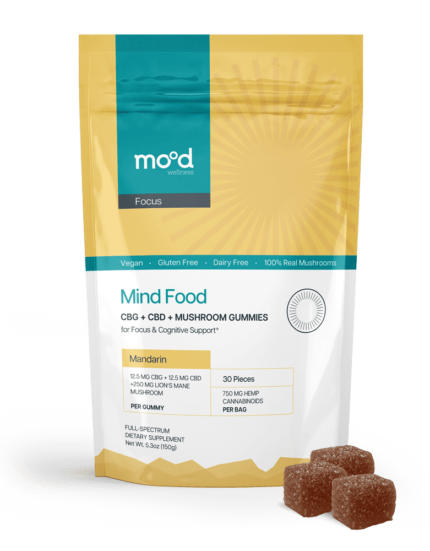
Mind Food is the most relevant Mood option for this topic. Mood Mind Food combines CBD, CBG and Lion’s Mane in a stimulant-free gummy designed for a calm, focused daytime routine.
What should I compare before choosing a product?
Compare the cannabinoid amount per measured serving, the complete ingredient list, spectrum or THC information, current product directions and available batch documentation. The best choice is the formula that fits the goal and is easy to use consistently.
How should I start using a new CBD or cannabinoid product?
Follow the current package directions, choose a low-demand first-use window and keep timing and meal context reasonably consistent. Review medication, pregnancy, liver and impairment considerations with a qualified clinician when relevant.
References
- Zhou LW, et al. Global diversity of the Ganoderma lucidum complex inferred from morphology and multilocus phylogeny. Phytochemistry. 2015.
- Raja HA, et al. The ITS region provides a reliable DNA barcode for identifying Reishi from herbal supplements. PLOS ONE. 2020.
- Gao JJ, et al. Quantitative determination of six major triterpenoids in Ganoderma lucidum and related species by HPLC. 2006.
- Zhang X, et al. Enhanced production of polysaccharides and triterpenoids in G. lucidum fruiting bodies. 2018.
- Xia Q, et al. A Review of Ganoderma Triterpenoids and Their Bioactivities. 2023.
- Mood Wellness. Sweet Dreams CBD + CBN 6-Mushroom Gummies. Current first-party product information reviewed September 10, 2026.
Evidence boundary: Analytical composition does not establish a health result. Preclinical studies on isolated compounds and unmatched Reishi preparations cannot validate a retail product or justify a disease claim.