Define the product before comparing it
Search results often mix three very different products:
- Functional mushroom gummies containing ingredients such as Lion's Mane, Cordyceps, Reishi, Turkey Tail, Maitake or Shiitake.
- Functional mushroom gummies with cannabinoids containing CBD and sometimes CBG, CBN or THC.
- Psychoactive or ambiguously marketed mushroom edibles that may reference Amanita, muscimol, “nootropics,” hemp-derived intoxicants or undisclosed compounds.
This guide covers the first two categories. It does not treat psychedelic or intoxicating mushroom edibles as equivalent to ordinary functional mushroom supplements.
A mushroom-shaped gummy is not evidence of mushroom identity. Likewise, a hemp leaf, “hemp” ingredient or store category does not establish CBD or THC content. Read the actual ingredient and cannabinoid fields.

The two-axis comparison
Use a worksheet that prevents one appealing feature from hiding missing evidence elsewhere.
| Axis | Mushroom-only gummy | Mushroom gummy with CBD |
|---|---|---|
| Mushroom species | Must be named and verified | Must be named and verified |
| Fruiting body/mycelium | Product-specific field | Product-specific field |
| Extract or powder | Product-specific field | Product-specific field |
| Mushroom amount | Per gummy and per serving | Per gummy and per serving |
| Beta-glucans/markers | Requires its own evidence | Requires its own evidence |
| CBD | None claimed; verify if avoidance matters | Record per gummy and serving |
| CBG/CBN | None claimed; verify separately | Record each cannabinoid separately |
| THC | Separate absence/testing question | Spectrum and lot result matter |
| Interaction review | Mushrooms and other actives | Mushrooms, CBD and every other active |
| COA coverage | Identity/composition/contaminants | Same, plus cannabinoid potency |
The left column is not automatically simpler. A cannabinoid-free gummy can still contain several mushrooms, vitamins, botanicals, sweeteners or proprietary blends. The right column is not automatically more complete. CBD milligrams do not verify the mushrooms.
What adding CBD changes
CBD introduces a measurable active ingredient and a separate evidence burden. Record:
- CBD per gummy;
- gummies per labeled serving;
- CBD per serving;
- extract type or spectrum wording;
- delta-9 THC and other cannabinoid results;
- current product and lot match;
- other active ingredients; and
- medication, drowsiness and liver considerations.
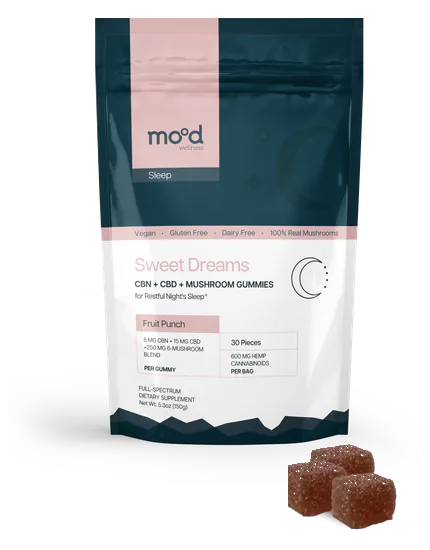
If the front says “600 mg,” determine whether that number describes CBD, a mushroom blend, combined ingredients or the entire package. Never divide or combine unlike quantities without a clear denominator.
The FDA warns that CBD can cause adverse effects, including liver injury and drowsiness, and can interact with medications. It also advises caution for pregnancy and breastfeeding. These considerations do not disappear because CBD is packaged with familiar-looking mushrooms.
What adding CBD does not prove
CBD does not establish:
- mushroom species identity;
- fruiting-body content;
- beta-glucan percentage;
- extract ratio;
- finished-product mushroom amount;
- better absorption of a mushroom ingredient;
- clinical synergy; or
- superior sleep, focus, calm or energy.
The strongest evidence for a combined product would test that exact finished formula against a matched cannabinoid-free version under a prespecified protocol. No such direct comparison was identified for the ordinary retail products considered here.
Studies of CBD alone or one mushroom extract can inform ingredient questions. They cannot be added together as if the finished gummy has been tested.
Cannabinoid-free does not mean evidence-free
A product without CBD avoids CBD-specific exposure, but the mushroom side still needs verification. Look for:
- the common and scientific species name where appropriate;
- fruiting body, mycelium and substrate disclosure;
- extract or powder status;
- each ingredient amount or a clearly defined blend total;
- gummies per serving;
- extract ratio only when its basis is explained;
- beta-glucan or other composition results with method and matrix; and
- current contaminant and lot documentation.
“Ten mushrooms” is an ingredient count, not an amount. “10:1 extract” is not a beta-glucan percentage. “Polysaccharides” is not automatically mushroom beta-glucan. A cannabinoid-free badge cannot fill those gaps.
CBD-free, THC-free and non-intoxicating are different claims
These phrases answer different questions.
CBD-free means CBD is claimed absent under a stated basis. It says nothing by itself about THC, CBG, CBN, muscimol or other actives.
THC-free is a THC claim. Ask whether it means no THC ingredient, nondetectable delta-9 THC at a stated reporting threshold, or a broader panel with multiple isomers.
Non-intoxicating is an effect claim, not an analyte list. CBD is not generally treated like delta-9 THC, but a finished product can contain other intoxicating ingredients or enough THC to matter.
Broad-spectrum and isolate commonly signal different hemp preparations, but the current lot report should confirm the cannabinoid profile. Full-spectrum products may contain multiple cannabinoids, including measurable delta-9 THC within the applicable product framework.
If you face workplace, athletic, legal or clinical drug testing, do not rely on “hemp,” “legal” or “trace.” Review the current lot and your testing policy. Even compliant full-spectrum products can create uncertainty.
Mood's CBD and drug-testing guide owns the detailed risk discussion.

Normalize the labels before comparing
Create one row per active ingredient. Do not compare one product's per-gummy quantity with another product's two-gummy serving.
| Field | Product A | Product B |
|---|---|---|
| Gummies per serving | ||
| Lion's Mane per gummy/serving | ||
| Cordyceps per gummy/serving | ||
| Other mushrooms | ||
| CBD per gummy/serving | ||
| CBG per gummy/serving | ||
| CBN per gummy/serving | ||
| Delta-9 THC per gummy/serving | ||
| Other actives | ||
| Gelling system/allergens | ||
| Lot-matched reports |
When only a blend total is given, preserve it as a blend total. Do not divide it equally among species. When a quantity is absent, write “not stated,” not zero.
Mood's gummy potency guide contains the per-unit and per-serving arithmetic.
Mushroom evidence remains its own axis
Mushroom research depends on species, strain or material, preparation, amount, duration, population and endpoint. A study of one Lion's Mane powder cannot prove an extract gummy. A Cordyceps exercise study cannot establish an evening blend. A Reishi preparation cannot be used as evidence for every six-mushroom formula.
Composition markers also have limits. Beta-glucan content can help characterize fungal material, but it is not a universal efficacy score. Modern gummy matrices can complicate analytical procedures because of starches, sugars and other formula components.
The best comparison keeps three levels separate:
- Label evidence: what ingredients and amounts the seller states.
- Analytical evidence: what a matching sample report measured.
- Human evidence: what a study of a defined preparation found.
Only an exact-formula trial connects all three for the marketed product.

Ingredient report versus finished-product report
An ingredient COA may verify a supplier lot of mushroom extract. It can be useful for incoming-material controls. It does not prove how much reached each gummy or what happened after blending, heating, depositing and storage.
A finished-gummy report addresses the combined matrix more directly, but only for its listed panels. A cannabinoid potency page does not verify beta-glucans or contaminants. A contaminant pass does not verify labeled mushroom amounts.
Use Mood's mushroom gummy COA guide to match product, lot, sample and panel without turning “lab tested” into a blanket conclusion.
Current Mood formulas
Mood's mushroom gummy collection is cannabinoid-containing. Current pages reviewed for this project describe:
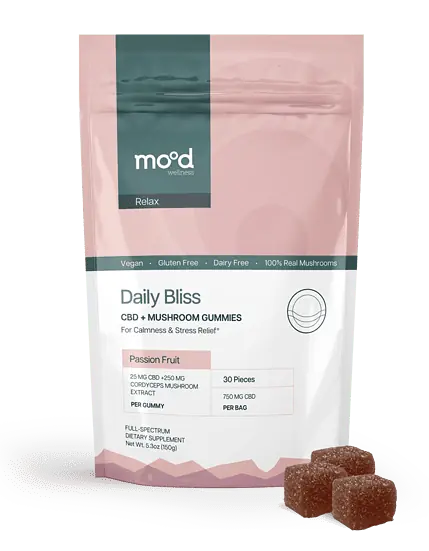
- Daily Bliss: CBD with Cordyceps fruiting-body extract;
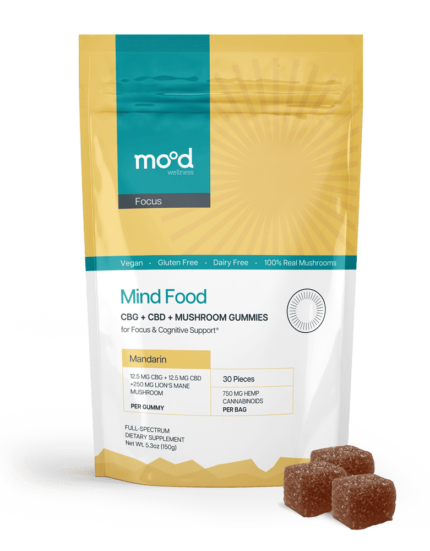
- Mind Food: CBD, CBG and Lion's Mane fruiting-body extract; and
- Sweet Dreams: 15 mg CBD, 5 mg CBN and six named mushroom fruiting-body extracts per gummy.
Sweet Dreams lists organic full-spectrum hemp extract. The visible page names Reishi, Cordyceps, Turkey Tail, Maitake, Shiitake and Agaricus blazei but does not state the total or individual mushroom weights in the section reviewed.
The CBD + CBN mushroom formula guide, Lion's Mane + CBD + CBG guide and Cordyceps + CBD guide own the detailed formula evaluations.
Mood does not currently offer a cannabinoid-free mushroom gummy in the product set reviewed. If avoiding cannabinoids is the priority, these products are not a match. That is a category-fit conclusion, not a judgment that another product is more effective.
Current Mood laboratory boundary
Mood's public lab-results page lists Daily Bliss, Mind Food and Sweet Dreams. The gummy reports captured in the September 9 audit were older cannabinoid-potency documents, including February 2023 reports for Mind Food and Sweet Dreams.
Those documents can support only the named samples and analytes they display. They do not visibly establish current-lot mushroom beta-glucan, identity or full contaminant coverage. Request current product- and lot-matched documents when those questions matter.
Decision paths
You must avoid all cannabinoids
Choose a formula whose complete label omits CBD, CBG, CBN, THC and hemp-derived actives. Verify with an appropriate current report if the consequence of exposure is meaningful. Mood's reviewed mushroom gummies do not fit this path.
You want mushrooms and intentionally want CBD
Compare the mushroom formula first, then record CBD and every additional cannabinoid separately. Review medication, drowsiness, THC and testing considerations before use.
You want to avoid THC but not CBD
Do not equate CBD with THC-free. Inspect spectrum wording and the current cannabinoid panel. Record the method threshold behind ND.
You care most about mushroom documentation
Prioritize species/material identity, disclosed amounts, method-appropriate composition testing and finished-lot traceability. CBD content neither strengthens nor weakens that evidence automatically.
You use medications or have a health condition
Bring the complete label, not only the front panel, to a pharmacist or qualified clinician. Include mushrooms, cannabinoids, botanicals, vitamins and other actives.
Mushroom Gummies with CBD Buyer Checklist
- [ ] Is this a functional mushroom product rather than a psychoactive or ambiguous edible?
- [ ] Are all mushroom species named?
- [ ] Is fruiting body, mycelium or substrate disclosed?
- [ ] Are extract/powder status and amounts clear?
- [ ] Is the serving size defined?
- [ ] Are CBD, CBG, CBN and THC listed separately?
- [ ] Does “free” wording identify the analyte and testing basis?
- [ ] Does the current lot match the report?
- [ ] Are mushroom composition, cannabinoid potency and contaminants separate panels?
- [ ] Have interaction, drowsiness and drug-test constraints been considered?
- [ ] Is the choice based on ingredients and evidence rather than an untested synergy promise?
Safety Boundaries for Mushroom Gummies with CBD
Functional mushroom ingredients can cause digestive upset or allergic reactions, and safety evidence is preparation-specific. Stop use and seek appropriate care for signs of a serious reaction.
CBD can interact with medications and contribute to drowsiness. Avoid driving or safety-sensitive work until you understand the product's effects. Alcohol and other sedating substances can add risk. FDA advises against CBD use during pregnancy and breastfeeding.
Keep all gummies away from children and pets. Store them in original packaging so ingredient, lot and safety information remain available.

Bottom Line: Mushroom Gummies with CBD
Mushroom gummies with CBD and cannabinoid-free mushroom gummies are not two potency levels of the same product. They are different exposure choices.
Evaluate the mushroom formula on its own evidence: species, material, preparation, amount and testing. Then evaluate CBD, CBG, CBN and THC as separate ingredients with separate label, safety and drug-test questions.
Choose the category that fits what you intend to include, and what you need to avoid. Do not treat CBD as proof of mushroom quality, and do not treat cannabinoid-free as proof of clinical effectiveness.
Quick answers
Frequently asked questions about Mushroom Gummies With CBD vs Without
What is the practical answer about Mushroom Gummies With CBD vs Without?
Mushroom gummies with CBD and cannabinoid-free mushroom gummies are not two potency levels of the same product. They are different exposure choices. Evaluate the mushroom formula on its own evidence: species, material, preparation, amount and testing. Then evaluate CBD, CBG, CBN and THC as separate ingredients with separate label, safety and drug-test questions.
Which Mood product fits this topic?
Mind Food is the most relevant Mood option for this topic. Mood Mind Food combines CBD, CBG and Lion’s Mane in a stimulant-free gummy designed for a calm, focused daytime routine.
What should I compare before choosing a gummy?
Compare the cannabinoid amount per measured serving, the complete ingredient list, spectrum or THC information, current product directions and available batch documentation. The best choice is the formula that fits the goal and is easy to use consistently.
How should I start using a new CBD or cannabinoid product?
Follow the current package directions, choose a low-demand first-use window and keep timing and meal context reasonably consistent. Review medication, pregnancy, liver and impairment considerations with a qualified clinician when relevant.
Sources
- U.S. Food and Drug Administration. What You Need to Know About Products Containing Cannabis or Cannabis-Derived Compounds, Including CBD. Accessed September 9, 2026.
- Bonn-Miller MO, et al. A double-blind, randomized, placebo-controlled study of the safety and effects of CBN with and without CBD on sleep quality. PMID 37796540.
- McCleary BV, Draga A. Measurement of β-Glucan in Mushrooms and Mycelial Products. PMID 26957216.
- Mood Wellness. Sweet Dreams, Daily Bliss and Mind Food product pages; functional mushroom collection; lab-results page and linked reports. Reviewed September 9, 2026.
- U.S. Food and Drug Administration. Dietary Supplements. Accessed September 2026.