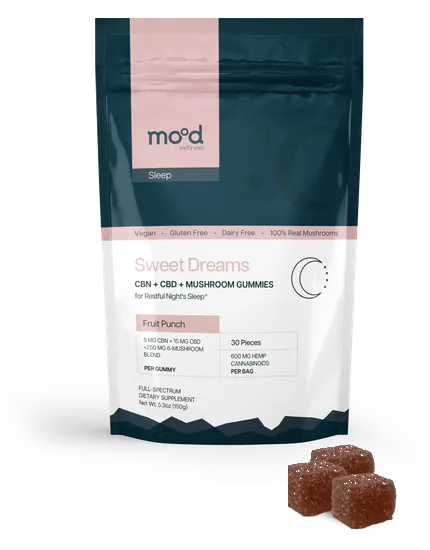
Editorial disclosure: Mood publishes this guide and sells Sweet Dreams, a CBD + CBN + six-mushroom gummy. Current product claims are reviewed as first-party formula evidence, not independent proof of sleep benefit.
What the current Sweet Dreams page states
| Formula field | Visible statement | What remains unknown |
|---|---|---|
| CBD | 15 mg per gummy | Current-lot result unless matched certificate is supplied |
| CBN | 5 mg per gummy | Current-lot result unless matched certificate is supplied |
| Mushrooms | Six named fruiting-body extracts | Total blend mass and each species amount |
| Hemp spectrum | Full spectrum, less than 0.3% THC | Exact THC result for the package lot |
| Melatonin | Melatonin-free | Does not establish sleep efficacy |
The page directs users to take one gummy before bedtime and, if needed and tolerated, consider two on a subsequent night. Arithmetic gives:
| Gummies | CBD claim | CBN claim | Mushroom mass |
|---|---|---|---|
| 1 | 15 mg | 5 mg | Not stated on visible page |
| 2 | 30 mg | 10 mg | Still not calculable |
The CBD-to-CBN ratio remains 3:1. It would be incorrect to add an unknown mushroom amount, divide the blend equally among six species or infer potency from the ingredient count.

Six mushrooms do not mean six equal doses
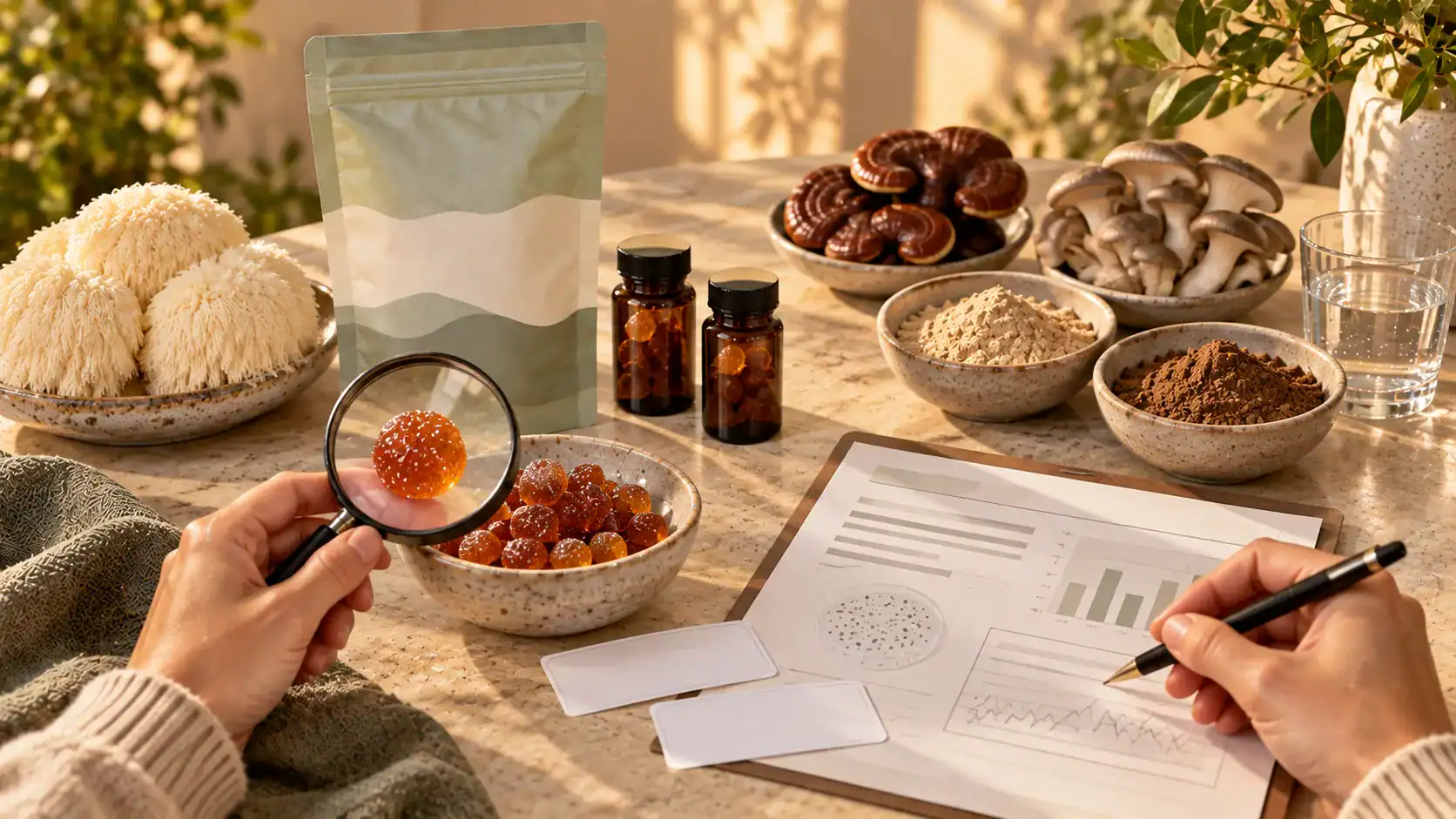
Sweet Dreams names Reishi, Cordyceps, Turkey Tail, Maitake, Shiitake and Agaricus blazei. A list communicates identity, not allocation.
If a hypothetical two-gummy serving stated a 600 mg proprietary blend, the only supported normalized amount would be 300 mg total blend per gummy. It would not support 50 mg of each species unless individual amounts were disclosed.
For each mushroom, useful evidence would include:
- scientific species;
- fruiting body, mycelium or other material;
- extract or unextracted powder;
- amount or defined blend allocation;
- extraction method and carrier;
- relevant marker assay; and
- ingredient-lot traceability.
The scheduled fruiting-body-versus-mycelium article owns the material comparison. This page focuses on what the mushrooms add, and do not add, to interpretation of the evening cannabinoid formula.

An evidence ladder for the formula
Level 1: Product-page and package claims
These establish the manufacturer’s stated ingredients, amounts and directions.
Level 2: Batch and ingredient records
Cannabinoid potency, mushroom identity, beta-glucans, contaminants and residual solvents require different records or panels.
Level 3: Studies of CBD, CBN or mushroom preparations
These inform separate evidence landscapes. They do not directly test the finished combination.
Level 4: Exact-formula human trial
The strongest outcome evidence would test the marketed CBD + CBN + six-mushroom gummy at its serving against an appropriate control. No such study was identified.
Calling the formula “synergistic” skips from level 1 or 3 to level 4 without direct evidence.
What the CBD + CBN sleep trial found
A 2024 double-blind randomized placebo-controlled study enrolled adults who rated their sleep quality poor or very poor. Participants received placebo, 20 mg CBN, or 20 mg CBN combined with 10, 20 or 100 mg CBD for seven nights.
In the modified intent-to-treat analysis of 293 participants, 20 mg CBN reduced reported nighttime awakenings and overall sleep disturbance compared with placebo. The primary sleep-quality result was not statistically significant, and there were no differences for sleep-onset latency, wake after sleep onset or daytime fatigue. Importantly, adding CBD did not positively augment the CBN effects.
This study is relevant but does not validate Sweet Dreams:
- CBN was 20 mg, four times the per-gummy claim;
- CBD doses differed from 15 mg;
- the tested products did not contain six mushrooms;
- the study lasted seven nights; and
- sponsorship and formulation context should be considered.
The result argues against assuming that more CBD automatically makes CBN work better.
Other cannabinoid sleep evidence
Another randomized trial compared 15 mg CBD isolate with formulations containing 15 mg CBN, with or without another cannabinoid. It found no significant differences between the CBD-only and CBD+CBN formulations under that protocol. Again, those formulas were not Sweet Dreams.
A small 2026 crossover trial used overnight polysomnography in 20 adults with insomnia and tested 30 mg and 300 mg CBN. CBN did not significantly change the primary wake-after-sleep-onset endpoint. Selected secondary findings appeared at 300 mg, and many mild-to-moderate adverse events occurred across arms. Larger and longer trials are needed.
Together, these studies show that CBN is being tested in humans, but outcomes depend on dose, endpoint and design. They do not support a simple “CBN is a sedative” rule, especially at 5 mg.
What CBD evidence can add
CBD research uses a wide range of doses. A 150 mg nightly pilot trial for insomnia and other studies at hundreds of milligrams do not directly apply to a 15 mg gummy.
CBD can affect alertness and medications, and FDA highlights unresolved consumer safety questions. It should not be assumed to improve sleep, remove next-day effects or neutralize THC.
The formula’s CBD amount is still important because it contributes to total cannabinoid exposure and potential interaction risk, even when the user’s main interest is CBN.
What mushroom research cannot prove here
Individual mushrooms have preclinical, traditional and limited human research. But a study of one Reishi preparation, a Cordyceps exercise product or a Turkey Tail extract does not establish the effect of an undisclosed six-mushroom blend in a CBD+CBN gummy.
The blend creates additional uncertainty:
- individual species amounts are not visible;
- extraction specifications may differ;
- relevant markers are not shown on the product page;
- the contribution of each mushroom cannot be isolated; and
- cannabinoid and mushroom timing may not share one mechanism.
“Functional mushrooms” accurately describes the category. It should not be converted into claims of deeper sleep, immune support or recovery without formula-specific evidence.
Reading the public Sweet Dreams certificate
The PDF captured from Mood’s lab-results page identifies batch 2212292 and a report date of February 22, 2023. One tested unit reported 15.627 mg CBD, 7.544 mg CBN and 0.904 mg delta-9 THC.
The CBD result is close to the current 15 mg page claim; the reported CBN is above the current 5 mg statement. This is historical information about the submitted unit, not proof of today’s formula or every gummy.
The document reviewed:
- is dated and not current-lot evidence;
- measures cannabinoid potency;
- does not state total mushroom mass;
- does not allocate the six mushrooms;
- does not assay beta-glucans or mushroom identity; and
- is not a comprehensive contaminant certificate.
Use Mood’s COA guide to compare units, limits, laboratory, date and lot. “Not shown” means unverified in that document, not necessarily absent or failed.
Full-spectrum THC and drug testing
The page describes full-spectrum hemp below 0.3% THC. That legal concentration threshold is not the same as THC-free. The historical submitted unit contained a measurable delta-9 THC amount.
Trace THC can matter for:
- workplace or athletic drug testing;
- next-morning alertness;
- sensitivity to THC;
- combining servings; and
- use with alcohol, sedatives or other intoxicants.
CBD does not guarantee that THC effects or detection are canceled. Anyone who must avoid THC should not infer zero exposure from “hemp” or “less than 0.3%.”
Timing and next-morning safety
Sweet Dreams is positioned for nighttime use. Its page directs one gummy 45–60 minutes before bedtime and warns against nighttime redosing. Individual onset varies with food, formulation, metabolism and prior exposure.
Avoid testing a new evening product before driving, caregiving, operating equipment or an early high-stakes morning. Do not combine it with alcohol, sleep medications, sedating antihistamines or other central nervous system depressants without professional guidance.
Track the same variables for several uses:
- serving count;
- timing;
- meal context;
- other substances;
- sleep schedule;
- nighttime awakenings;
- next-morning alertness; and
- product lot.
Self-observation can identify tolerability patterns. It cannot prove which ingredient caused a change.
Safety and interaction checklist
FDA warns that CBD can cause drowsiness, affect how medications work and pose liver risks. CBN interaction data are limited, and full-spectrum THC adds another variable. Mushrooms can cause digestive or allergic reactions.
Consult a clinician or pharmacist before use if you:
- take prescription or over-the-counter medication;
- use sleep drugs, sedatives, antihistamines or alcohol;
- have liver disease or abnormal liver tests;
- use anticoagulants, immunosuppressants or antiseizure drugs;
- have mushroom or mold allergies;
- are pregnant or breastfeeding;
- are preparing for surgery; or
- must avoid THC.
Stop use and seek advice for a concerning reaction. Do not use the product to self-treat persistent insomnia, sleep apnea symptoms or another medical condition without assessment.
A shopper decision matrix
| Question | Stronger evidence | Weak substitute |
|---|---|---|
| CBD and CBN amount? | Current label plus lot-matched potency | Front-label ratio alone |
| Mushroom quantity? | Total and individual amounts per serving | Number of species |
| Mushroom quality? | Identity, material, extract and marker records | “Premium blend” |
| Exact formula improves sleep? | Controlled finished-formula trial | Separate ingredient studies |
| THC-free? | Explicit current result and spectrum | “Hemp-derived” |
| Safe for me? | Medication, liver, allergy and next-day review | Customer testimonials |
How to evaluate Sweet Dreams
Start with the current Sweet Dreams page and package. Then:
- Confirm serving size, CBD and CBN per gummy.
- Keep the mushroom amount marked unknown unless the current label supplies it.
- Match the package lot to cannabinoid potency results.
- Request mushroom ingredient specifications and relevant assays if composition matters.
- Review THC and drug-testing risk.
- Check medications, liver context, allergies and pregnancy status.
- Avoid translating individual-ingredient research into a finished-formula promise.
For broader shopping criteria, compare the functional mushroom collection using the same fields.
Bottom Line: Functional Mushrooms in CBD + CBN Gummies
Sweet Dreams combines 15 mg CBD, 5 mg CBN and six named mushroom extracts per gummy. The visible page does not disclose the mushroom-blend mass, and no direct human trial of the exact finished formula was identified.
Controlled CBN research is mixed, and one major study found that adding CBD did not positively augment CBN effects. Evaluate the product through current amounts, lot-matched testing, mushroom documentation, full-spectrum THC context and personal safety, not through ingredient count or assumed synergy.
Quick answers
Frequently asked questions about Functional Mushrooms in CBD + CBN Gummies
What is the practical answer about Functional Mushrooms in CBD + CBN Gummies?
Sweet Dreams combines 15 mg CBD, 5 mg CBN and six named mushroom extracts per gummy. The visible page does not disclose the mushroom-blend mass, and no direct human trial of the exact finished formula was identified. Controlled CBN research is mixed, and one major study found that adding CBD did not positively augment CBN effects.
Which Mood product fits this topic?
Sweet Dreams is the most relevant Mood option for this topic. Mood Sweet Dreams combines CBD, CBN and functional mushrooms in a premeasured gummy for shoppers who prefer a simple nighttime format.
What should I compare before choosing a gummy?
Compare the cannabinoid amount per measured serving, the complete ingredient list, spectrum or THC information, current product directions and available batch documentation. The best choice is the formula that fits the goal and is easy to use consistently.
How should I start using a new CBD or cannabinoid product?
Follow the current package directions, choose a low-demand first-use window and keep timing and meal context reasonably consistent. Review medication, pregnancy, liver and impairment considerations with a qualified clinician when relevant.
Sources
- Bonn-Miller MO, et al. A double-blind, randomized, placebo-controlled study of the safety and effects of CBN with and without CBD on sleep quality. 2024. PMID 37796540.
- The Safety and Comparative Effectiveness of Non-Psychoactive Cannabinoid Formulations for the Improvement of Sleep. 2023. PMID 37162192.
- Cannabinol for Acute Treatment of Insomnia Disorder in a Randomized Placebo-Controlled Crossover Trial. 2026. PMID 41698831.
- U.S. Food and Drug Administration. What You Need to Know About Products Containing Cannabis or Cannabis-Derived Compounds, Including CBD.
- Mood Wellness. Sweet Dreams product page, lab-results page and linked certificate. Checked September 9, 2026.
- U.S. Food and Drug Administration. Dietary Supplements. Accessed September 2026.