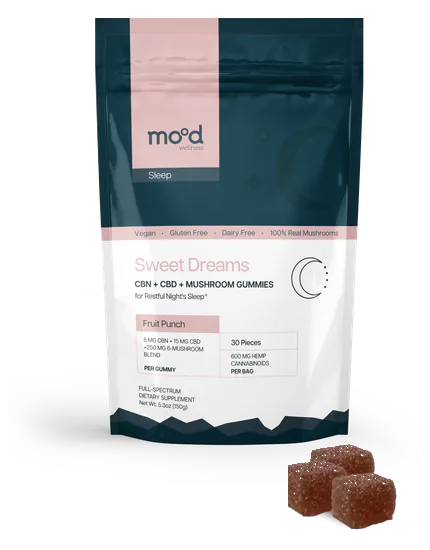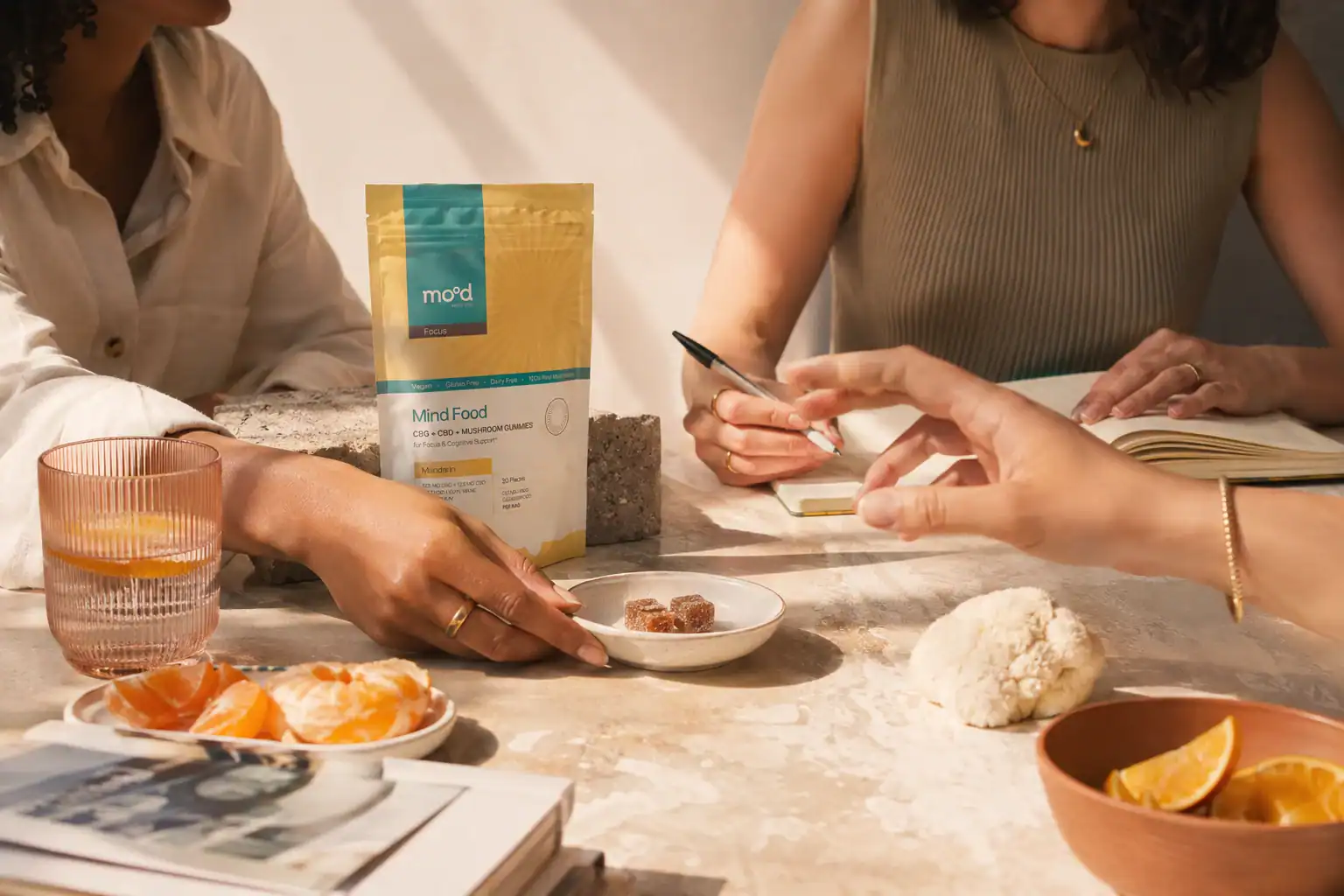

What is actually in a Lion’s Mane + CBD + CBG formula?
The three headline ingredients belong to different categories.
| Ingredient | What it is | What to record from the label |
|---|---|---|
| Lion’s Mane | A mushroom, Hericium erinaceus, used as food and supplement material | Species, fruiting body or mycelium, extract or powder, amount and marker specification |
| CBD | Cannabidiol, a cannabinoid derived from hemp or cannabis | Milligrams, spectrum, route, THC context and batch potency |
| CBG | Cannabigerol, a less-studied cannabinoid | Milligrams, route, co-occurring cannabinoids and batch potency |
The gummy base, sweeteners, carriers and other ingredients also matter for tolerability and use. “Three active ingredients” is marketing shorthand, not a validated measure of biological activity.
Mood’s older Lion’s Mane and CBD article owns the broad two-ingredient benefits discussion. This guide addresses the narrower three-part formula decision, adds CBG and applies a stricter label-and-evidence framework.
The current Mind Food label example
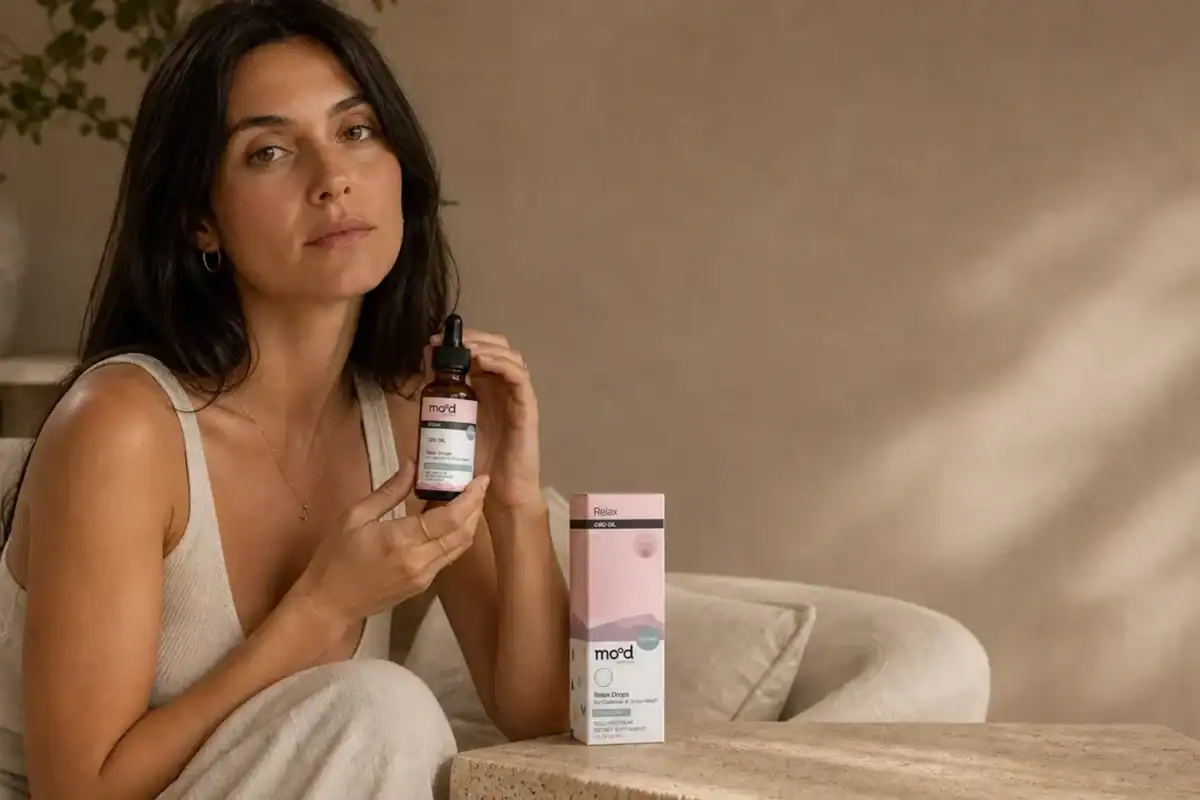
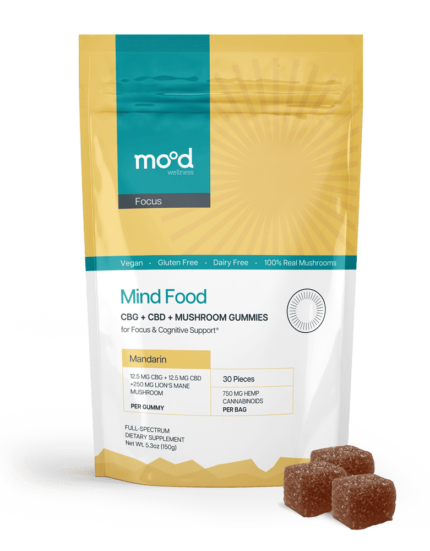
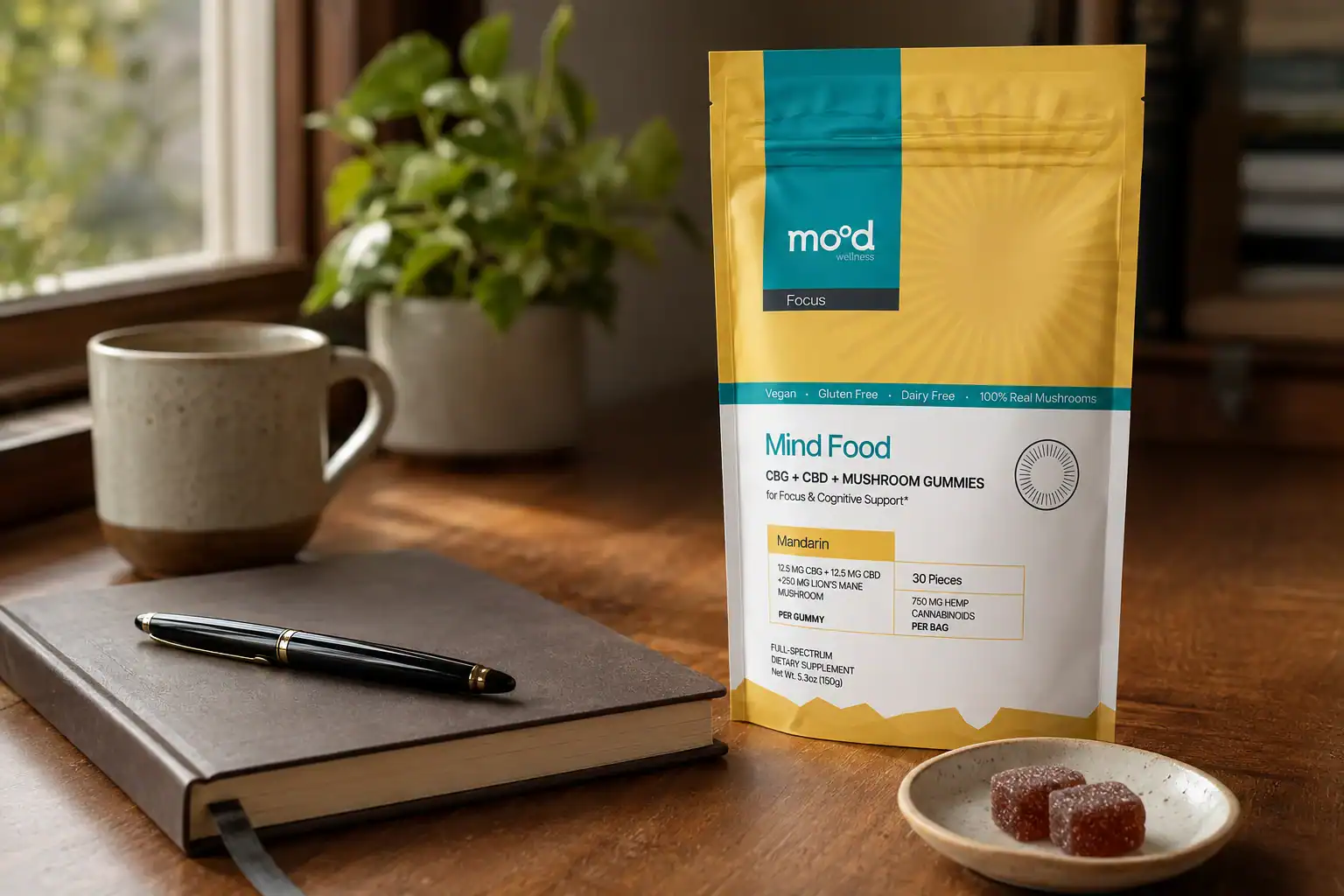
The Mind Food product page checked September 9, 2026 states the following per gummy:
- 250 mg Lion’s Mane fruiting-body extract;
- 12.5 mg CBD;
- 12.5 mg CBG; and
- full-spectrum hemp with less than 0.3% THC.
The page recommends starting with one gummy and describes a one-to-two-gummy use range. That yields straightforward arithmetic, not a personalized recommendation:
| Number of gummies | Lion’s Mane claim | CBD claim | CBG claim |
|---|---|---|---|
| 1 | 250 mg | 12.5 mg | 12.5 mg |
| 2 | 500 mg | 25 mg | 25 mg |
The CBD-to-CBG ratio remains 1:1 at either count because both cannabinoid amounts scale equally. Lion’s Mane should not be included in that ratio; mushroom-extract milligrams and cannabinoid milligrams describe different materials.
Do not interpret two gummies as automatically better than one. Serving decisions involve tolerance, medications, THC exposure, product directions and professional advice.

A four-level evidence ladder
Mixed formulas are easier to evaluate when evidence is placed in the correct level.
Level 1: The formula claim
The product page and package state what the manufacturer says is present. This is the starting point for amounts and directions.
Level 2: Composition and batch testing
A certificate can test selected analytes in a submitted sample. Cannabinoid potency, beta-glucans, microbial contaminants and heavy metals are different panels. One result cannot stand in for another.
Level 3: Single-ingredient human evidence
A study of Lion’s Mane alone may inform the ingredient’s research landscape. A CBG tincture study may inform CBG. Neither directly tests the three-ingredient gummy.
Level 4: Exact-formula human evidence
The strongest efficacy evidence would test the finished Lion’s Mane + CBD + CBG formula, at its marketed dose and route, against an appropriate control in the intended population. No such trial was identified for Mind Food in this review.
Moving from level 1 or 3 to an exact-formula benefit claim requires an inference. That inference must be labeled, not presented as established fact.
What Lion’s Mane human research can show
Human Lion’s Mane research is growing but heterogeneous. Studies differ by fruiting body or mycelium, extract specification, daily amount, duration, age and cognitive status.
A 2025 randomized crossover study gave 18 healthy adults aged 18–35 an acute 3 g dose of a 10:1 fruiting-body extract. The investigators reported limited acute findings and called for more chronic research, dose work and timing data. Three grams of that specified extract is not equivalent to 250 mg of an unspecified extract in a combined gummy.
A 2019 randomized, double-blind, placebo-controlled study examined a Lion’s Mane fruiting-body supplement over 12 weeks. It supports continued research into Lion’s Mane alone, but it does not establish how CBD or CBG modifies the result.
Other trials have used mycelial material enriched for specific compounds or enrolled people with cognitive impairment. Those interventions should not be generalized to every fruiting-body gummy.
The label questions remain essential:
- Is the scientific species identified?
- Is the material fruiting body, mycelium or both?
- Is it an extract or unextracted powder?
- Is the extraction ratio or marker content defined?
- Does a current assay support beta-glucan or other composition claims?
What CBG human research can show
CBG has far less human evidence than CBD. A 2024 double-blind, placebo-controlled crossover field trial studied 20 mg of hemp-derived CBG tincture in 34 healthy adults. It reported preliminary changes in anxiety and stress ratings and a verbal-memory result, with no evidence of subjective intoxication or impairment under that protocol.
The study is relevant because it is controlled human evidence. It is also limited for this formula:
- it tested 20 mg CBG, not 12.5 mg;
- it used a tincture, not a gummy;
- it was acute and small;
- it did not include CBD or Lion’s Mane; and
- it did not validate a daily focus claim.
One study should not be turned into a universal “CBG improves memory” statement. Replication, dose-response work and exact-formula research remain necessary.
What CBD human research can show
CBD has a larger clinical literature, but much of it uses prescription-level or research doses that differ substantially from consumer gummies.
In a small randomized feasibility trial in healthy college students, 300 mg CBD oil produced mostly similar cognitive and psychomotor results to placebo, with selected differences in vigilance measures. Other controlled studies at varying doses have produced mixed or context-specific findings.
That makes two boundaries important:
- A 300 mg CBD study cannot validate a 12.5 mg CBD gummy.
- CBD should not automatically be described as sharpening attention or canceling THC effects.
FDA has also emphasized unresolved safety questions around long-term consumer CBD exposure, medication interactions and liver effects. Evidence quantity does not remove the need for product-specific caution.
Why “synergy” is a hypothesis, not a result
Ingredients can interact pharmacologically, through absorption, metabolism or downstream pathways. But plausible interaction is not proof of a beneficial net effect.
For this combination, “synergy” would require a study designed to distinguish:
- Lion’s Mane alone;
- CBD alone;
- CBG alone;
- relevant two-ingredient combinations;
- the three-ingredient formula; and
- placebo.
It would also need a predefined endpoint, sufficient sample size, appropriate duration and safety monitoring. Without that design, a consumer may experience the combined product, but the contribution of each component remains unknown.
Use “combined in one formula” for a label fact. Reserve “synergistic effect” for evidence that actually demonstrates more than additive or independent effects.
Reading the public Mind Food certificate
The Mind Food PDF currently linked from Mood’s lab-results page identifies batch 2212081 and a report date of February 22, 2023. The potency panel reported one tested unit containing 14.157 mg CBD and 13.548 mg CBG. Delta-9 THC was not detected at the method’s stated limits.
Those results are directionally consistent with the current page’s equal 12.5 mg CBD and CBG claims, but several boundaries apply:
- the report is dated and cannot prove the lot sold today;
- it represents the submitted sample, not every unit;
- it does not assay Lion’s Mane amount or identity;
- it does not show beta-glucan content; and
- the captured document is not a comprehensive contaminant panel.
The correct phrasing is “the currently linked 2023 certificate reported,” not “every current gummy contains.” A current package QR code or lot number should lead to documentation matching that lot.
Mood’s COA reading guide explains how to compare analyte, units, detection limits, laboratory, date and batch.
Full-spectrum hemp, THC and drug testing
The Mind Food page describes full-spectrum hemp containing less than 0.3% THC. The 0.3% threshold is a legal concentration boundary for hemp, not a guarantee of zero THC exposure or a negative drug test.
The reviewed certificate reported delta-9 THC as not detected in that submitted unit at the listed method limits. “Not detected” does not mean absolute zero, and an older result cannot be applied to a different batch.
People subject to workplace, athletic, legal or medical drug testing should treat full-spectrum use as a real risk decision. CBD and CBG do not guarantee that trace THC is neutralized or undetectable.
Timing, food and self-observation
The three components may not share one onset curve. Oral cannabinoid exposure can vary with formulation, food, metabolism and product matrix. A mushroom ingredient may be studied over weeks rather than as an immediately perceptible effect.
That means a single “kick-in time” for the whole formula is not scientifically secure. Follow the current label, avoid rapid redosing and keep timing, meal context and product batch consistent when observing tolerability.
Do not use moment-to-moment sensation as proof that Lion’s Mane is working. Likewise, an absence of a noticeable feeling does not prove that a labeled ingredient is absent.
Safety checklist for the combined formula
CBD can interact with medications and has been associated with liver-enzyme concerns and sleepiness at studied doses. CBG has limited human interaction data. Lion’s Mane can cause gastrointestinal or allergic reactions in some people. A combined gummy also includes full-spectrum hemp and other formulation ingredients.
Consult a qualified clinician or pharmacist before use if you:
- take prescription or over-the-counter medication;
- have liver disease or abnormal liver tests;
- take sedatives, anticoagulants, antiseizure drugs or other interaction-sensitive medicines;
- have mushroom or mold allergies;
- are preparing for surgery;
- are pregnant or breastfeeding; or
- need to avoid THC for any reason.
FDA strongly advises avoiding CBD and THC during pregnancy and breastfeeding. Do not drive or operate machinery until you know how the full product affects you. Stop use and seek advice for a concerning reaction.
A decision matrix for shoppers
| Question | Stronger evidence | Weak substitute |
|---|---|---|
| What is in one gummy? | Current Supplement Facts and per-gummy math | Front-label ingredient icons |
| Are CBD and CBG near 1:1? | Lot-matched cannabinoid potency result | Formula name alone |
| Is Lion’s Mane characterized? | Species, material, extract amount and marker assay | “Premium mushroom” |
| Is the exact combination effective? | Controlled finished-formula human trial | Three separate ingredient studies |
| Is it THC-free? | Appropriate current result and spectrum disclosure | Hemp logo or “non-intoxicating” copy |
| Is it safe for me? | Full medication and health review | A positive customer review |
If the exact-formula evidence row is blank, keep it blank. A transparent unknown is more useful than a synthetic certainty.
How to compare Mind Food without overclaiming
Use the current Mind Food product page to confirm the package, ingredient claims, serving directions and warnings. Then:
- Match the package lot to a certificate.
- Verify CBD, CBG and THC results in compatible units.
- Request the Lion’s Mane ingredient specification and relevant assay if composition matters to the decision.
- Record fruiting-body, extraction and beta-glucan claims separately.
- Review medication, liver, allergy and drug-testing considerations.
- Treat benefit language as unproven for the exact formula unless finished-product trials become available.
This workflow supports a purchase decision without turning a commercial formula into a medical recommendation.

Bottom Line: CBD and CBG
Lion’s Mane, CBD and CBG can be combined in one convenient gummy. The combination is a verifiable formulation fact, not proof of cognitive synergy.
Mind Food currently states 250 mg Lion’s Mane fruiting-body extract plus 12.5 mg each of CBD and CBG per gummy. Its publicly linked 2023 certificate provides historical cannabinoid-potency evidence for one submitted unit, while leaving current-lot status and mushroom composition unverified in the document reviewed.
Judge the product on transparent amounts, lot-matched testing, Lion’s Mane specifications, full-spectrum THC context and personal safety. Keep separate-ingredient studies in their proper lane until direct human evidence tests the actual three-part formula.
Quick answers
Frequently asked questions about Lion’s Mane with CBD and CBG
What is the practical answer about Lion’s Mane with CBD and CBG?
Lion’s Mane, CBD and CBG can be combined in one convenient gummy. The combination is a verifiable formulation fact, not proof of cognitive synergy. Mind Food currently states 250 mg Lion’s Mane fruiting-body extract plus 12. 5 mg each of CBD and CBG per gummy.
Which Mood product fits this topic?
Mind Food is the most relevant Mood option for this topic. Mood Mind Food combines CBD, CBG and Lion’s Mane in a stimulant-free gummy designed for a calm, focused daytime routine.
What should I compare before choosing a product?
Compare the cannabinoid amount per measured serving, the complete ingredient list, spectrum or THC information, current product directions and available batch documentation. The best choice is the formula that fits the goal and is easy to use consistently.
How should I start using a new CBD or cannabinoid product?
Follow the current package directions, choose a low-demand first-use window and keep timing and meal context reasonably consistent. Review medication, pregnancy, liver and impairment considerations with a qualified clinician when relevant.
Sources
- Docherty S, et al. Acute effects of a standardised extract of Hericium erinaceus on cognition and mood in healthy younger adults. 2025. PMID 40276537.
- Saitsu Y, et al. Improvement of cognitive functions by oral intake of Hericium erinaceus. 2019. PMID 31413233.
- Cuttler C, et al. Acute effects of cannabigerol on anxiety, stress, and mood. Scientific Reports. 2024. PMID 39003387.
- Rudisill TM, et al. The effects of cannabidiol on subjective states, cognition, and psychomotor function in healthy adults. 2023. PMID 36625844.
- U.S. Food and Drug Administration. What You Should Know About Using Cannabis, Including CBD, When Pregnant or Breastfeeding.
- Mood Wellness. Mind Food product page, lab-results page and linked certificate. Checked September 9, 2026.
- U.S. Food and Drug Administration. Dietary Supplements. Accessed September 2026.