Start with the itinerary
Domestic-flight decision table
The useful question is not only “Is CBD federally legal?” It is whether this exact product is lawful and appropriate at every point where the traveler will possess it.
| What you know | Practical decision | Why |
|---|---|---|
| Current batch report confirms hemp-derived product at or below 0.3% delta-9 THC by dry weight; departure and destination rules permit it | Lower legal risk, but not a guarantee | The product may fall outside the federal marijuana definition, while other federal and state rules still apply |
| Package says “CBD” or “hemp,” but there is no matching batch report | Leave it home | A marketing label does not prove cannabinoid content |
| The gummy exceeds the federal hemp THC threshold or is a state-licensed marijuana edible | Do not take it on the flight | State permission does not erase federal marijuana restrictions |
| One state, airport, airline or connection rule is unclear | Pause and obtain current official guidance | A direct flight still involves departure and arrival jurisdictions |
| The itinerary crosses an international border | Safest default: leave it home | Export, import, customs and transit-country rules can all apply |
The federal hemp threshold is a classification rule, not a TSA approval program. It also does not establish that a gummy was made accurately or that an officer can verify its contents at a checkpoint.
Do not substitute this guide for legal advice.
Cannabis rules and enforcement change. Check official sources close to departure and seek qualified legal advice when the consequences matter.
Separate the rule makers
What TSA, FAA, FDA and state authorities each regulate
TSA’s current What Can I Bring guidance says marijuana and certain cannabis-infused products remain illegal under federal law, with an exception described for products containing no more than 0.3% THC on a dry-weight basis or products approved by FDA. It also says screening focuses on aviation security rather than searching for drugs. If officers discover a suspected illegal substance, they refer the matter to law enforcement.
That wording is often shortened online to “TSA allows CBD.” That is inaccurate. TSA does not test or certify retail gummies, and the law-enforcement authority receiving a referral can apply federal, state or local rules.
| Authority | Primary role | What it does not prove |
|---|---|---|
| TSA | Security screening and referral of suspected violations | That a retail CBD gummy is approved, accurately labeled or lawful in every state |
| FAA | Aviation safety, airport compliance and airman certification | That a passenger product complies with food law |
| FDA | Foods, dietary supplements, drugs and labeling under the FD&C Act | That a low-THC gummy is lawful under every state possession rule |
| State and local authorities | Possession, age, product-form and enforcement rules in their jurisdiction | That another state or the federal government treats the product the same way |
| Airline | Contract and baggage conditions | That government law permits the item |
| Foreign customs and border agencies | Import, export and entry rules | That U.S. hemp status carries across a border |
The FDA layer is easy to miss. The 2018 Farm Bill changed the Controlled Substances Act treatment of qualifying hemp, but it preserved FDA authority. FDA’s position remains that CBD cannot lawfully be added to conventional food or marketed as a dietary supplement in interstate commerce under the current statutory framework. A gummy can therefore present a different federal food-law issue even when its hemp-derived cannabinoids are not controlled marijuana.
For a broader explanation of the overlapping framework, read Mood’s CBD legality guide.
Packing does not change the law
CBD gummies in a carry-on versus a checked bag

A solid gummy is not a liquid, gel or aerosol, so the TSA liquid 3-1-1 size limit does not normally control the gummy itself. An accompanying CBD oil, beverage, cream or gel may face separate liquid rules in carry-on baggage.
Both carry-on and checked bags pass through security systems. Moving a product into a checked suitcase does not change its cannabinoid content, legal classification or destination law. It can also make it harder to answer questions immediately if a bag is inspected away from the passenger.
Keeps the package and documents accessible. It may be seen during screening. Accessibility is not permission.
May be inspected and delayed. It is not a legal workaround and should not be used to hide an uncertain product.
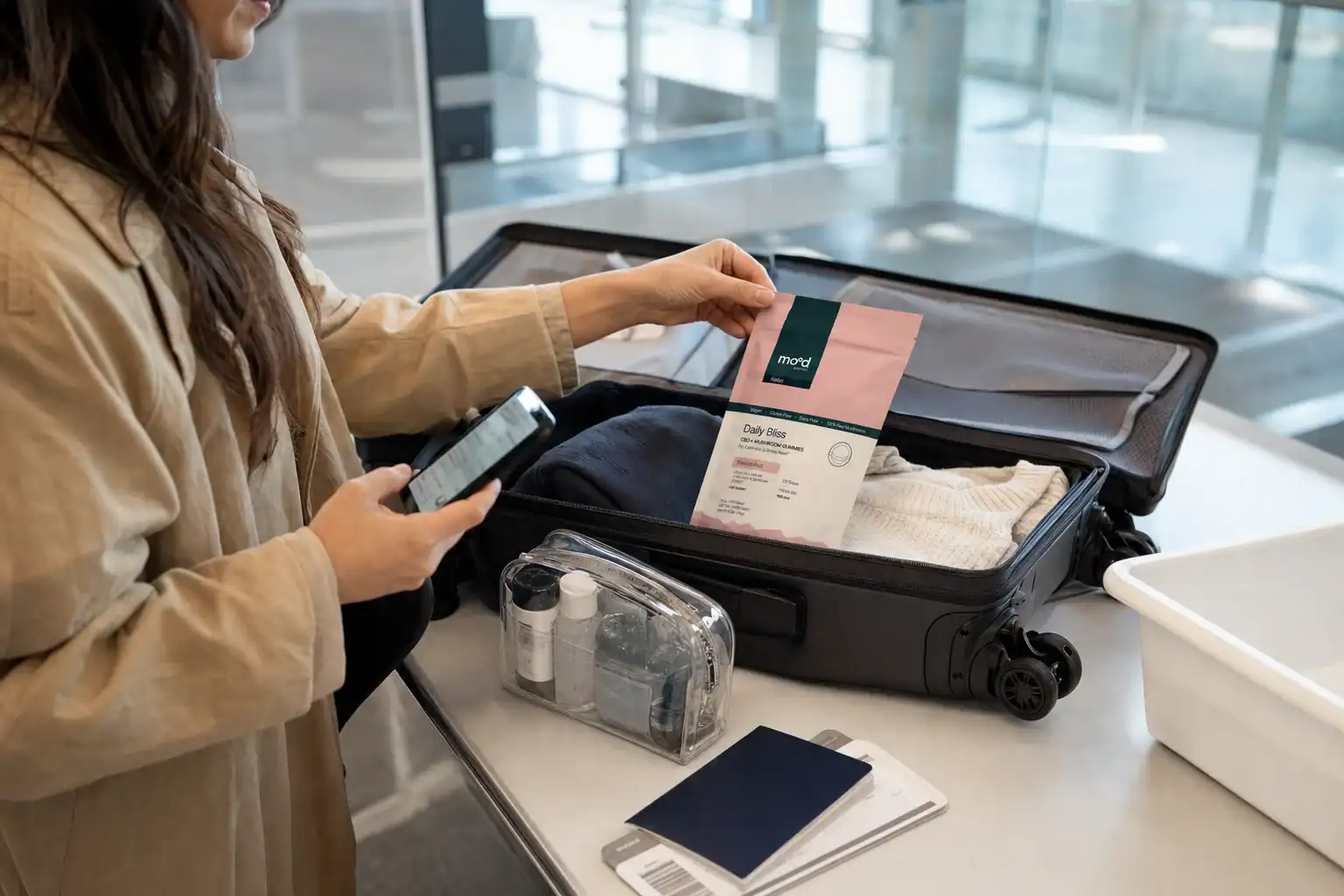
Keep a permitted product in its original, plainly labeled package rather than mixing it with ordinary candy or transferring it to an unmarked container. Never conceal it. If carrying the item requires concealment, the safer decision is not to bring it.
A six-step preflight check
What to verify before leaving home
1
Identify the actual product type
Confirm that it is a hemp-derived CBD gummy, not a marijuana edible, delta-9 product above the federal hemp threshold or an unlabeled homemade item.
2
Match the package to a current batch report
The lot number on the package should match the certificate of analysis. Check the measured delta-9 THC result and serving size, not only the front-label claim.
3
Check the departure jurisdiction
Review the state and local rules that apply at home and at the departure airport. Airport property does not erase local law.
4
Check the destination and every connection
Confirm possession, age and product-form rules using current government sources. A connection can add another jurisdiction even if you do not leave the terminal.
5
Read TSA and airline guidance again
Rules can change. Save links to the current official pages, but understand that a screenshot is not an exemption.
6
Choose the low-consequence option
If the product or any rule is uncertain, leave it home and make another plan for the trip.
Bring only what you can explain accurately.
Original packaging and a matching laboratory report are more useful than a generic “hemp legal” statement. Neither document guarantees passage through screening or protection from enforcement.
Verify the batch, not the branding
How to inspect a CBD gummy label and COA
A certificate of analysis, or COA, is a laboratory report for a specific batch. It should identify the lab, client or product, lot number, test date, methods and measured cannabinoids. A polished QR code that opens a generic marketing page is not enough.
| Check | What to look for | Red flag |
|---|---|---|
| Batch match | Package lot number matches the report | One old report used for every product |
| Delta-9 THC | Quantified result and clear units that allow dry-weight interpretation | Only “pass,” “ND” without a reporting limit, or no THC panel |
| Total package and serving | Amount per gummy and number of gummies are unambiguous | Large front-label number without per-serving context |
| Product identity | CBD, broad-spectrum, isolate or full-spectrum description agrees with the report | Full-spectrum product marketed as guaranteed drug-test safe |
| Lab and date | Named laboratory, recent report and test method | Edited image, missing pages or unverifiable laboratory |
Dry-weight percentage and milligrams per gummy are not interchangeable without the product weight. If you cannot understand the units, ask the manufacturer or a qualified professional before travel. Mood customers can use the Mood lab-results hub to look for a matching report, but availability on a brand website is not a legal determination.
Even accurately labeled full-spectrum products may contain THC. That matters for possession rules and for employment drug testing. See the separate guide to CBD and drug-test risk.
U.S. rules stop at the border
International flights, connections and customs
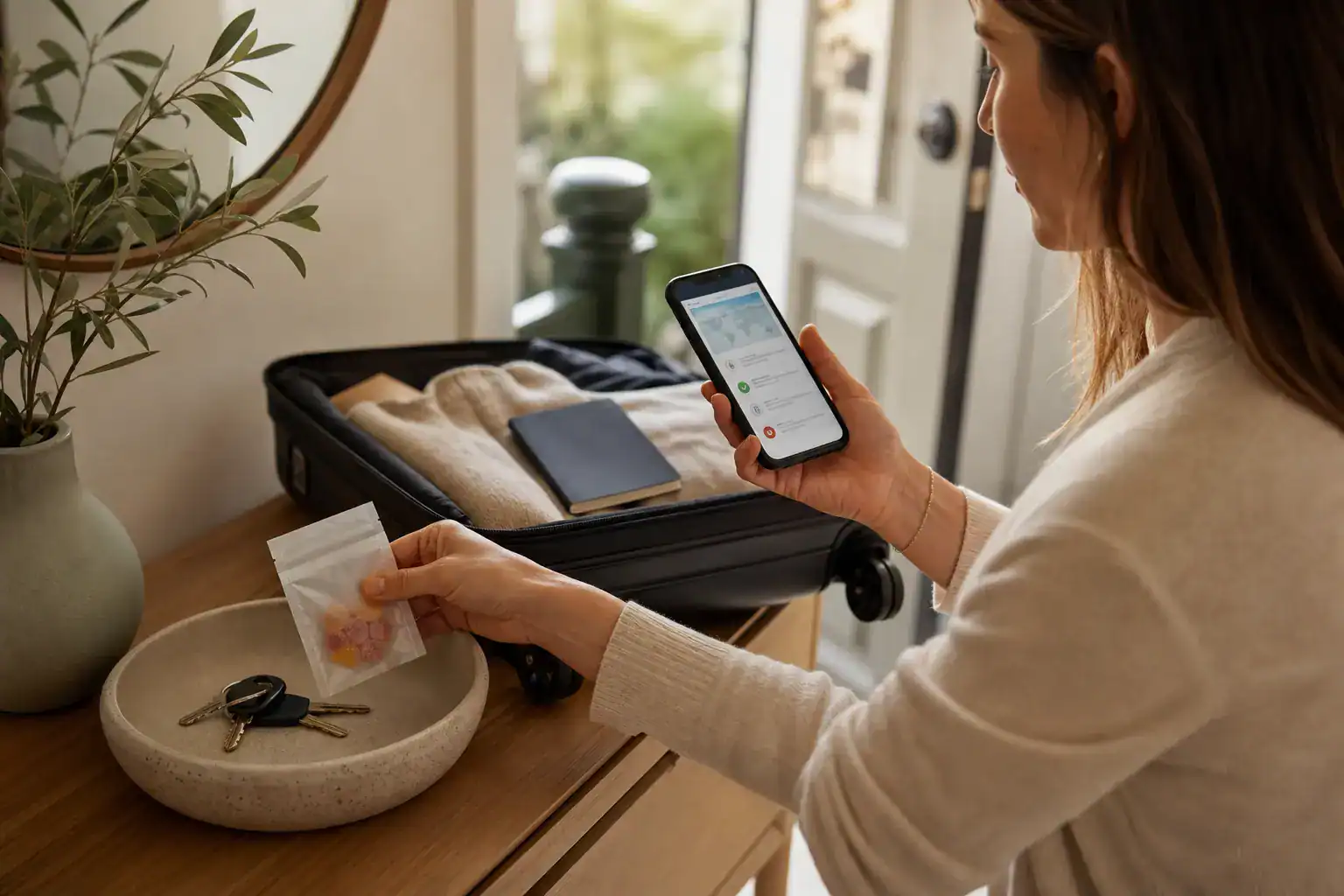
Do not carry CBD gummies internationally based only on a U.S. Farm Bill explanation. A trip can involve U.S. export rules, the destination country’s import and possession rules, the law of a transit country and airline conditions. Some jurisdictions regulate all cannabis extracts, trace THC or food products differently from the United States.
Remaining airside during a connection does not guarantee that local law is irrelevant. Bags can be screened again, flights can be diverted and customs preclearance may occur before departure. A return trip also creates a U.S. import question, which is different from possessing the same package before leaving home.
The safest international default is to leave CBD at home.
If travel is necessary, obtain current written guidance from official customs, border, health or embassy sources for every departure, transit and destination country. Do not rely on a retailer, travel forum or another passenger’s experience.
A U.S. medical recommendation, state cannabis card or prescription document does not compel a foreign authority to permit the product. Do not assume declaring an item makes an otherwise prohibited item lawful. Declaration and permission are separate.
Higher-consequence situations
Pilots, aircrew, medical use and drug testing
FAA guidance aimed at pilots and certificate holders is stricter and carries consequences that a general passenger article cannot resolve. The FAA warns pilots about transporting marijuana and about certificate action. FAA safety material also cautions that CBD products can contain enough THC to produce a positive test. Airmen, flight crew and safety-sensitive transportation employees should use their employer and regulator’s current compliance process before using or carrying any cannabinoid product.
If CBD is part of a medical plan, ask the treating clinician about a travel alternative before departure. This is especially important for prescription cannabidiol, seizure treatment or a condition in which missed doses may be dangerous. Keep prescription medicine in the pharmacy-labeled container and use TSA’s current medication guidance. Do not replace prescription cannabidiol with a retail gummy.
| Traveler | Who to contact | Main issue |
|---|---|---|
| Pilot, airman or safety-sensitive employee | FAA-authorized medical examiner, employer compliance office or union counsel | Certification, testing and safety duties |
| Person using prescription cannabidiol | Prescriber, pharmacy, TSA Cares when appropriate and destination authority | Continuity of treatment and lawful documentation |
| Traveler on interacting medication | Pharmacist or prescribing clinician | CBD can interact with medicines; travel disruption may alter timing |
| Traveler subject to drug testing | Employer or program administrator | Trace THC and mislabeled-product exposure |
For medication questions, prepare the complete label and use Mood’s guide to CBD drug interactions as a discussion aid, not a substitute for a pharmacist.
Apply the framework
Common travel scenarios
Check current Colorado, California, airport and airline rules, then confirm the batch report. The familiar retail markets do not remove the federal food-law issue or guarantee screening outcome.
Do not assume state legality permits air transport. A marijuana edible is not converted into federally lawful hemp by placing it in luggage.
Review the matching batch report. Broad-spectrum and THC-free are product claims, not travel exemptions or guarantees against trace contamination.
Airport retail availability does not prove the item is lawful at the destination or on an international connection.
Do not try a new product for the first time during travel. Drowsiness, dizziness or medication interactions can complicate an already stressful environment.
Import rules and FDA requirements apply. A product permitted for sale abroad is not automatically admissible into the United States.
The consistent principle is simple: product identity, itinerary and traveler status matter more than the word “CBD.”
Bottom line
A simple preflight check makes domestic CBD travel clearer
A verified hemp-derived gummy at or below the federal delta-9 THC threshold may be suitable for some domestic itineraries. Keep it in the original package, match the lot to a current batch report and confirm the departure and destination rules close to travel.
International trips require separate customs and country checks. When a route permits CBD, good packaging and transparent testing make the product easier to identify and explain; when a rule remains unclear, leaving it at home is the simplest choice.
Quick answers
Frequently asked questions about flying with CBD gummies
Can I take CBD gummies through TSA?
TSA says certain cannabis products containing no more than 0.3% THC on a dry-weight basis or approved by FDA fall within its stated federal exception. TSA does not approve retail products, and suspected violations are referred to law enforcement.
Should CBD gummies go in my carry-on or checked bag?
Neither bag changes the legal status. Solid gummies are not normally subject to the liquid 3-1-1 limit, but both carry-on and checked bags can be screened.
Do CBD gummies need to be in original packaging?
Original packaging is the clearest way to identify the product and match a batch report. It is not a legal exemption and cannot prove the contents by itself.
Can I fly with full-spectrum CBD gummies?
Full-spectrum gummies may contain THC. Check the current batch report, federal threshold, state and local rules, airline policy and drug-test consequences. If any part is uncertain, leave them home.
Can I fly with CBD gummies internationally?
The safest default is no. U.S. hemp rules do not control foreign import, possession or transit-country law. Obtain current official confirmation for every jurisdiction before considering travel.
Does a medical card let me fly with CBD or marijuana edibles?
No universal rule makes a state medical card valid across federal aviation settings, other states or foreign borders. Ask the relevant authorities and a qualified legal professional.
Will TSA test my CBD gummies?
TSA is a security-screening agency, not a retail cannabinoid certification service. If an item is suspected to violate law, TSA can refer it to law enforcement.
Can CBD gummies cause a positive drug test after travel?
Yes. Full-spectrum or mislabeled products can expose a user to THC. A COA reduces uncertainty but cannot guarantee a negative result.
Transparency
Sources and legal-review note
Why Mood is included: Mood Wellness sells cannabinoid products, so we use clear packaging and accessible lab results to demonstrate a practical preflight product check. Official sources were checked August 31, 2026.
- Transportation Security Administration. Medical Marijuana, What Can I Bring?
- Transportation Security Administration. Complete What Can I Bring list.
- Federal Aviation Administration. Compliance Guidance Letter 2022-04.
- Federal Aviation Administration. Marijuana Can't Fly.
- Food and Drug Administration. Regulation of dietary supplements and conventional foods containing cannabis-derived compounds.
- Food and Drug Administration. Response to CBD dietary-supplement petitions.
- U.S. Customs and Border Protection. Prohibited and Restricted Items.
Travel rules and product formulas can change. Check current TSA, airline, destination and package information before each trip, especially for international travel.
Written by Mood Editorial TeamGovernment guidance and product information checked August 31, 2026.