Start here
CBD legality has four separate layers
The sentence “CBD is legal” often compresses several different questions into one. A more accurate answer identifies the product, the place, and the activity.
First, controlled-substance law asks whether the cannabis material fits the federal definition of hemp or falls within the definition of marijuana. Second, the U.S. Food and Drug Administration regulates what companies may put in foods, drugs, cosmetics, and products marketed as dietary supplements. Third, states and local governments can impose additional rules for manufacturing, sale, age limits, product form, testing, labeling, and possession. Fourth, a setting may have its own policy, including an employer, airline destination, sports body, school, military installation, or federal property.
A hemp-derived ingredient may fall outside federal controlled-substance scheduling while the finished edible or its marketing still conflicts with FDA or state requirements.
A CBD gummy can involve hemp definitions, food law, state retail rules, age restrictions, destination rules, and workplace drug-testing risk at the same time.
The useful question
Instead of asking only “Is CBD legal?”, ask: Is this exact batch, product type, intended use, location, and activity permitted under the rules that apply today?
Federal baseline
What federal law says about hemp-derived CBD today
The Agriculture Improvement Act of 2018 removed hemp from the federal Controlled Substances Act definition of marijuana. Under the framework that is still in effect on August 31, 2026, hemp generally means Cannabis sativa L. and its derivatives with no more than 0.3% delta-9 THC on a dry-weight basis. The USDA hemp laws and regulations page explains the production system and links to the controlling rules.
This change made lawfully produced hemp and many hemp-derived CBD preparations no longer controlled substances under federal drug law. It did not approve CBD as a food additive, dietary supplement, or treatment. It also did not prevent states from regulating hemp products more strictly within their borders.
Source matters. CBD derived from a cannabis product that does not fit the applicable hemp definition can remain subject to federal marijuana controls even though the molecule cannabidiol is the same. A label that says “CBD” does not prove where the extract came from or how much THC the batch contains.
Why the 0.3% statement is only a starting point
The familiar threshold refers to a concentration calculation, not a universal permission slip. Product weight, serving size, the form of THC measured, testing method, and state-specific total-THC rules can change the result. A product may also be mislabeled or may change as cannabinoids degrade over time. That is why a recent batch-specific certificate of analysis matters.
Important date
This federal baseline is scheduled to change on November 12, 2026. Readers and businesses should not use a pre-change summary for decisions made after that date.
2026 update
A narrower federal hemp definition is scheduled for November 12, 2026
Congress amended the federal hemp definition in Public Law 119-37. According to the Congressional Research Service, the amended language is scheduled to take effect on November 12, 2026. It changes the legal analysis from the 2018 Farm Bill’s delta-9-THC-focused definition toward a stricter total-THC and finished-product framework, with additional treatment of cannabinoids made or synthesized outside the plant.
The practical effect is that some products that qualify as hemp before the effective date may not qualify afterward. Products with measurable THC, including some full-spectrum CBD products, deserve a new compliance review rather than an assumption that a 2025 or early-2026 COA settles the question.
| Question | Through November 11, 2026 | Beginning November 12, 2026, if unchanged |
|---|---|---|
| Core THC test | Current hemp definition centers on no more than 0.3% delta-9 THC by dry weight. | The amended definition applies a stricter total-THC approach and finished-product limits. |
| Full-spectrum CBD | May fit the hemp definition when the batch meets the current threshold, subject to other laws. | Needs a product-specific review because even naturally occurring THC content may affect eligibility. |
| Broad-spectrum or isolate | Often lower risk under controlled-substance rules when THC is genuinely non-detectable. | Still requires verification of the full cannabinoid profile, manufacturing method, FDA category, and state rules. |
| Older inventory and COAs | A current, representative test is already important. | Testing and labels should be reviewed against the new definition rather than the old threshold alone. |
The implementation details and enforcement landscape may continue to develop. Check updated federal guidance and the law of your state near the effective date. A brand statement cannot replace legal analysis for manufacturers, retailers, or high-risk inventory decisions.
Product-by-product
CBD products do not all have the same legal profile
Two products can show the same CBD amount on the front label and still present very different legal questions. The following table is a screening tool, not a state-specific legal opinion.
| Product | Main federal question | Additional check |
|---|---|---|
| CBD isolate oil or topical | Was the CBD derived from lawful hemp, and does testing confirm the relevant THC limits? | State product rules, labeling, claims, and cosmetic or consumer-product requirements. |
| Broad-spectrum CBD | Does the batch truly show non-detectable THC, and how was the extract produced? | Do not treat “THC-free” on the front label as proof. Review the complete COA. |
| Full-spectrum CBD | Does the batch fit the hemp definition in effect on the date of sale or possession? | State total-THC rules and the November 2026 federal change are especially relevant. |
| CBD gummy, drink, or other food | Controlled-substance status is only one issue. | FDA says CBD cannot lawfully be added to food in interstate commerce under the current federal framework; state retail rules also vary. |
| Product marketed as a dietary supplement | Hemp status does not create dietary-supplement approval. | FDA states that CBD products are excluded from the federal dietary supplement definition under current law. |
| CBD cosmetic | Source and THC remain relevant. | Cosmetic safety, adulteration, labeling, claims, and state restrictions still apply. |
| Prescription CBD | FDA-approved cannabidiol drug products follow their approval and prescription rules. | Do not substitute a consumer CBD product for a prescribed medicine. |
| Marijuana-derived CBD | Generally remains controlled at the federal level when it does not fit the hemp definition. | State medical or adult-use cannabis rules may permit it within that state. |
For a deeper explanation of CBD isolate, broad-spectrum, and full-spectrum extracts, read our guide to cannabinoids and the entourage effect. The legal status of a spectrum is not a guarantee of quality or suitability.
A separate federal layer
The FDA regulates product category and claims, not just THC
The FDA’s position is frequently missed in CBD legality articles. The agency states that CBD cannot currently be lawfully marketed as a dietary supplement and cannot be added to conventional food introduced into interstate commerce. The reason is tied to the federal drug-exclusion provisions and the prior investigation and approval of CBD as a drug ingredient. The FDA cannabis and CBD Q&A explains these distinctions.
The FDA has approved one prescription CBD product for specific seizure disorders. That approval does not extend to consumer oils, gummies, vapes, or cosmetics, and it does not establish that an over-the-counter product can diagnose, treat, cure, or prevent a disease.
Claims can change the regulatory category
A company that markets a CBD product as treating anxiety, pain, cancer, insomnia, or another disease can cause the product to be treated as an unapproved drug, regardless of the hemp source. Terms such as “natural” and “wellness” do not protect a disease claim.
FDA and state enforcement priorities are not the same as legal authorization. The fact that CBD foods are widely sold does not mean the FDA has approved CBD for use in food or dietary supplements. Consumers should distinguish market availability from regulatory status.
Health decisions are separate from legal status
A legally available product can still cause side effects or interact with medication. CBD use during pregnancy, breastfeeding, childhood, liver disease, or alongside prescription drugs requires qualified clinical guidance.
Local rules
State law can be stricter, more specific, and faster-changing
States regulate hemp products in different ways. Their rules may address ingestible CBD, smokable hemp, age limits, retail licenses, testing, packaging, total THC, serving limits, synthetic cannabinoids, delivery, and where a product can be sold. City or county rules can add another layer.
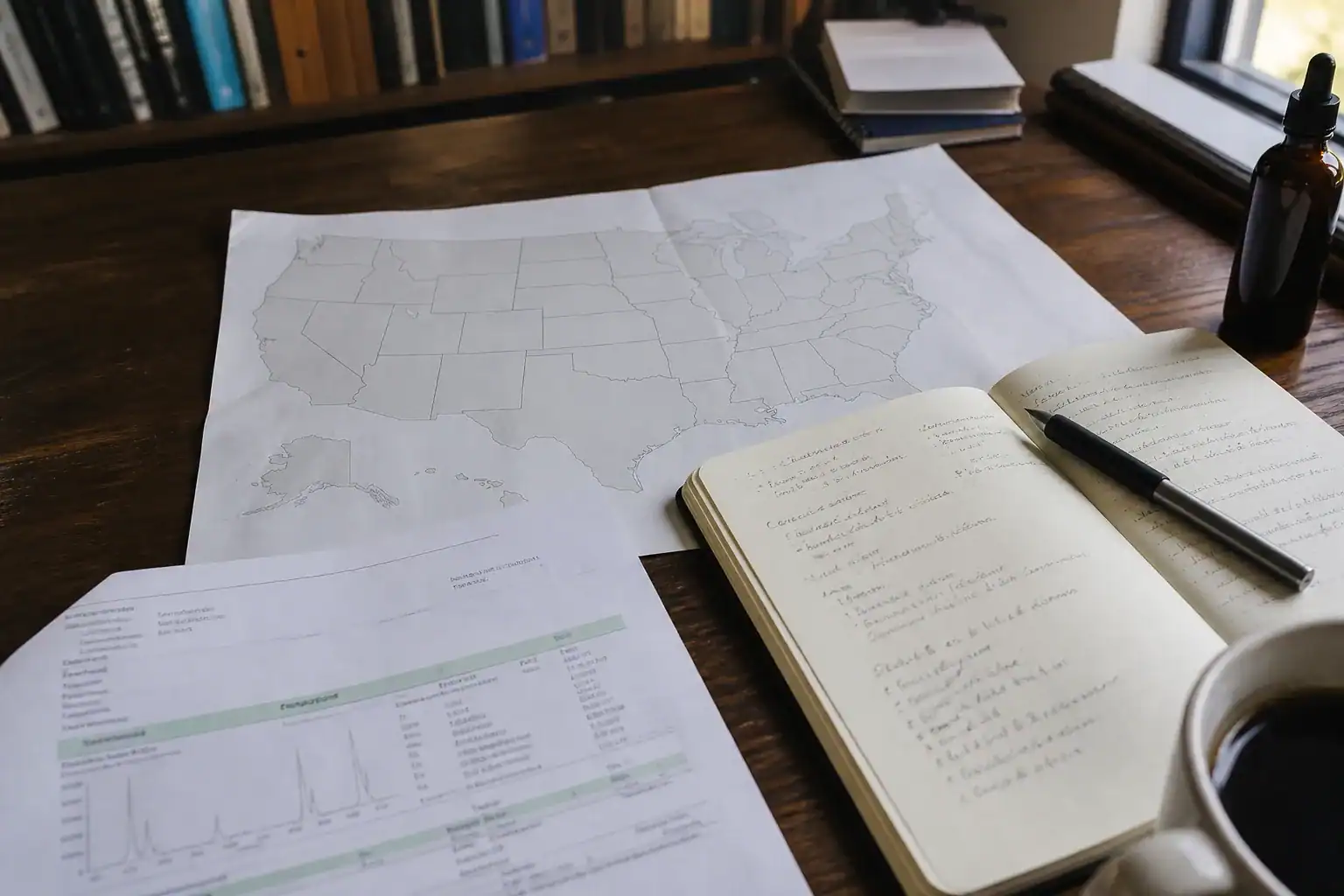
A static 50-state table becomes unreliable quickly because it can hide product-specific exceptions and new legislation. For current research, start with the NCSL State Cannabis Legislation Database, then confirm the rule with the responsible state agriculture, health, cannabis, or attorney general’s office.
Use this state-law check
- Name the product form. Oil, gummy, beverage, flower, vape, topical, and pet products may be regulated differently.
- Identify the cannabinoids. Record CBD, delta-9 THC, THCA, delta-8 THC, and any other detectable cannabinoid shown on the COA.
- Check age and retail restrictions. A state may allow a product only through licensed sellers or above a certain age.
- Check manufacturing and testing rules. A product can be lawful in concept but noncompliant because the label, package, laboratory, or registration does not meet state requirements.
- Check the date. Use enacted law and current agency guidance, not an undated blog map.
For businesses, legal counsel and current agency guidance are appropriate because manufacturing, interstate sale, inventory, advertising, and tax exposure go beyond consumer education.
Practical verification
How to check whether a CBD product raises legal red flags
No consumer checklist can guarantee legality, but it can identify when a product deserves more scrutiny. Start with the exact batch rather than the brand’s general promise.
1
Match the product and batch
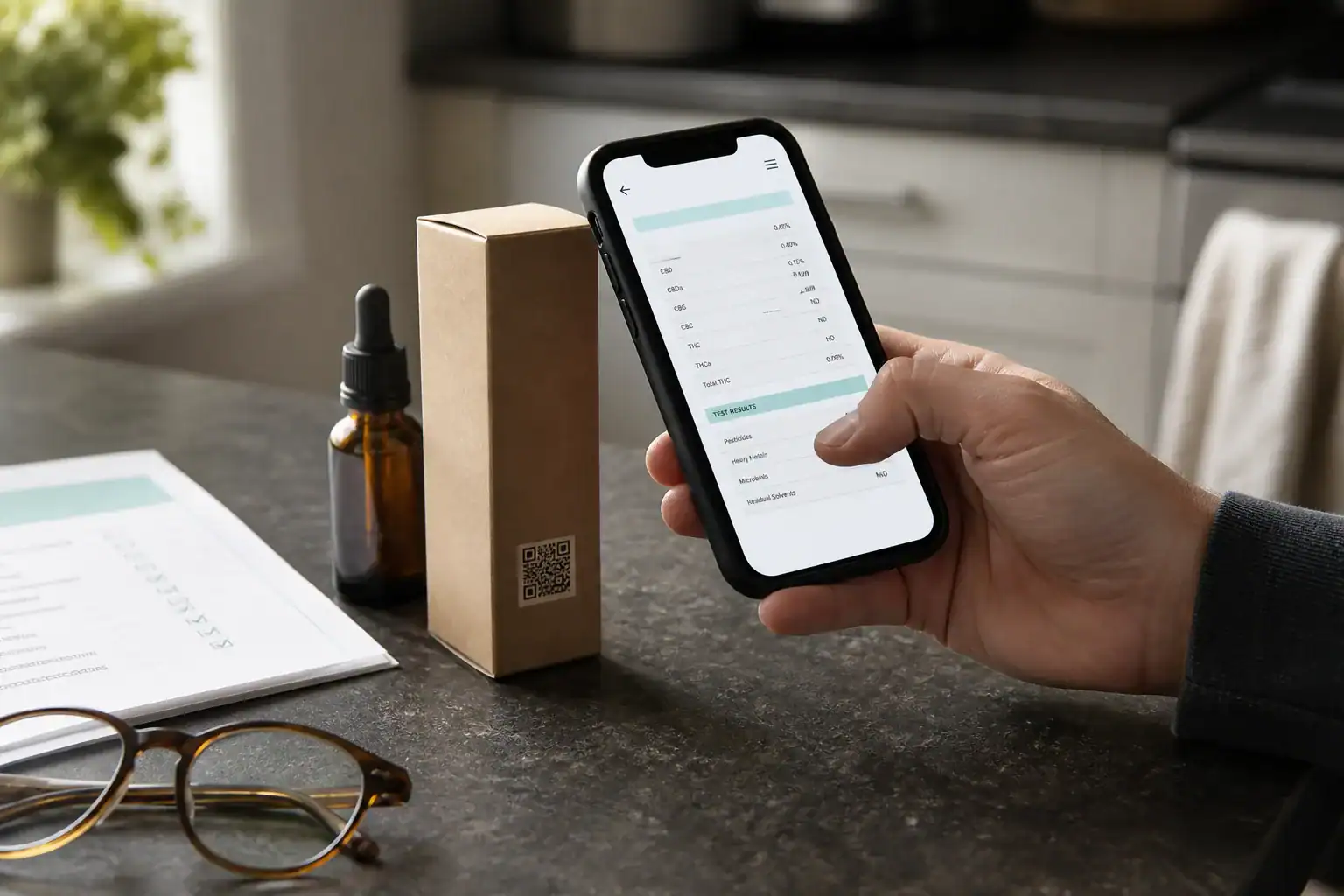
The product name, strength, lot number, and date on the certificate of analysis should correspond to the item in your hand.
2
Confirm the laboratory
Look for an identifiable independent laboratory, test date, methods, and a report that has not expired or been reused across unrelated products.
3
Read the cannabinoid panel
Review delta-9 THC, THCA, total THC where reported, CBD, and other cannabinoids. “Pass” without numbers provides less information.
4
Compare the label with the report
Check whether total CBD and serving information are reasonably consistent with the laboratory results.
5
Check product form and claims
A gummy, beverage, vape, topical, and oil can be subject to different rules. Avoid products presented as unapproved treatments.
6
Verify your state and destination
Review current rules for where you buy, possess, use, and travel with the product.
7
Recheck after November 12, 2026
Do not rely on the old delta-9-only summary after the scheduled federal definition change.
Mood publishes available testing through its lab results library. Our CBD buyer’s guide explains how to assess strength, ingredients, extraction information, and brand transparency beyond the legal minimum.
Context matters
Flying, mailing, drug testing, sports, and federal property add their own rules
A product that can be sold at a local store is not automatically appropriate in every setting.
| Situation | What to verify | Next guide |
|---|---|---|
| Domestic air travel | Federal hemp status, TSA rules, departure and destination law, airline limits, and liquid-size rules. | Flying with CBD gummies |
| International travel | Destination and transit-country law. U.S. legality does not travel with the passenger. | Use embassy and customs sources for every country on the itinerary. |
| Mail or delivery | Carrier policy, federal mailing rules, source documentation, destination law, and restricted product forms. | Check the selected carrier’s current policy before shipping. |
| Workplace drug testing | Employer policy and the risk that full-spectrum products or mislabeled products expose the user to THC. | CBD and drug tests |
| Competitive sport | The governing body’s prohibited list, testing threshold, and supplement-risk policy. | Use the current rulebook for the athlete’s organization. |
| Federal property or regulated employment | Agency-specific rules, security policy, and employment conditions. | Ask the responsible compliance office before possession or use. |
Do not carry an unlabeled product or rely on a screenshot of a generic lab report. Keep the original packaging and a batch report when documentation is appropriate, while recognizing that documentation does not override a prohibition.
Bottom line
Transparent hemp-derived CBD can be a confident wellness choice
Many hemp-derived CBD products can fit within the federal framework in effect today. Choosing a clearly labeled product with a current batch report helps you confirm its source and cannabinoid profile before purchase.
Check the product format and current rules in your state, and revisit the federal requirements before November 12, 2026. Mood’s public lab-results hub makes the product-verification step straightforward.
Quick answers
Frequently asked questions about CBD legality
Is CBD federally legal in the United States?
Some hemp-derived CBD can be lawful under federal controlled-substance rules, but federal legality is not one blanket approval. The product must fit the hemp definition in effect, and FDA rules still apply to foods, dietary supplements, drugs, cosmetics, and claims.
Is CBD legal in all 50 states?
There is no reliable one-sentence answer for every product. States regulate forms, THC limits, testing, labeling, age, retail channels, and possession differently. Check the exact product against current state agency guidance.
Is full-spectrum CBD legal?
It may fit the current federal hemp definition when the batch meets the applicable THC threshold, but state law and the scheduled November 12, 2026 federal change can alter the analysis. Review a current batch COA rather than relying on “full spectrum” alone.
Is THC-free CBD automatically legal?
No. “THC-free” may be inaccurate, and legality also depends on source, manufacturing, product category, claims, and state rules. Broad-spectrum and isolate products still require verification.
Can the FDA approve a CBD brand?
The FDA has approved one prescription drug containing CBD for specific seizure disorders. It has not approved ordinary consumer CBD oils, gummies, vapes, or cosmetics as treatments. A company should not imply otherwise.
Will CBD law change in November 2026?
A narrower federal hemp definition is scheduled to take effect on November 12, 2026. Products with THC and certain manufactured cannabinoids may need a new compliance review. Check current federal and state guidance as the date approaches.
Does a COA prove a CBD product is legal?
A COA is evidence about the tested batch, not a legal opinion. It helps verify cannabinoid content and label accuracy, but product category, claims, state law, testing rules, and the date still matter.
Transparency
Sources and editorial review
Research method: This guide prioritizes federal agency materials, current Congressional Research Service summaries, and the NCSL state legislation database. It avoids a static 50-state “legal/illegal” chart because those labels can hide product-specific exceptions and become outdated.
- USDA Agricultural Marketing Service. Hemp Laws and Regulations.
- USDA Office of General Counsel. Legal Opinion on 2018 Farm Bill Hemp Provisions.
- U.S. FDA. Regulation of Cannabis and Cannabis-Derived Products, Including CBD.
- U.S. FDA. Consumer Update on Products Containing CBD.
- Congressional Research Service. Federal Hemp Definition and 2026 Effective Date.
- National Conference of State Legislatures. State Cannabis Legislation Database.
- Drug Enforcement Administration. Hemp and CBD Controlled-Substance Context.
General educational information, not legal or medical advice. Laws, regulations, agency interpretations, and enforcement priorities can change. Verify current federal, state, local, destination, employer, and governing-body rules for your situation.
Written by Mood Editorial TeamMaterially reviewed and updated August 31, 2026. No attorney review is claimed. Corrections can be submitted through Mood Wellness support.