
What “vegan” means on a US label
FDA’s draft guidance on plant-based alternatives notes that federal regulations do not currently define “vegetarian” or “vegan.” It describes the common use of vegan to communicate that a food contains no animal-derived products.
This leaves room for private standards and company policies to differ. Questions may include whether a standard covers:
- intentionally added animal-derived ingredients;
- processing aids not present or functional in the final food;
- sugar processing inputs;
- microbial fermentation media;
- animal testing policies;
- shared equipment and cross-contact; and
- packaging adhesives or other non-food materials.
A shopper does not need to investigate every theoretical upstream input. Decide which boundary matters to you, then choose evidence that actually covers it.
Why gelatin is the obvious first check
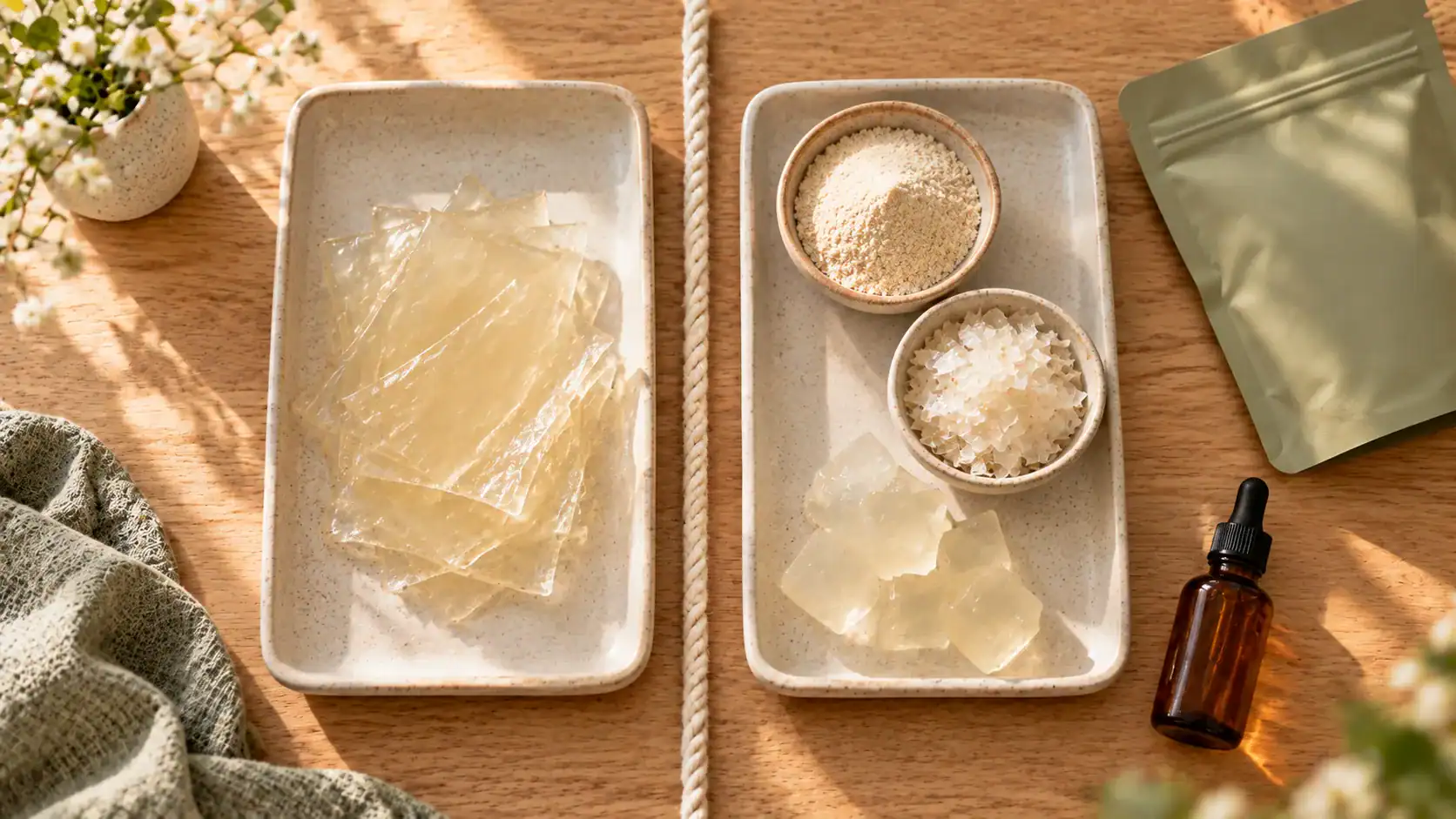
Gelatin is produced from animal collagen and is widely used to create a chewy gummy texture. If gelatin appears in the ingredient list, the finished gummy is not vegan under the ordinary meaning of the term.
Plant-based alternatives include pectin, agar and combinations of hydrocolloids such as locust bean gum. Their presence can support a gelatin-free formula, but the rest of the list still needs review.
| Gelling term | General source | Vegan conclusion |
|---|---|---|
| Gelatin | Animal collagen | Not vegan |
| Pectin | Plant cell walls, commonly fruit-derived | Generally plant-based; check complete formula |
| Agar | Red algae | Plant-based/non-animal gelling system |
| Locust bean gum | Carob seed endosperm | Plant-derived thickener/stabilizer |
| Unnamed “gelling agent” | Unclear | Ask for common/usual name and source |
Texture is not a reliable identification method. A soft gummy may be pectin-based, and a firm gummy may contain gelatin.
Read the ingredient list in order
FDA explains that ingredients are generally listed in descending order by weight. In a gummy, syrups and sugars often appear early because they form much of the base; concentrated hemp extract may appear later.
Ingredient order does not identify animal origin and does not rank ethical importance. It gives relative formulation context.
Read:
- the full ingredient statement;
- subingredients in parentheses;
- a “Contains” allergen statement;
- precautionary cross-contact language;
- footnotes identifying organic ingredients; and
- any separate Supplement Facts panel.
The broader CBD gummy ingredient guide explains sweeteners, acids, colors, oils and active ingredients in more detail.
Vegan, vegetarian and plant-based differ
“Vegetarian” is commonly used for products without meat, fish or poultry but may permit milk, eggs or honey. “Plant-based” can describe an emphasis rather than a strict exclusion standard. “Vegan” commonly communicates no animal-derived ingredients.
Do not treat the terms as interchangeable. If a package says only plant-based, inspect whether the brand defines that phrase for the finished product.
Similarly, “pectin gummy” describes one structural ingredient. It does not certify every flavor, color, coating or processing input.
Vegan and organic answer different questions
USDA organic categories concern how agricultural ingredients are produced and handled and how much certified organic content is in the finished product. They do not establish the absence of animal-derived ingredients.
An organic gummy can contain organic gelatin or honey. A vegan gummy can use non-organic cane sugar, pectin and flavors.
| Claim | Main question | Does not automatically prove |
|---|---|---|
| Vegan | Are animal-derived ingredients excluded under the stated standard? | Organic farming, allergen-free status, potency or safety |
| Organic | Does the product/ingredient meet USDA organic production and composition rules? | Vegan status or no added sugar |
| Non-GMO | Does sourcing meet the stated genetic-engineering standard? | Vegan or organic status |
| Kosher | Does the formula/process meet the certifier’s kosher standard? | Vegan status; pareve products can include non-vegan materials in some cases |
The scheduled kosher-versus-vegan CBD gummy guide owns the full comparison between those two systems.

What vegan certification adds
Independent certification can define a standard, review documentation and license a mark for a specific product or company scope. It can reduce uncertainty, especially when flavors, processing aids or suppliers are complex.
Verify:
- certifier name;
- exact product and flavor covered;
- current certificate or directory listing;
- standard definition;
- expiration or validity date;
- handling of shared equipment; and
- whether the mark covers ingredients only or broader practices.
A vegan logo generated by the brand is a claim, not independent verification. An expired certificate or a certificate for another flavor does not cover the current package.
Certification is not mandatory for a formula to be vegan. It is one evidence route.
Cross-contact is different from an ingredient
A product can be formulated without animal-derived ingredients and still be made on equipment that also handles milk, egg or other animal ingredients. This is a manufacturing and allergen-control question.
For an ethical preference, a brand’s cleaning and segregation explanation may be enough. For a serious food allergy, vegan status is not a substitute for allergen controls or medical guidance.
Ask whether the statement means:
- no animal-derived ingredients intentionally added;
- dedicated vegan facility;
- dedicated line;
- validated cleaning between runs; or
- shared equipment with precautionary labeling.
Do not infer “dairy free” or “allergen free” from vegan alone.
Sugar processing and strict vegan preferences
Some cane sugar can be refined using bone char, although the processing aid is not intended to remain as an ingredient. Beet sugar and certified or supplier-confirmed cane sugar may follow different processes.
Because this detail is not reliably visible from “organic cane sugar” or “cane sugar” alone, strict shoppers can ask the brand whether its supplier uses bone char. Keep the answer product- and supplier-specific.
Do not describe sugar as containing bones or animal material when the concern is a processing method. Precision matters.
CBD fields still need their own audit
Vegan status says nothing about cannabinoid content. Record:
- CBD per gummy and per serving;
- other cannabinoids such as CBG or CBN;
- full-, broad-spectrum or isolate wording;
- THC result and reporting limit;
- product and lot match; and
- potency and contaminant panels.
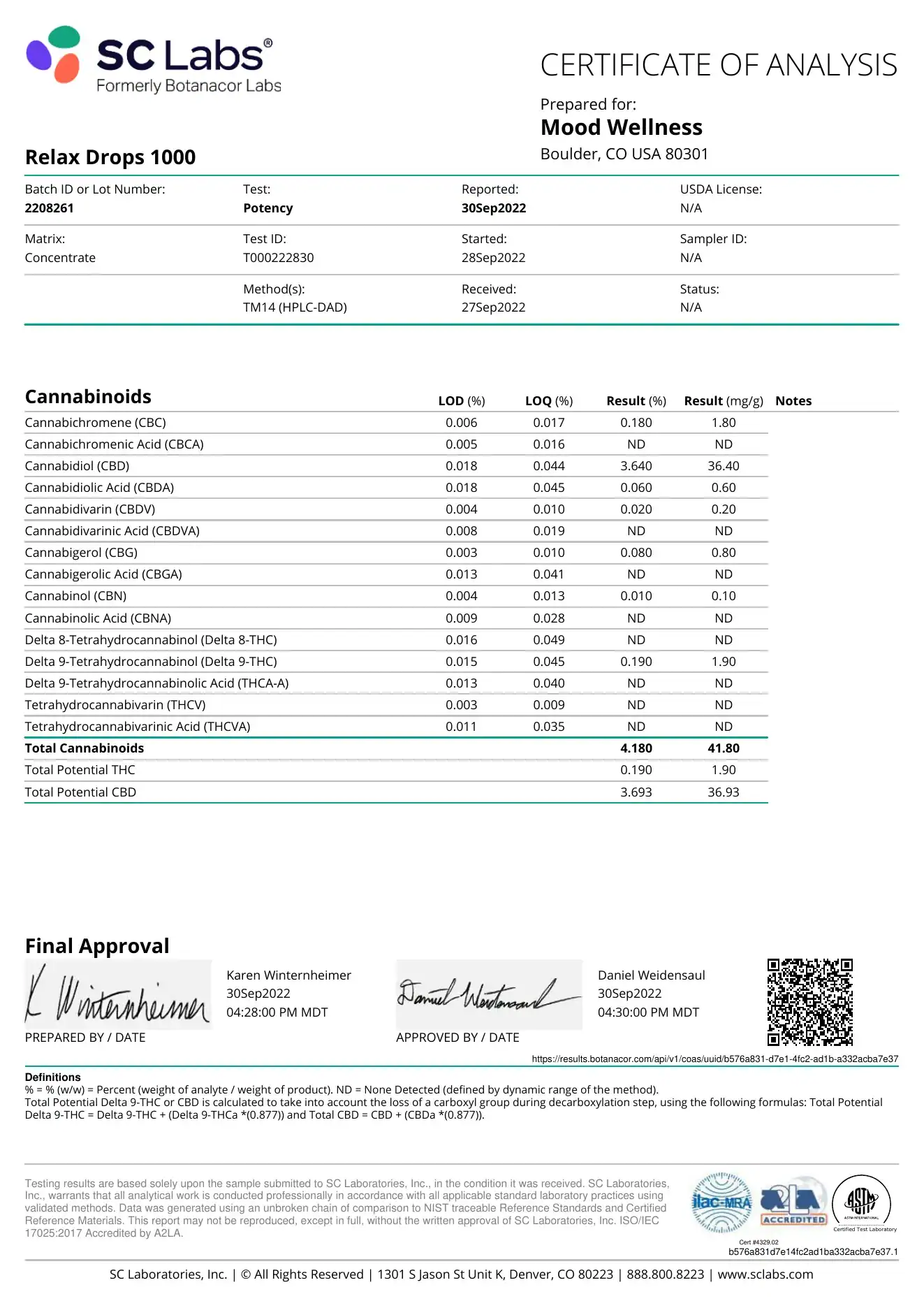
A vegan gummy may contain full-spectrum hemp and trace THC. It may affect drug testing. It may have an inaccurate CBD claim. Use the CBD COA reading workflow and match the batch number to the COA.
Current Mood vegan gummy examples
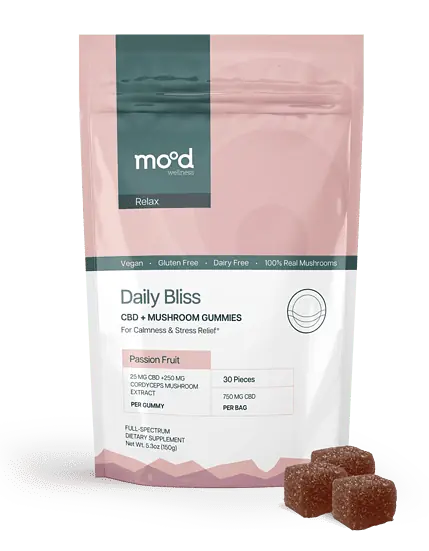
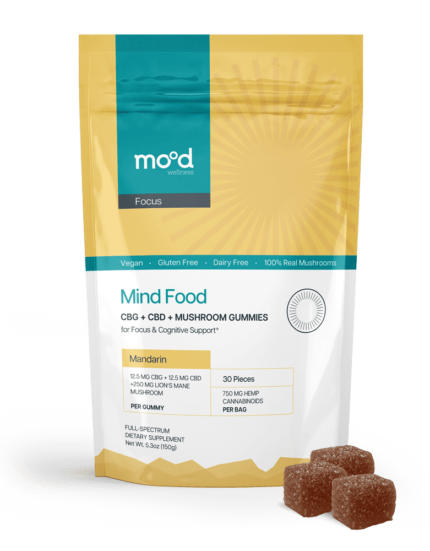
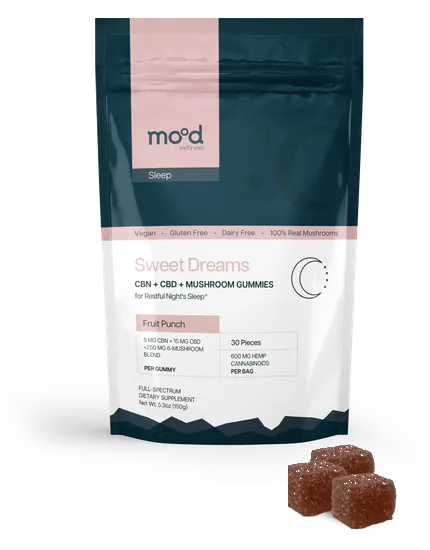
Mood’s current CBD gummy collection describes Daily Bliss, Mind Food and Sweet Dreams as vegan and gelatin-free.
Sweet Dreams
The current page lists organic locust bean gum and organic agar as part of its gelling system. It also lists organic tapioca syrup, organic cane sugar, water, organic tropical fruit-punch flavor, mushroom extracts, organic MCT coconut oil, organic full-spectrum hemp extract, sodium citrate, citric acid and organic sunflower lecithin.
The visible formula contains no gelatin. The vegan claim should still be understood as Mood’s finished-product statement and checked against the current package.
Mind Food
Mood describes Mind Food as vegan and gelatin-free and combines CBD, CBG and Lion’s Mane in a plant-based gummy formula. Its current product-specific label remains the authority for the full ingredient statement.
Daily Bliss
Mood describes Daily Bliss as a vegan, gelatin-free CBD plus Cordyceps gummy. Do not transfer Sweet Dreams ingredients to Daily Bliss; verify each formula independently.
The current Mood CBD gummy collection is the appropriate comparison page. Product claims and ingredients can change after this snapshot.
A vegan CBD gummy checklist
| Field | Evidence found | Follow-up needed |
|---|---|---|
| Exact product/flavor/version | ||
| Vegan statement | ||
| Gelatin absent | ||
| Named gelling system | ||
| Beeswax/glaze/coating | ||
| Carmine/cochineal/colors | ||
| Natural/artificial flavors | ||
| Vitamins and carriers | ||
| Oils and lecithin sources | ||
| Sugar-processing policy | ||
| Shared equipment/cross-contact | ||
| Independent certification | ||
| CBD/THC and lot-matched COA |
Leave a field unknown when the label cannot answer it. Contact the manufacturer with the exact product and lot rather than accepting a generic FAQ for every formula.
Safety Boundaries for Vegan CBD Gummies
Vegan does not mean medically safer. CBD can cause liver injury, interact with medications and increase sedation with alcohol or other substances that slow brain activity. FDA advises against CBD during pregnancy and breastfeeding.
Consult a clinician or pharmacist if you take medication, have liver disease, are preparing for surgery or have another relevant condition. Full-spectrum gummies may contain trace THC and may contribute to a positive drug test.
Keep gummies away from children and pets. Their candy-like appearance increases accidental-ingestion risk.
Recheck after a flavor or supplier change
Vegan status can change without a new product-family name. A different flavor may use another color, glaze or processing aid, and a supplier substitution can change the source of sugar or minor ingredients. Save the exact ingredient panel and date reviewed, then recheck when the package design, flavor, manufacturer or formulation changes. If strict avoidance matters, ask whether the answer applies to the finished lot, not only to the brand's general formulation policy.

Bottom Line: Vegan CBD Gummies
Verify vegan CBD gummies as a complete finished formula, not a gelatin replacement. Check gelling agents, coatings, colors, flavors, nutrient sources, oils, processing aids and shared-equipment policies.
Because FDA regulations do not currently define vegan, look for a clear manufacturer standard or product-specific independent certification when the distinction matters. Then evaluate CBD amount, THC and laboratory evidence separately: vegan status is an ingredient claim, not a potency, safety or effectiveness certificate.
Quick answers
Frequently asked questions about Vegan CBD Gummies
What is the practical answer about Vegan CBD Gummies?
Verify vegan CBD gummies as a complete finished formula, not a gelatin replacement. Check gelling agents, coatings, colors, flavors, nutrient sources, oils, processing aids and shared-equipment policies. Because FDA regulations do not currently define vegan, look for a clear manufacturer standard or product-specific independent certification when the distinction matters.
Which Mood product fits this topic?
Daily Bliss is the most relevant Mood option for this topic. Mood Daily Bliss offers a premeasured CBD gummy with functional mushrooms for shoppers who prefer a convenient, positive daily wellness routine.
What should I compare before choosing a gummy?
Compare the cannabinoid amount per measured serving, the complete ingredient list, spectrum or THC information, current product directions and available batch documentation. The best choice is the formula that fits the goal and is easy to use consistently.
How should I start using a new CBD or cannabinoid product?
Follow the current package directions, choose a low-demand first-use window and keep timing and meal context reasonably consistent. Review medication, pregnancy, liver and impairment considerations with a qualified clinician when relevant.
Sources
- U.S. Food and Drug Administration. Draft Guidance for Industry: Labeling of Plant-Based Alternatives to Animal-Derived Foods.
- U.S. Food and Drug Administration. Types of Food Ingredients.
- U.S. Department of Agriculture, Agricultural Marketing Service. Labeling Organic Products.
- U.S. Food and Drug Administration. What You Need to Know About Products Containing Cannabis or Cannabis-Derived Compounds, Including CBD.
- Mood Wellness. CBD Gummies collection, Sweet Dreams, Mind Food and Lab Results pages. Checked September 9, 2026.
- U.S. Food and Drug Administration. What the FDA is Doing to Protect Consumers from Cannabidiol (CBD) in Foods. Accessed September 2026.