The claims are not equivalent
| Label wording | What it can mean | What it does not prove |
|---|---|---|
| Sugar-free / no sugar / zero sugar | Less than 0.5 g sugars per reference amount and labeled serving, subject to FDA conditions | Zero carbohydrate, zero calories, no sweeteners or no glucose response |
| Low sugar | No FDA-defined threshold for this claim | A standardized amount that can be compared across brands |
| Reduced sugar / less sugar | At least 25% less sugars than an appropriate reference food, with comparative labeling | Sugar-free or low carbohydrate |
| No added sugar | No sugar or sugar-containing ingredient added under the rule's conditions | Zero naturally occurring sugar or zero total carbohydrate |
| Unsweetened | A factual statement governed differently from sugar-free | No naturally occurring sugars |
| Low carb / keto | Separate marketing or dietary concepts | Compliance with the sugar-free definition or predictable individual response |
The front panel is a starting point. The nutrition or supplement panel and ingredients determine what the statement means in practice.
What FDA means by sugar-free
FDA guidance summarizing 21 CFR 101.60(c) says a food using “sugar free” must contain less than 0.5 gram of sugars per reference amount customarily consumed and per labeled serving. Related phrases such as “no sugar” and “zero sugar” are treated as sugar-content claims.
The rule also addresses sugar ingredients and calorie context. When a food is not low or reduced in calories, the sugar-free claim may need an accompanying statement such as “not a reduced calorie food,” “not a low calorie food” or “not for weight control.”
Two details matter for gummies.
First, less than 0.5 gram is not the same as an analytically absolute zero. Label rounding and the regulatory threshold can produce a displayed zero even when a trace amount exists.
Second, the test applies to the labeled serving and the reference amount. A person who takes multiple servings should not read “0 g” as proof that repeated servings contribute literally nothing.
Why low sugar is a weak comparison term
FDA's Food Labeling Guide lists “low” for sugars as not defined and says the claim may not be used as a defined nutrient-content claim. That differs from nutrients such as sodium, for which “low sodium” has a numeric criterion.
In everyday shopping language, people may still use “low sugar” to mean “less than products I usually buy.” That can be a personal comparison, but it is not a universal regulatory cutoff.
If a seller calls a gummy low in sugar, ask for the quantitative basis:
- grams of Total Sugars per serving;
- gummies per serving;
- grams per gummy;
- comparison product or category;
- date and version of both labels; and
- whether the statement actually means reduced sugar.
“Only a little sugar” and “lightly sweetened” also deserve numbers. An accurate statement such as “2 g Total Sugars per serving” is more useful than an undefined adjective.
Reduced sugar is a relative claim
Reduced sugar does not set a fixed ceiling. FDA's framework generally requires at least 25% less sugars per reference amount than an appropriate reference food.
The comparison food matters. A gummy with 3 grams of sugar could be reduced sugar relative to a comparable gummy with 4 grams, but it is not sugar-free. Another gummy with 1 gram could lack a reduced claim simply because the manufacturer does not make the comparison.
Check that the label identifies:
- the reference food;
- the percentage or fraction of reduction;
- the sugar amounts for both foods; and
- equivalent serving or reference amounts.
Do not compare a one-gummy serving with a two-gummy serving without normalizing units.
No added sugar is not sugar-free
FDA allows “no added sugar” or “without added sugars” under conditions that focus on processing: no sugar or sugar-containing ingredient is added when it would contribute added sugars.
A no-added-sugar product may still contain naturally occurring sugars from fruit or another ingredient. It may also contain carbohydrates and calories.
Likewise, a sugar-free product can be sweetened. Sugar alcohols, certain differently metabolized sugars and high-intensity sweeteners can create sweetness while Total Sugars remains below the threshold.
Read the claim literally:
- sugar-free describes the regulated sugar amount;
- no added sugar describes addition during formulation;
- unsweetened describes the absence of added sweetening in its factual context; and
- sweetener-free would be a different claim altogether.
Read Total Sugars and Added Sugars correctly
FDA explains that Total Sugars includes naturally occurring sugars plus Added Sugars. Added Sugars is a subset of Total Sugars.
If a label shows 4 g Total Sugars and “Includes 4 g Added Sugars,” the serving contains 4 grams of sugar, not 8. The “includes” line explains where the total came from.
Use this sequence:
- Confirm the serving size in gummies.
- Record Total Carbohydrate.
- Record Total Sugars.
- Record the amount of Added Sugars included in the total.
- Record sugar alcohol if declared.
- Read the sweetener ingredients.
- Convert to the amount you actually use.
The complete CBD gummy ingredient guide covers syrup, cane sugar, pectin, acids, flavors, oils and other formula components in more depth.

Calculate per gummy and per routine
Suppose a label lists a serving as two gummies with 4 g Total Sugars, including 4 g Added Sugars.
- Total Sugars per labeled serving: 4 g.
- Added Sugars per labeled serving: 4 g, already included above.
- Total Sugars per gummy: 4 ÷ 2 = 2 g.
If you use one gummy, the label-based estimate is 2 grams. If you use three, it is 6 grams, assuming uniform pieces. The three-gummy amount is 1.5 labeled servings.
Now consider a one-gummy serving that displays 0 g Total Sugars. You cannot safely convert that rounded zero into an exact laboratory zero. The sugar-free threshold permits less than 0.5 gram per serving, so repeated servings may still have a small cumulative amount.
Keep label arithmetic separate from cannabinoid serving advice. Do not change a CBD serving merely to hit a sugar target without considering CBD, other cannabinoids and the product directions.
Total carbohydrate still matters
Sugar-free does not mean carbohydrate-free. Total Carbohydrate can include starch, fiber, sugar alcohols and other carbohydrates in addition to sugars.
For shoppers counting carbohydrates, the Total Carbohydrate line is the appropriate starting value. Do not subtract ingredients using a generic internet formula and call the result “net carbs” unless the product explains its method and that method fits your purpose.
Different sugar alcohols and fibers are not interchangeable. Their energy contribution, digestion and individual tolerance can differ. A front-panel “keto” statement does not replace the quantitative label.
If you use insulin or medication affected by carbohydrate intake, ask a qualified clinician how to interpret the entire product for your treatment plan.

Sugar alcohols need their own check
Sugar alcohols, also called polyols, are used in many sugar-free products. Examples can include erythritol, xylitol, sorbitol, maltitol and isomalt.
They are not counted as Total Sugars, but they may be included in Total Carbohydrate and can be declared separately. Their presence explains how a gummy can taste sweet while displaying little or no sugar.
The ingredient identity matters because tolerance varies. Some polyols can cause gas, bloating or a laxative effect, especially at higher amounts. Do not generalize one person's response or one sweetener study to every blend.
For pets, xylitol is especially dangerous. Keep all gummies secured regardless of sweetener, and contact a veterinarian or poison resource promptly after accidental ingestion.
Alternative sweeteners are not automatically better
Allulose and other sugars metabolized differently from traditional sugars may be treated differently on the Nutrition Facts label. High-intensity sweeteners such as stevia-derived glycosides or sucralose contribute sweetness in small amounts.
Choosing among them is not a universal ranking. Consider:
- the quantitative nutrition panel;
- digestive tolerance;
- aftertaste and texture preferences;
- other carbohydrate ingredients;
- clinician advice when medically relevant; and
- the complete CBD formula.
“Natural” is not a numeric sugar claim. “Plant-derived” does not establish low sugar, and sugar-free does not establish vegan sourcing. Strict vegan shoppers can use the separate vegan gummy verification guide.
Sugar claims do not predict glucose response
A sugar-free label is not a treatment claim and does not guarantee that blood glucose will remain unchanged. Total carbohydrate, serving quantity, other ingredients and individual physiology can matter.
Do not use a CBD gummy to treat hypoglycemia or replace a planned carbohydrate source unless your clinician has specifically incorporated it into your care. Conversely, do not assume every gummy with some sugar is categorically unsuitable.
People with diabetes, reactive hypoglycemia, gastrointestinal conditions or prescribed dietary plans should bring the exact panel and ingredient list to a registered dietitian, clinician or pharmacist. Product marketing cannot individualize that decision.
Current Mood gummies: what can be said
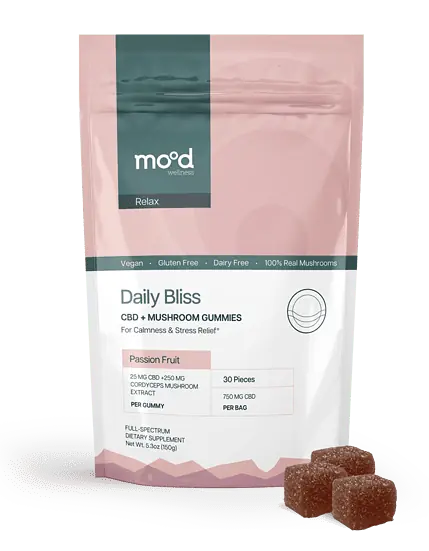
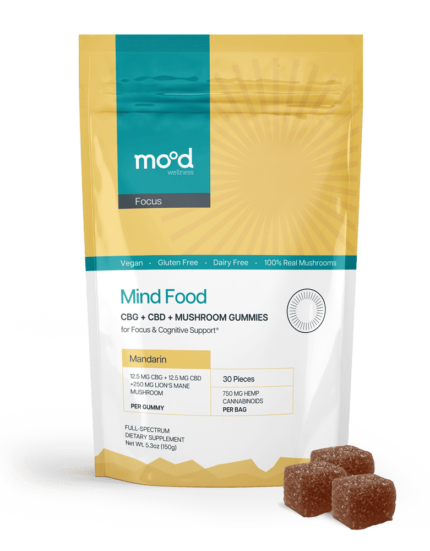
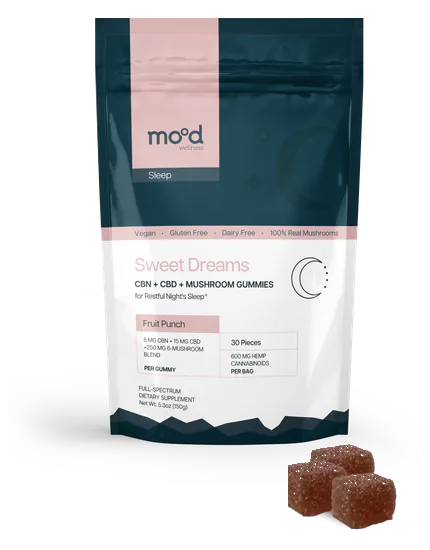
Mood's current gummy pages describe sweetener ingredients such as tapioca syrup and cane sugar in the formulas. Those ingredients mean the products should not be casually presented as sugar-free.
The visible current collection does not provide a defensible basis for this guide to call every Mood gummy “low sugar.” Because low sugar lacks a standardized FDA threshold, the appropriate evidence is the quantitative panel for each exact product.
For Daily Bliss, Mind Food and Sweet Dreams:
- check the physical package's current serving size;
- record Total Sugars and Added Sugars;
- divide by gummies per serving;
- do not transfer one formula's values to another; and
- account for the cannabinoid profile separately.
The current Mood CBD gummy collection is the place to compare available formulas. This is a seller disclosure, not a recommendation that the products fit a sugar-restricted diet.
CBD and THC are separate label fields
Sugar content does not validate cannabinoid content. A complete comparison also records:
- CBD per gummy and serving;
- CBG, CBN or other cannabinoids;
- full-spectrum, broad-spectrum or isolate wording;
- measured THC and reporting limits;
- product and batch match; and
- potency and contaminant panels.
Use the CBD COA reading guide and confirm the batch number matches the report.
A sugar-free gummy may still contain trace THC. It may still interact with medication or cause drowsiness. Nutrition claims are not safety or effectiveness certificates.
A practical comparison worksheet
| Field | Product A | Product B |
|---|---|---|
| Exact product and flavor | ||
| Serving size in gummies | ||
| Total Carbohydrate per serving | ||
| Total Sugars per serving | ||
| Added Sugars included | ||
| Sugar alcohol per serving | ||
| Total Sugars per gummy | ||
| Sweetener ingredients | ||
| Exact front-panel claim | ||
| Reference food for reduced claim | ||
| CBD and other cannabinoids per gummy | ||
| THC and lot-matched COA | ||
| Personal tolerance questions |
Photograph the complete package rather than saving only a front-panel badge. If a value is absent, mark it unknown and ask the manufacturer for the current label, not a generic marketing answer.
Safety Boundaries for Sugar-free vs Low-sugar CBD Gummies
FDA warns that CBD can interact with medications, affect the liver and increase sedation with alcohol or other substances that slow brain activity. FDA advises against CBD during pregnancy and breastfeeding.
Consult a clinician or pharmacist when you take medication, have liver disease, are preparing for surgery or need medical nutrition guidance. Full-spectrum products may contain trace THC and can create drug-testing risk.
Sugar alcohols and alternative sweeteners may cause digestive symptoms in some people. Start with the labeled amount only after considering the complete cannabinoid serving; stop and seek advice if you experience a concerning reaction.
Keep gummies away from children and pets. Candy-like appearance and sugar-free wording do not make accidental ingestion harmless.

Bottom Line: Sugar-free vs Low-sugar CBD Gummies
Sugar-free CBD gummies meet a defined sugar threshold under FDA rules. “Low-sugar” gummies do not have a standardized FDA cutoff, so the phrase cannot support a fair comparison by itself.
Use the numbers: serving size, Total Sugars, Added Sugars, Total Carbohydrate, sugar alcohol and grams per gummy. Treat reduced sugar, no added sugar, unsweetened, low carb and keto as separate statements. Then evaluate CBD, THC and batch evidence independently.
The best option is not universally the sweetest, the lowest number or the boldest badge. It is the product whose full label, ingredient system, cannabinoid serving and personal tolerance fit the decision you are actually making.
Quick answers
Frequently asked questions about Sugar-Free vs Low-Sugar CBD Gummies
What is the practical answer about Sugar-Free vs Low-Sugar CBD Gummies?
Sugar-free CBD gummies meet a defined sugar threshold under FDA rules. “Low-sugar” gummies do not have a standardized FDA cutoff, so the phrase cannot support a fair comparison by itself. Use the numbers: serving size, Total Sugars, Added Sugars, Total Carbohydrate, sugar alcohol and grams per gummy.
Which Mood product fits this topic?
Daily Bliss is the most relevant Mood option for this topic. Mood Daily Bliss offers a premeasured CBD gummy with functional mushrooms for shoppers who prefer a convenient, positive daily wellness routine.
What should I compare before choosing a gummy?
Compare the cannabinoid amount per measured serving, the complete ingredient list, spectrum or THC information, current product directions and available batch documentation. The best choice is the formula that fits the goal and is easy to use consistently.
How should I start using a new CBD or cannabinoid product?
Follow the current package directions, choose a low-demand first-use window and keep timing and meal context reasonably consistent. Review medication, pregnancy, liver and impairment considerations with a qualified clinician when relevant.
Sources
- U.S. Food and Drug Administration. Guidance Regarding Sugar Free Claims; 21 CFR 101.60(c).
- U.S. Food and Drug Administration. Food Labeling Guide: Definitions of Nutrient Content Claims.
- U.S. Food and Drug Administration. Added Sugars on the Nutrition Facts Label.
- U.S. Food and Drug Administration. Industry Resources on Changes to the Nutrition Facts Label; Sugar Alcohols.
- U.S. Food and Drug Administration. Sugars That Are Metabolized Differently Than Traditional Sugars.
- U.S. Food and Drug Administration. Consumer information on cannabis-derived products, including CBD.
- Mood Wellness. CBD Gummies collection and current product pages. Checked September 9, 2026.
- U.S. Food and Drug Administration. What the FDA is Doing to Protect Consumers from Cannabidiol (CBD) in Foods. Accessed September 2026.