
A fair test for an unusual claim
How should you evaluate a “spiritual benefit” claim?
Spiritual language can describe something personally meaningful without making it scientifically testable. “I felt more connected during meditation” is a report about one experience. “Lion’s Mane reliably creates spiritual connection” is a causal claim about other people and requires controlled evidence. Marketing often moves between those two statements without acknowledging the change.
Start by asking what the claimed benefit actually means. Is the outcome sustained attention, reduced mind-wandering, dream recall, a validated well-being score, a mystical-experience questionnaire or simply satisfaction with a ritual? A vague outcome cannot be confirmed or disproved because every response can be reinterpreted as success.
| Statement | Type of information | Responsible interpretation |
|---|---|---|
| “I enjoy Lion’s Mane tea before meditation.” | Personal preference | Valid for that person; no universal effect implied |
| “My sessions felt different after a new supplement.” | Uncontrolled observation | Worth recording; cause remains uncertain |
| “Monks traditionally used it for focus.” | Historical or cultural claim | Requires a reliable source and does not prove efficacy |
| “Lion’s Mane improves attention tests.” | Measurable scientific claim | Depends on trial quality, preparation and population |
| “Lion’s Mane opens consciousness.” | Broad causal claim | No clinical evidence establishes it |
| “Lion’s Mane works like psilocybin.” | Pharmacologic claim | False category equivalence; the mushrooms contain different compounds |
Next, look for controls. A credible experiment compares a standardized preparation with placebo, measures expectations, defines the outcome in advance and reports adverse effects. A testimonial does none of those things. It cannot separate the product from meditation practice, a change in sleep, caffeine, group support, placebo effects or normal day-to-day variation.
Finally, check whether the story is being used to sell certainty. Claims such as “ancient monks knew,” “activates hidden brain pathways,” “raises vibration” or “guarantees lucid dreams” create authority without giving a testable product, amount or outcome. A responsible brand can discuss ritual and uncertainty while still stating exactly what the product contains.
The evidence-led answer
Does Lion’s Mane have spiritual benefits?
Science has not established that Lion’s Mane causes spiritual awakening, mystical experiences, altered consciousness or deeper meditation.
Spiritual benefit is a personal and culturally shaped idea. It may refer to meaning, connection, attention, compassion, ritual or a felt relationship with nature. Those experiences can be important, but they are not standard clinical outcomes. Lion’s Mane studies generally measure cognition, mood, sleep questionnaires or laboratory mechanisms;not spirituality.
This creates two mistakes in online content. The first treats a traditional story about monks or meditation as if it were a controlled human trial. The second jumps from laboratory interest in nerve-growth pathways to claims about consciousness. Neither step is justified.
A person can still choose to include tea, food or a supplement in a contemplative routine. The honest interpretation is that the routine may support attention or meaning while the ingredient’s unique contribution remains unknown. A ritual does not need a medical claim to be worthwhile.
Bottom line:
Lion’s Mane is not a shortcut to enlightenment. If you use it, define a modest goal, preserve the meditation practice as the active foundation and do not treat a subjective experience as proof of a universal mushroom effect.
Clear category boundary
Is Lion’s Mane psychedelic?
No. Lion’s Mane, Hericium erinaceus, is an edible functional mushroom. It does not contain psilocybin or psilocin and is not expected to cause hallucinations, a psychedelic trip or a classic altered state of consciousness.
The confusion comes partly from language. Lion’s Mane is discussed in online microdosing communities and sometimes appears in “stacks” alongside psilocybin and niacin. Being included in a combined protocol does not make Lion’s Mane psychedelic or prove it potentiates psilocybin. The psychoactive component in such a stack is a separate substance with different pharmacology, legal status and risks.
| Question | Lion’s Mane | Psilocybin mushroom |
|---|---|---|
| Scientific category | Edible Hericium species | Multiple species containing psilocybin |
| Psilocybin present | No | Yes |
| Expected psychedelic effect | No | Yes, dose and context dependent |
| Common research questions | Cognition, mood, nerve-related mechanisms | Altered consciousness and potential clinical applications under controlled conditions |
| US federal status | Sold as food or dietary supplement ingredient | Psilocybin is Schedule I federally |
If a product labeled Lion’s Mane causes hallucinations, marked confusion, loss of coordination or strong intoxication, do not assume that is a normal functional-mushroom effect. Stop use, retain the package and lot information, and seek medical or poison-control guidance. Inaccurately labeled mushroom edibles have contained unexpected substances.
History without mythology inflation
Where did the meditation story come from?
Lion’s Mane has a history in East Asian food and traditional medicine. Its Japanese name, yamabushitake, is associated with the yamabushi, mountain ascetics connected with Shugendo traditions. Modern supplement content also repeats stories that Buddhist monks used Lion’s Mane tea to support concentration during meditation.
These narratives deserve careful wording. A name or repeated legend can provide cultural context; it does not document a standardized preparation, dose, outcome or causal effect. Historical use is not equivalent to a randomized trial, and a modern gummy containing cannabinoids is not equivalent to a traditional mushroom dish or tea.
There is also a risk of flattening distinct religious and medical traditions into a generic wellness aesthetic. Responsible editorial treatment avoids claiming that one ingredient explains a spiritual practice. Meditation traditions involve training, ethics, community, attention and worldview;not simply consumption of a mushroom.
A respectful modern routine can acknowledge the history while remaining modest: prepare a quiet space, practice consistently, observe without forcing an outcome and avoid borrowing sacred claims as product promises.
What human studies measure
What does Lion’s Mane research actually show?
A 2025 systematic review collected a mixed literature of small randomized trials, pilot studies, laboratory work and other evidence. Human trials have explored cognitive performance, mild cognitive impairment, mood, sleep and related outcomes using different powders and extracts. The evidence is interesting but heterogeneous, and some of the strongest biological claims come from cells or animals rather than people.
A separate 2024 review of mushrooms, mood and neurocognition found mixed intervention results and called for larger, better standardized human studies. Lion’s Mane research often differs in species verification, fruiting body versus mycelium, extract composition, amount, duration and participant population. Those variables make it difficult to predict the effect of a retail product.

| Outcome studied | What a positive result might support | What it does not prove |
|---|---|---|
| Memory or cognitive score | A preparation may affect that test in that population | Higher consciousness or spiritual insight |
| Mood questionnaire | A selected subjective symptom may change | Treatment of depression or spiritual well-being |
| Sleep questionnaire | Possible change in reported sleep | Lucid dreaming or mystical experience |
| NGF or neurite findings in cells | A mechanism worth further study | Human brain regeneration or meditation enhancement |
| Animal behavior | A preclinical research signal | Human meaning, consciousness or enlightenment |
Memorial Sloan Kettering summarizes limited clinical data for memory and mood and notes reported gastrointestinal discomfort and rash. That is a more defensible frame than promising spiritual transformation. No human trial identified in these reviews was designed to show that Lion’s Mane deepens meditation or produces a mystical state.
Subjective does not mean false
Why might someone associate Lion’s Mane with a spiritual experience?
A personal experience can be sincere without identifying its cause. Expectation can focus attention on subtle sensations. A new morning routine can improve consistency. Sitting quietly can change perception of thoughts and body signals. Sleep, caffeine, food, stress and social context can all affect the same session.
Mixed formulas make attribution even harder. CBD, CBG, CBN, THC, caffeine, herbs or several mushrooms may be present. If a gummy produces calm, stimulation or drowsiness, Lion’s Mane is only one possible contributor. Full-spectrum hemp can contain THC; unexpectedly strong alteration should never be reframed as a spiritual benefit.
Vivid dreams and lucid dreams
Online anecdotes sometimes connect Lion’s Mane with vivid or lucid dreams. Controlled human evidence has not established that outcome or its frequency. Dream recall naturally varies with awakenings, sleep timing, expectation and journaling. A nighttime blend may also contain ingredients more directly associated with sedation or sleep.
“Feeling disconnected” or emotionally different
Other anecdotes describe emotional blunting, anxiety or a changed sense of connection. Anecdotes cannot estimate risk, but an unwanted change still deserves attention. Stop the product, note the full formula and timing, and seek professional advice if symptoms are intense, persistent or interfere with daily life.
The useful stance is neither automatic belief nor dismissal. Record what happened, preserve alternative explanations and avoid turning one experience into advice for everyone.
Practice before product
A grounded way to combine Lion’s Mane with meditation
Meditation does not require Lion’s Mane. If an adult still chooses to include a transparent product after reviewing safety, the cleanest approach is to keep the practice measurable and the claims modest.
1
Establish a baseline
Practice for one or two weeks without changing supplements. Use the same approximate time and session length so you know what an ordinary day feels like.
2
Choose the practice
Use a simple method;breath attention, open monitoring, walking meditation or compassion practice. Define success as showing up, not forcing a special state.
3
Change one variable
If use is appropriate, introduce only one product and follow the labeled serving. Do not combine it with microdosing, THC, a new medication or several supplements and then assign the result to Lion’s Mane.
4
Record neutral observations
Note sleep, caffeine, timing, attention, discomfort and expectations. Write what happened rather than “proof” that a spiritual claim is true.
5
Review after a defined period
Ask whether the routine is easier, unchanged or worse. Stop for adverse effects. A product that adds complexity without a clear benefit does not earn a permanent place.

Mindfulness training has its own research base, methods and limitations. Any benefit from the practice should not automatically be credited to a nearby ingredient. The supplement is optional; the practice remains available without it.
Know what you are taking
How to evaluate a Lion’s Mane product
| Check | Look for | Why it matters |
|---|---|---|
| Identity | Hericium erinaceus | Confirms the named species |
| Mushroom part | Fruiting body, mycelium or both | Materials are not interchangeable |
| Preparation | Powder, extract and process details | Helps compare with research |
| Amount | Milligrams per serving | A blend total may hide the Lion’s Mane amount |
| Other actives | Cannabinoids, caffeine, herbs and vitamins | Changes effects and safety |
| Testing | Lot-linked identity, potency and contaminants | Supports quality control |
| Claims | No guaranteed mystical or medical outcome | Marketing should not exceed evidence |
“Fruiting body” can be useful disclosure, but it is not an automatic guarantee of clinical benefit. Some mycelial preparations have been studied, and products vary in substrates and extraction. The relevant question is whether the material and amount match evidence for the outcome being discussed.
For cannabinoid blends, use the CBD COA guide to match the report to the lot and review CBD and THC. A cannabinoid report does not automatically prove mushroom identity or spiritual benefit.
Safety and interpretation
Lion’s Mane side effects and precautions
Human safety data are limited by small studies. Reported reactions include digestive discomfort, nausea, headache, rash and allergic symptoms. People with mushroom or mold allergies should be especially cautious.
Ask a clinician or pharmacist before using a concentrated product during pregnancy or breastfeeding, before surgery, with a bleeding or immune-related condition, during cancer treatment, or alongside prescription medication. Do not use Lion’s Mane to replace treatment for depression, anxiety, dementia or another condition.
Mixed cannabinoid formulas add separate risks. CBD can interact with medicines and may cause drowsiness or gastrointestinal effects; full-spectrum hemp may contain THC and create impairment or drug-test risk. Do not drive until you know how the entire formula affects you.
Seek urgent help for trouble breathing, swelling of the face or throat, fainting, severe confusion or another serious reaction. If unusual perceptions, panic or marked intoxication occur after a product sold as non-psychoactive Lion’s Mane, retain the packaging and lot information and contact poison control or a healthcare professional.
Quick answers
Lion’s Mane and spirituality questions
Does Lion’s Mane open your third eye?
No scientific evidence supports that claim. “Third eye” is a spiritual metaphor, not a clinical outcome established for Lion’s Mane.
Can Lion’s Mane deepen meditation?
That has not been demonstrated in controlled human studies. Consistent practice, expectation and routine can influence the experience.
Does Lion’s Mane cause a spiritual awakening?
No. It is not psychedelic, and no trial shows that it causes awakening or mystical experience.
Can Lion’s Mane cause vivid or lucid dreams?
Anecdotes exist, but controlled evidence has not established this effect or its frequency. Sleep timing and other formula ingredients matter.
Is Lion’s Mane psychoactive?
It is sometimes called a nootropic, but it is not intoxicating or psychedelic and does not contain psilocybin.
Can Lion’s Mane be taken with psilocybin?
Do not assume online “stack” claims establish safety or synergy. Psilocybin has separate legal and medical risks, and combination evidence is inadequate.
How much Lion’s Mane should I take for meditation?
No evidence-based meditation dose exists. Product amounts should not be reverse-engineered from unrelated cognition studies.
Can CBD change the experience of a Lion’s Mane gummy?
Yes. CBD, CBG, CBN or THC can change effects, interactions and drug-test risk, making attribution to Lion’s Mane impossible.
Evidence and disclosure
Sources and editorial review
- Benefits, side effects and uses of Hericium erinaceus: systematic review.
- Review of mushrooms, mood and neurocognitive health across the lifespan.
- Memorial Sloan Kettering Cancer Center. Lion’s Mane Mushroom.
- LiverTox/NCBI Bookshelf. Lion’s Mane.
- Operation Supplement Safety. Mushroom dietary supplements.
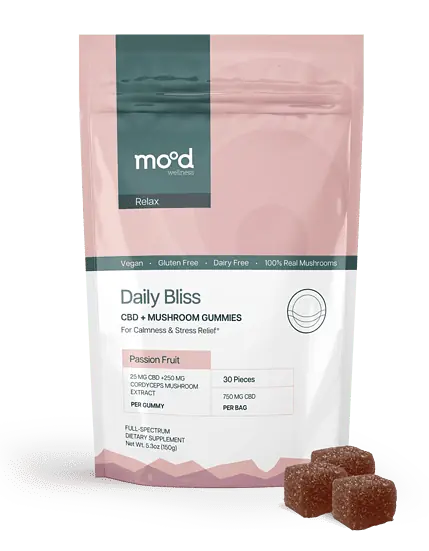
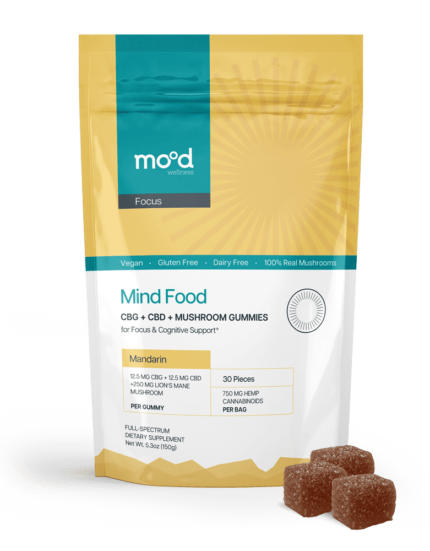
Product disclosure: Mood Wellness sells Mind Food. It is included as a transparent mixed formula example, not as evidence of spiritual, meditative or medical benefits.
This article is educational and is not medical, spiritual or legal advice. Lion’s Mane is not presented as a psychedelic or treatment for any health condition.
Written and reviewed by Mood MagazineMaterially researched and updated September 6, 2026. Clinical review is recommended before publication; no clinician review is claimed here.