
Define the outcome
What does “brain health” mean?
A product can be marketed for brain health while its evidence concerns stress, exercise fatigue, sleep or a laboratory pathway-not cognition itself.
Cognition includes attention, processing speed, working memory, learning, recall, executive function and global cognitive performance. These are measured with different tasks and scales. Mood and perceived stress are related to daily function but are not cognitive tests. Fatigue can change how focused someone feels without improving memory. Sleep can influence next-day performance without a mushroom acting directly on the brain.
Disease prevention is a still higher claim. A small change on one task in a selected group does not demonstrate prevention of mild cognitive impairment, dementia, depression or another disorder. Responsible comparison begins by matching the claim to the exact human outcome.
Attention, memory, processing speed and executive function require validated task outcomes.
Self-reported tension or mood may matter, but should not be renamed “mental clarity.”
Exercise physiology and subjective energy are not direct measures of brain performance.
A wind-down routine can affect tomorrow’s focus without proving neurocognitive action.
Human evidence map
Which functional mushrooms have brain-health research?
A 2024 review systematically evaluated 34 human studies of mushrooms, mood and neurocognition across the lifespan. Twenty-four were observational and ten were interventions. Dietary patterns that included mushrooms were associated with favorable outcomes in many observational studies, but intervention results were mixed and primarily investigated Lion’s Mane. The authors called for larger acute and chronic studies with sensitive neurocognitive tests and a broader range of mushrooms.
Observational findings are useful for generating hypotheses. They cannot determine whether mushrooms caused the outcome because diet quality, education, income, physical activity and other behaviors may differ between groups. A supplement trial is more direct, but small samples, multiple outcomes and unlike extracts still limit certainty.
| Mushroom | Most relevant human outcome | Evidence position |
|---|---|---|
| Lion’s Mane | Selected cognition, mood and stress outcomes | Most direct in the category, but small and mixed |
| Cordyceps | Exercise, fatigue and oxygen-use outcomes | Indirect for focus; not a cognition leader |
| Reishi | Fatigue or quality-of-life outcomes in selected groups | Little direct evidence for memory or attention |
| Turkey Tail | Specialized immune/oncology adjunct research | No persuasive direct healthy-cognition evidence |
| Chaga, Maitake, Shiitake | Mostly nutrition, mechanisms or condition-specific research | No established cognitive-performance benefit |

Most direct, still limited
Lion’s Mane and cognition
Lion’s Mane (Hericium erinaceus) dominates the intervention literature. Small studies in older adults with mild cognitive impairment have reported selected score improvements during several weeks of use. Other studies in healthy or younger adults report limited task-level signals, trends or null findings. Preparations include whole powder, fruiting-body extracts and specialized mycelium enriched for particular compounds.
That heterogeneity blocks a simple “best dose” or universal benefit. A positive result in older adults cannot be assumed in healthy workers or students. A specialized mycelium preparation cannot be replaced gram-for-gram with a fruiting-body gummy. When many tasks are tested, one positive result also deserves context from the full outcome set.
Laboratory research on hericenones, erinacines, nerve-growth-factor pathways, neurogenesis, inflammation and oxidative stress explains why Lion’s Mane attracts attention. It does not establish that a consumer product repairs nerves, grows brain cells, prevents dementia or treats depression. For the full evidence and safety analysis, use the dedicated Lion’s Mane benefits, side effects and dosage guide.
Best-supported does not mean proven:
Lion’s Mane is the most directly researched functional mushroom for cognition, but the category leader still has a small, preparation-specific evidence base.
Indirect routes
Cordyceps, Reishi, Turkey Tail and other mushrooms
Cordyceps is often placed beside Lion’s Mane in “focus” formulas, but its human research is centered more on exercise physiology, fatigue and recovery. A change in oxygen-use or cycling performance does not establish better attention, memory or executive function. Small heterogeneous trials also make reliable energy promises premature. See the Cordyceps evidence guide for the species and preparation problem.
Reishi is frequently positioned for stress or sleep, which marketers connect indirectly to brain health. Direct controlled evidence for improving healthy cognition is sparse. Some studies concern fatigue, quality of life or specific patient populations; those results cannot be generalized into a memory or focus claim.
Turkey Tail research is concentrated in immune pathways and specialized adjunctive oncology preparations such as PSK-not healthy cognitive performance. Chaga has extensive antioxidant and preclinical language but little direct human cognition research. Maitake and Shiitake are nutritious foods with interesting compounds, yet nutrient content and laboratory mechanisms do not prove that an extract improves the brain.
Multi-mushroom blends often appear comprehensive because the species list is long. Scientifically, a long list can reduce interpretability when individual amounts are undisclosed. If an outcome changes, the formula cannot identify which ingredient contributed. If the blend supplies only a small total amount, every species may be present at a fraction of the serving used in single-ingredient research.
Practical interpretation
What should you realistically expect?
No functional mushroom has been shown to produce a reliable immediate “focus switch.” Some acute trials exist, but most proposed effects are evaluated over days or weeks and results vary. Not feeling a sensation does not mean a product is ineffective-and it is not a reason to double the serving.
Before assigning a change to a mushroom, account for sleep duration, caffeine, alcohol, hydration, meal timing, training load, stress and any cannabinoid or herb in the formula. These variables can change attention and perceived energy more strongly and more quickly than a mushroom extract.
For healthy brain aging, functional mushrooms should not displace better-supported fundamentals: regular physical activity, adequate sleep, blood-pressure and metabolic care, hearing and vision support, social engagement, varied nutrition and evaluation of persistent cognitive changes. A supplement is a discretionary addition, not a foundation or treatment.

Formulation literacy
How to evaluate a brain-health mushroom label
| Label detail | Why it matters | Red flag |
|---|---|---|
| Scientific species | Common names can cover unlike fungi | Only “mushroom complex” |
| Fruiting body or mycelium | The material and chemistry differ | No mushroom part stated |
| Finished amount per serving | Allows a transparent comparison | Proprietary blend without individual amounts |
| Extraction and standardization | Can change the finished material | Ratio used as proof of clinical potency |
| All active ingredients | Caffeine, cannabinoids and herbs confound effects | Marketing name hides the full formula |
| Lot-specific testing | Supports identity, potency or contaminant checks | Generic certificate unrelated to the batch |
“Polysaccharides” is a broad carbohydrate measure and can include starch. A validated beta-glucan method is more specific, but neither number proves cognitive efficacy. An extract ratio describes manufacturing input and output; it does not demonstrate that 10:1 is ten times more effective.

Safety first
Side effects and who should use extra caution
Mushroom supplements can cause digestive discomfort, nausea, diarrhea, rash or allergic reactions. The exact profile differs by species, extract and complete formula. Stop use and obtain urgent help for trouble breathing, facial or throat swelling, fainting or another severe reaction.
Interaction evidence is incomplete. Seek individualized guidance if you use prescription medication, manage a health condition, are pregnant or breastfeeding, have a mushroom or mold allergy, receive cancer treatment, use immunosuppressants or are preparing for surgery. Bring the entire label and current batch information.
Mixed products require special care. CBD, CBG, CBN, trace THC, caffeine, adaptogenic herbs and sweeteners can affect alertness, digestion, sedation, drug interactions and drug testing. A “mushroom” headline does not make the other ingredients secondary.
New or progressive memory loss, confusion, language difficulty, personality change or impaired daily function deserves medical assessment. Supplements should not delay evaluation of potentially reversible causes or evidence-based care.
Quick answers
Functional mushroom brain-health questions
Which mushroom is best for brain health?
Lion’s Mane has the most direct human cognition research, but evidence remains limited and preparation-specific. No study establishes one mushroom as universally best.
What is the best mushroom for focus?
No head-to-head trial ranks mushrooms for everyday focus. Lion’s Mane is the closest evidence match to cognition; Cordyceps research is more about exercise and fatigue.
Do functional mushrooms work immediately?
No reliable immediate effect is established. Trial durations and outcomes vary, and a sensation is not a valid test of cognitive benefit.
Can mushrooms prevent dementia?
No functional mushroom supplement has been proven to prevent dementia. Observational dietary associations and early trials cannot establish prevention.
Are functional mushrooms psychedelic?
Lion’s Mane, Cordyceps, Reishi, Turkey Tail, Maitake, Shiitake and Chaga are not psilocybin mushrooms and are not expected to create a psychedelic experience.
Is a multi-mushroom blend better?
Not necessarily. Blends may be convenient but often lack individual amounts and direct trials, which makes evidence matching and reaction attribution harder.
Can I combine mushrooms with CBD or CBG?
Combination evidence is limited. Evaluate cannabinoids, trace THC, medication interactions and sedation separately rather than assuming the mushroom research covers the formula.
Evidence and disclosure
Sources and editorial review
- Review of mushrooms, mood and neurocognitive health across the lifespan (2024).
- Systematic review of Lion’s Mane benefits, uses and side effects (2025).
- Lion’s Mane acute and 28-day healthy-adult pilot trial.
- Acute standardized Lion’s Mane fruiting-body extract trial.
- Narrative review of Cordyceps exercise and recovery research (2026).
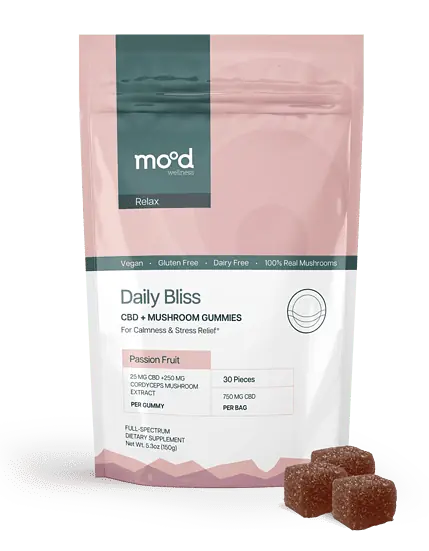
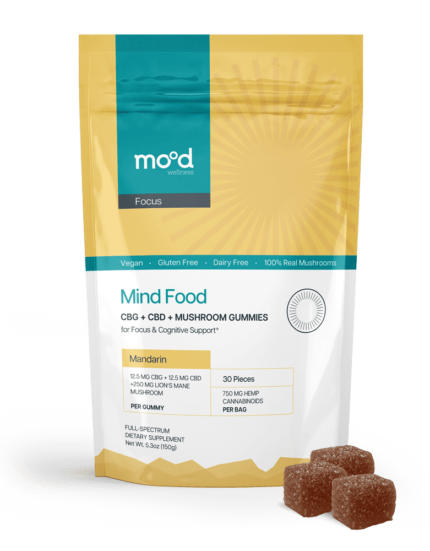
Product disclosure: Mood Wellness sells Mind Food. Its mixed formula is included to explain why a finished product cannot be treated as a single-ingredient mushroom trial.
This article is educational and is not medical advice. Functional mushrooms are not presented as treatments or substitutes for professional care.
Written and reviewed by Mood MagazineEvidence and product information checked September 2, 2026.