
Editorial disclosure: Mood publishes this guide and sells CBD + CBG products. Product pages are referenced for current label context, not as proof that a Mood product produces a particular onset or outcome.

First define what “take to work” means
Timing questions often combine four separate measurements.
| Endpoint | What it measures | What it does not prove |
|---|---|---|
| First detectable plasma CBG | When a laboratory first measures CBG above its threshold | When a person first feels something |
| Tmax | Time of the highest sampled blood concentration | Strongest perceived effect or clinical benefit |
| Subjective onset | When a person reports a noticeable change | That the change was caused by CBG or is therapeutic |
| Outcome onset | When a defined symptom or function changes | That every product, amount or person will respond alike |
A study can measure one endpoint without answering the others. Sampling schedules also matter: if blood is collected at set intervals, the true peak may occur between them.

The most relevant human CBG timing study
The 2024 randomized double-crossover pilot is unusually relevant because it actually used gummies. Nineteen adults completed the study. Participants received 25 mg CBG in either a non-emulsified isolate gummy or an emulsified gummy. They were assigned to controlled high-fat or low-fat meal conditions, and blood was drawn repeatedly from baseline through 450 minutes, with another draw at 24 hours.
The study did not use an ordinary retail product. The gummies were manufactured for the research, their CBG content was validated, and their weight was checked. Participants also faced health, medication and cannabinoid-use eligibility rules that do not represent every shopper.
What the Tmax numbers were
The published mean values were:
| Meal condition | Gummy formulation | Mean Tmax | Reported coefficient of variation |
|---|---|---|---|
| High fat | Emulsion | 0.75 hours | 64.55% |
| High fat | Isolate | 0.75 hours | 16.67% |
| Low fat | Emulsion | 1.35 hours | 75.70% |
| Low fat | Isolate | 1.88 hours | 71.73% |
These are study results, not consumer instructions. Three conditions showed wide relative variability. The high-fat isolate condition was less variable in this sample, but that does not prove that a high-fat meal will create a predictable felt onset for other formulations.
What food changed
When the researchers pooled the formulations by meal condition, the high-fat condition produced higher maximum concentration, greater area under the concentration-time curve and a shorter Tmax than the low-fat condition. None of the tested conditions met the study’s bioequivalence criteria.
That finding supports a narrow conclusion: dietary context materially affected CBG pharmacokinetics in this research system. It does not justify a blanket instruction to pair every CBG product with a high-fat meal. Greater exposure can change safety and interaction questions as well as timing, and retail formulations differ.
What emulsification did not prove
The trial compared one emulsification system with a non-emulsified gummy. Delivery-vehicle effects depended on meal context, and the authors did not find significant within-meal formulation differences for Tmax. “Emulsified,” “nano” or “fast acting” therefore cannot be treated as self-proving terms. A finished product needs its own evidence.
The 2026 CBG oil study adds another caution
A single-ascending-dose human laboratory study enrolled 12 healthy adults. Participants consumed placebo and 25, 50, 100 and 200 mg CBG isolate suspended in MCT oil. Researchers collected subjective, cognitive, physiological and plasma measures over eight hours.
The authors reported dose-orderly pharmacokinetics and significant individual variability. CBG was generally well tolerated during the acute study, with no drug-related adverse events reported, but robust subjective effects were limited. The investigators called for chronic-dosing studies.
This matters for timing language. A compound can appear in plasma and reach a measurable peak without creating a reliable sensation that acts like a stopwatch. The study also involved CBG isolate in a controlled oil suspension, not a full-spectrum retail tincture, a gummy with CBD and Lion’s Mane, or repeated daily use.
Blood concentration is not felt onset
Consumer content often turns Tmax into “when it kicks in.” That translation fails for several reasons:
- Tmax is the peak sampled concentration, not first detection.
- Subjective changes may occur before, near or after Tmax, or not be reported.
- A desired health outcome requires its own validated measure and study population.
- CBG is not expected to provide a consistent intoxicating cue.
- Other cannabinoids and active ingredients can change what a person notices.
- Expectation, context and normal day-to-day variation can affect self-report.
If the question concerns gummies specifically, Mood’s CBG gummy explainer covers the format and label. This page has a narrower job: interpreting CBG timing evidence across formats without converting laboratory endpoints into promises.
Format still changes the question
Gummies
A gummy is swallowed and passes through digestion. Its food matrix, ingredient release, meal context and first-pass metabolism can affect exposure. Check CBG per gummy, pieces per serving, other cannabinoids, added actives and the current batch report.
Oils
An oil may be held under the tongue and then swallowed, or swallowed directly according to its label. The proportion absorbed through oral tissues is product- and technique-dependent. A generic “sublingual” label does not validate a precise onset.
Inhaled products
Inhalation creates a different delivery pathway and separate lung, impairment and legal considerations. Evidence about inhaled cannabis cannot be applied to an oral CBG supplement merely because both contain a cannabinoid.
For the practical mechanics of choosing fixed pieces versus adjustable liquid, use the CBG oil vs gummies comparison. It intentionally owns the format-choice decision so this page can stay focused on timing evidence.
Why online timing ranges conflict
Different pages may quote 10–15 minutes, 30–60 minutes, one to two hours or longer. Before accepting any range, ask:
- Was CBG itself studied, or was the number borrowed from CBD or THC?
- Was the exact product tested in humans?
- Was the endpoint plasma concentration, subjective sensation or clinical outcome?
- Were food condition, formulation and administration technique specified?
- How many participants were included?
- Was variability reported?
- Does the claim describe first onset, peak or duration?
Without those answers, a precise range is better understood as marketing or a generalized estimate, not verified product performance.
A safer reassessment framework
The purpose of a timing framework is not to calculate a dose. It is to prevent uncertainty from becoming accidental stacking.
Before use
- Read the current serving and repeat-use directions.
- Record CBG, CBD, THC and every added active per serving.
- Confirm whether the amount is per piece, per milliliter or per container.
- Check the spectrum statement and batch-matched certificate.
- Resolve medication, pregnancy, liver, surgery and other health questions with a professional.
- Avoid beginning before driving or safety-sensitive activity.
At the time of use
Record the product, lot, labeled serving, clock time, meal context and any other substances. Do not estimate from gummy size, bottle color or a previous formulation.
While waiting
Do not treat a research Tmax or search-result range as a redosing interval. Follow only the current product directions. If the label is unclear, wait and seek clarification rather than adding another serving to an unknown first exposure.
Afterward
Use neutral observations: no obvious change, possible change, unwanted effect or a defined outcome worth discussing with a clinician. A single experience does not establish efficacy or an ideal schedule.
What if CBG produces no obvious feeling?
The 2026 acute study found few robust pharmacodynamic effects despite measurable, dose-orderly exposure. That does not prove a retail product works silently, but it shows why sensation is an unreliable absorption meter.
Do not chase a feeling by repeatedly increasing use. First verify:
- The exact product and serving were identified correctly.
- The package is within its stated date and stored as directed.
- The certificate matches the lot and product form.
- CBD, THC, mushrooms or other actives are accounted for.
- The expected outcome is specific and evidence-appropriate.
- A qualified professional has addressed interaction or health questions.
If a seller promises focus, energy, pain relief, sleep or another result on a fixed clock, look for a randomized human trial of that exact formulation and endpoint.

Mood product facts illustrate the limits
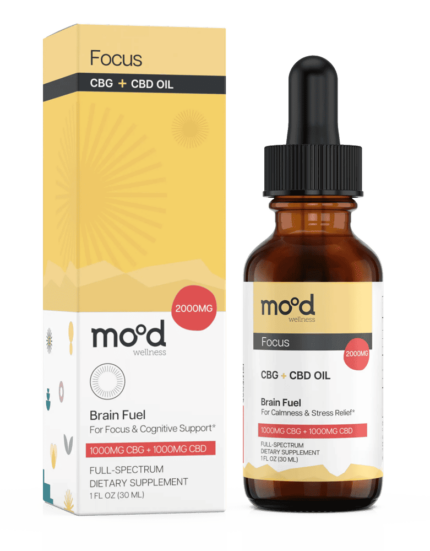
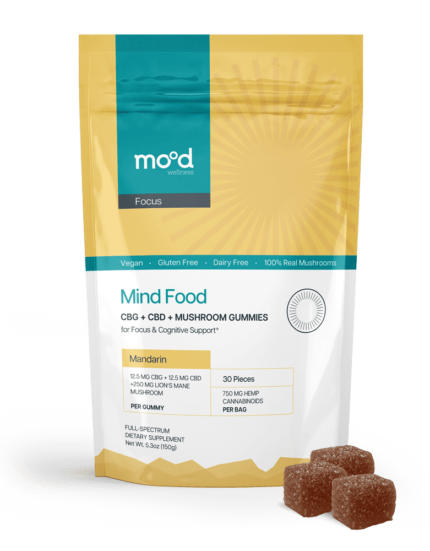
Mood currently sells Brain Fuel oil and Mind Food gummies as CBD + CBG products. Brain Fuel is positioned as a 1:1 CBD-to-CBG full-spectrum oil in 1,000 mg and 2,000 mg total-strength variants. Mind Food’s current page states 12.5 mg CBD, 12.5 mg CBG and 250 mg Lion’s Mane fruiting-body extract per gummy.
Neither formula is CBG alone. Any noticed experience could involve multiple ingredients, expectation and context. Current product directions also do not replace independent evidence of onset.
The public documentation has an important limitation. Mood’s linked Mind Food potency certificate is for batch 2212081 and was reported February 22, 2023. Its linked Brain Fuel 2000 certificate is for batch 2208303 and was reported October 3, 2022. Those files can describe the tested samples; they do not establish every current batch or a complete contaminant panel.
Before considering a Mood product, compare the current Brain Fuel label, Mind Food formula and public lab-results page. Request a current matching report when the lot or test scope is unclear.
Safety and interaction boundaries
Human CBG safety evidence remains early. A small acute study in healthy adults cannot establish long-term safety, safety in pregnancy, or safety with medications and medical conditions. Many commercial CBG products also contain CBD, which has known interaction and liver-safety concerns, or trace THC, which adds impairment and drug-test considerations.
Talk with a qualified clinician or pharmacist before use if you take prescription or over-the-counter medication, have a liver or other medical condition, are pregnant or breastfeeding, or are preparing for surgery. Do not drive if you feel impaired. Keep gummies secured from children and pets.
Use Mood’s guide to reading a CBD COA to verify identity, potency, THC and which contaminant panels were actually run. A potency-only certificate cannot prove pesticide, solvent, metal and microbial testing.
A timing-claim checklist
Before trusting “CBG works in X minutes,” confirm:
- The exact CBG product was studied in humans.
- The amount and formulation match the claim.
- The administration route and meal condition are stated.
- “Work” is tied to a defined endpoint.
- Sample size and population are relevant.
- Variability is shown, not hidden behind an average.
- Tmax is not relabeled as first felt effect.
- The claim does not become a redosing instruction.
- Other cannabinoids and active ingredients are disclosed.
- Current batch evidence matches the package.

Bottom Line: How Long Does CBG Take to Work
The best direct human evidence does not support one universal CBG onset time. A 19-participant gummy study reported mean Tmax values from roughly 0.75 to 1.88 hours across specific meal and formulation conditions, with wide variability in most groups. A separate 12-person CBG-in-MCT-oil study found dose-orderly blood exposure, significant individual variation and few robust subjective effects.
Those findings explain why CBG timing cannot be reduced to a single countdown. Tmax is a blood measurement, not a guaranteed first sensation or health result. Product format, food, formulation, serving, other ingredients and the individual all change the question.
Use the exact label, match the batch report and define the outcome before interpreting time. Never use a generalized timing range as permission to take more. When directions or health implications are unclear, pause and ask the manufacturer or a qualified healthcare professional.
Quick answers
Frequently asked questions about How Long Does CBG Take to Work? What Human Evidence Shows
What is the practical answer about How Long Does CBG Take to Work? What Human Evidence Shows?
The best direct human evidence does not support one universal CBG onset time. A 19-participant gummy study reported mean Tmax values from roughly 0. 75 to 1. 88 hours across specific meal and formulation conditions, with wide variability in most groups. A separate 12-person CBG-in-MCT-oil study found dose-orderly blood exposure, significant individual variation and few robust subjective effects.
Which Mood product fits this topic?
Brain Fuel is the most relevant Mood option for this topic. Mood Brain Fuel combines CBD and CBG in a clearly labeled full-spectrum oil designed for shoppers building a focused, balanced daytime routine.
What should I compare before choosing a product?
Compare the cannabinoid amount per measured serving, the complete ingredient list, spectrum or THC information, current product directions and available batch documentation. The best choice is the formula that fits the goal and is easy to use consistently.
How should I start using a new CBD or cannabinoid product?
Follow the current package directions, choose a low-demand first-use window and keep timing and meal context reasonably consistent. Review medication, pregnancy, liver and impairment considerations with a qualified clinician when relevant.
Sources
- Story G, et al. “Impact of Dietary Fat and Oral Delivery System on Cannabigerol Pharmacokinetics in Adults.” Cannabis and Cannabinoid Research. 2024;9(6):1543–1555.
- Wolinsky D, et al. “Safety, pharmacodynamics, and pharmacokinetics of oral cannabigerol in healthy adults.” Journal of Pharmacology and Experimental Therapeutics. Published online July 11, 2026.
- U.S. Food and Drug Administration. Consumer information on cannabidiol safety and regulation.
- Mood Wellness. Brain Fuel, Mind Food and Lab Results. Checked September 9, 2026.
Editorial note: Medical, legal and commercial fact review is required before release. This article is educational and is not medical advice.