
Start with the honest limit
Why there is no universal CBG dosage
CBG is commercially available faster than the human dose-response evidence has developed.
Cannabigerol, or CBG, is a minor cannabinoid from Cannabis sativa. Small human trials now provide useful information about acute exposure, tolerability and selected outcomes, but they do not establish a standard consumer dose for focus, mood, discomfort, sleep or any medical condition. There is no FDA-approved over-the-counter CBG dosing schedule.
A useful dose question has several parts: the exact form of CBG, the amount per serving, the other cannabinoids in the formula, the route of use, food, timing, prior cannabinoid experience, medicines and the outcome being observed. Two products with “1,000 mg” on the front can deliver very different amounts per serving.
Body weight alone does not solve the problem. Consumer calculators that multiply weight by an invented CBG factor create precision without a validated clinical rule. Age, metabolism, food, delivery system and drug interactions may matter, but current evidence does not support a universal milligram-per-kilogram formula for retail CBG.
Practical answer:
Use the smallest serving allowed by the verified product label, keep the formula and timing consistent, and do not escalate quickly. That is a conservative consumer framework, not a personalized medical prescription.
Bottle total is not serving amount
How to calculate CBG per serving correctly
Begin with the Supplement Facts or product panel. Find the serving size, number of servings and amount of CBG in one serving. If the label only promotes a container total and does not disclose CBG per serving, it is not giving enough information for a useful comparison.
| Label number | What it means | Common mistake |
|---|---|---|
| CBG per serving | The amount associated with the stated serving size | Treating it as the amount in one drop or one gummy without checking |
| Total CBG per container | The sum across all labeled servings | Reading the front-label total as a single dose |
| Serving size | The stated volume, number of gummies or number of capsules | Assuming one unit always equals one serving |
| CBD or THC per serving | Other cannabinoids delivered at the same time | Judging the experience as if CBG were the only active |
For an oil, use the manufacturer’s stated serving volume and the calibrated markings supplied with that product. Counting drops is less reliable because drop size changes with the dropper, liquid viscosity, angle and technique. Do not transfer a drop count from one bottle to another.
For gummies, check whether the stated amount applies to one gummy or a multi-gummy serving. A gummy that combines CBG with CBD, THC, caffeine, mushrooms or herbs should be evaluated as a finished formula. Dividing the gummy may not produce an exact fraction if active ingredients are not uniformly distributed or the manufacturer does not support splitting.
Format changes interpretation
CBG oil, gummies and capsules are not interchangeable
Oral CBG exposure can change with food and delivery system. In a small pharmacokinetic study, researchers gave adults a single 25 mg CBG dose under different meal and formulation conditions and observed differences in exposure. This supports a practical point: the same printed milligrams do not guarantee the same time course or blood concentration across products and routines.
| Format | Useful label detail | Interpretation limit |
|---|---|---|
| Oil or tincture | CBG per measured serving and dropper calibration | Drop counts vary; full-spectrum oils include other cannabinoids |
| Gummy | CBG per gummy and gummies per serving | Food-like format can encourage accidental or repeated use |
| Capsule | CBG per capsule and complete ingredient panel | Fixed unit is easy to count but not necessarily easy to adjust |
| Isolate | Verified CBG amount and independent identity testing | Research on isolate does not validate a broad-spectrum formula |
| Full-spectrum | CBG, CBD, detectable THC and batch report | Effects and drug-test risk cannot be assigned to CBG alone |
Sublingual marketing does not make every oil equivalent. Holding an oil in the mouth, swallowing it, taking it with food and using an emulsified product can change absorption. Follow the specific label rather than improvising a route. Never vape an oral oil, and do not add it to water or another carrier oil unless the product instructions explicitly direct that use.
Reduce avoidable uncertainty
A conservative way to assess a labeled CBG serving
- Define the goal. Use one observable outcome such as perceived daytime alertness at a fixed hour, not a broad promise like “wellness.”
- Record the whole formula. Note CBG, CBD, THC and other active ingredients per serving.
- Begin at the label’s smallest serving. Do not copy a research dose or influencer routine.
- Keep timing and food consistent. This makes comparisons less noisy.
- Wait through the stated assessment window. Rapid redosing can stack oral servings before the first is fully assessed.
- Change only one variable. Do not alter serving, caffeine, sleep supplements and timing together.
- Stop for unwanted effects. More is not the solution to dizziness, marked drowsiness, agitation, nausea or impairment.

Personal notes are not a clinical trial and cannot prove efficacy. Their value is narrower: they reduce recall bias and discourage impulsive serving changes. If no useful pattern emerges, that is information too. Do not keep increasing a product indefinitely to force an effect.
Use a locked or child-resistant storage location. Gummies can look like ordinary candy, and oils can be mistaken for food flavoring. Keep the original package so the ingredient list and lot number remain available.
Numbers need context
What CBG amounts have human studies tested?
Research doses can show what investigators studied; they do not define what an individual should take. A double-blind crossover field trial in 34 healthy adults evaluated a single 20 mg dose of hemp-derived CBG against placebo for acute anxiety, stress, mood and impairment outcomes. Its product, participants and testing conditions limit generalization.
A newer single-ascending-dose laboratory study enrolled 12 healthy adults and examined 0, 25, 50, 100 and 200 mg of CBG isolate. Pharmacokinetics increased with dose but varied substantially between individuals. No drug-related adverse events were reported in that small acute study, and liver tests remained within normal limits after the highest acute doses. This does not establish chronic safety or justify using the top studied amount.
A randomized sleep pilot in veterans used 25 mg daily for two weeks and then 50 mg daily for two more weeks. The primary sleep outcome did not differ significantly from placebo, and the number of participants completing without major protocol deviations was small. It is evidence against treating a dose printed in a study as a guaranteed benefit.
Across these studies, the most defensible conclusion is that human CBG evidence is emerging and product-specific. It does not support a universal “low,” “medium” and “high” consumer chart tied to health outcomes.
The complete formula matters
CBG side effects, medications and THC exposure
Small human studies have generally reported limited acute effects, but their size and duration cannot rule out uncommon events or long-term problems. Potentially unwanted experiences reported or actively monitored in research include dry mouth, dry eyes, sleepiness, dizziness, nausea, changes in appetite, palpitations and changes in subjective alertness.
Laboratory research indicates that CBG is metabolized through several cytochrome P450 enzymes. That creates a plausible interaction question, but laboratory metabolism does not tell us the clinical magnitude for every medicine. Do not use an online interaction list to stop, replace or reschedule a prescription. A pharmacist or prescriber can review the exact product and regimen.
Full-spectrum CBG products may contain CBD and legally permitted trace THC. CBD has its own interaction and liver-safety evidence, especially at higher exposures, while THC changes intoxication, driving and drug-test considerations. A reaction to a combined oil cannot be attributed to CBG from the front label alone. See the CBD vs. CBG vs. CBN guide and CBG intoxication guide for those distinctions.
Do not drive, operate machinery or perform safety-sensitive work until you know how the complete product affects you. Avoid combining it with alcohol or sedating substances during initial assessment. Pregnancy, breastfeeding, liver disease, significant cardiovascular symptoms, upcoming surgery, cancer treatment and multiple medicines are reasons to ask an appropriate clinician before use.
Get prompt help:
Seek medical care for severe or persistent symptoms, fainting, chest pain, trouble breathing, marked confusion, jaundice or a suspected accidental ingestion. Keep the bottle and lot number available.
Quick answers
CBG dosage questions
How much CBG should a beginner take?
No universal beginner dose has been clinically established. Verify CBG per serving, account for CBD and THC, and use the smallest serving permitted by the product label unless a clinician gives different advice.
Is 20 mg of CBG a lot?
Twenty milligrams has been used as a single study dose, but that does not classify it as appropriate for every product or person. Formula, route, other cannabinoids and individual context matter.
Can I take CBG every day?
Long-term human safety data are limited. Daily use should not be assumed safe from acute studies alone, particularly with medicines, liver disease or multi-cannabinoid formulas.
How long does CBG take to work?
There is no universal onset. Oral exposure varies with food, delivery system, formula and the outcome being observed. Follow the product instructions and avoid rapid redosing.
Should I take CBG with food?
Food can change cannabinoid exposure. Follow the product’s directions and keep food conditions consistent when evaluating a routine rather than switching randomly between fed and fasted use.
Can I take CBG and CBD together?
Many products combine them, but the serving must be judged as a combined formula. Add the CBG and CBD amounts to your record and review potential medication concerns.
Can CBG cause a positive drug test?
CBG itself is not the usual target, but full-spectrum products may contain THC and product labeling can be imperfect. No consumer hemp product can guarantee a negative employment or legal test.
Can I use a drop count to measure CBG oil?
Use the manufacturer’s stated serving volume and calibrated device. Drop size varies, so a drop count copied from another product is unreliable.
Evidence and disclosure
Sources and editorial review
- Safety, pharmacodynamics and pharmacokinetics of oral CBG in healthy adults.
- Acute effects of CBG on anxiety, stress and mood: placebo-controlled crossover trial.
- Impact of dietary fat and delivery system on CBG pharmacokinetics.
- CBG, sleep and quality of life in veterans: randomized pilot trial.
- CBG metabolites generated by human cytochrome P450 enzymes.
- FDA: consumer information on cannabis-derived products.
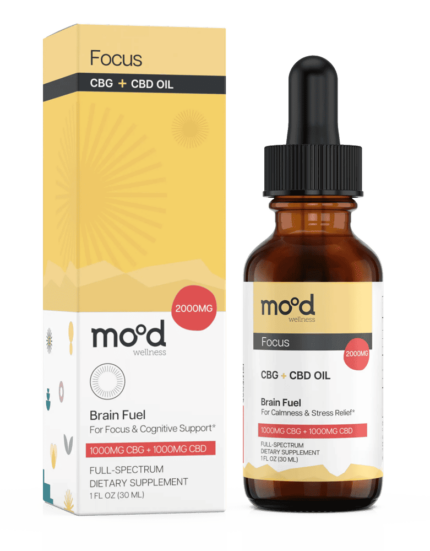
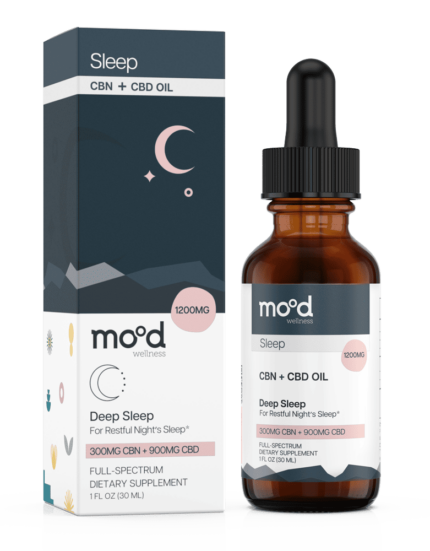
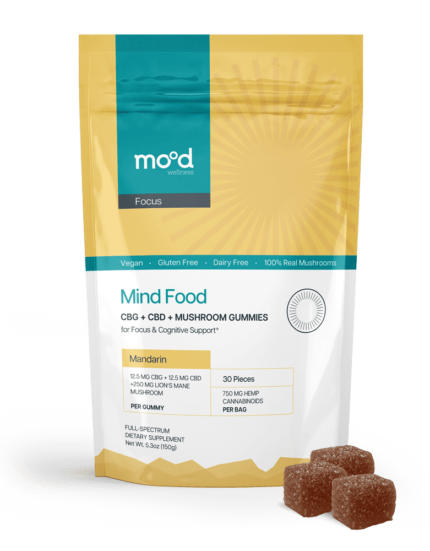
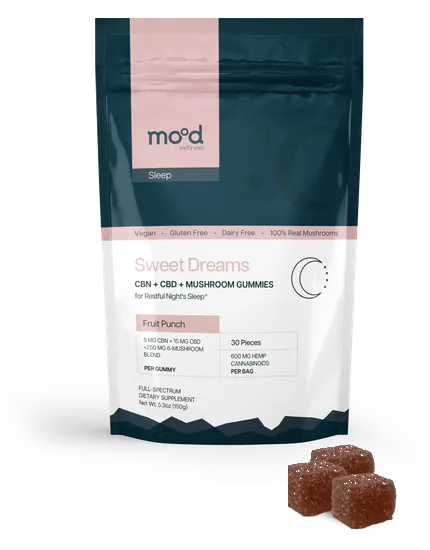
Product disclosure: Mood Wellness sells Brain Fuel, a full-spectrum CBG + CBD oil. It appears as a label-reading example, not as a universal dose recommendation or proof of a health outcome.
This guide is educational and is not medical advice. It does not provide a personalized dose or replace review of medicines, symptoms or health conditions.
Written and reviewed by Mood MagazineEvidence and product information checked September 3, 2026.